Vietnam commits to environmentally sustainable transport

The Ministry of Transport will continue activities to enhance environmentally sustainable transport in Vietnam, said Deputy Minister of Transport Le Anh Tuan.
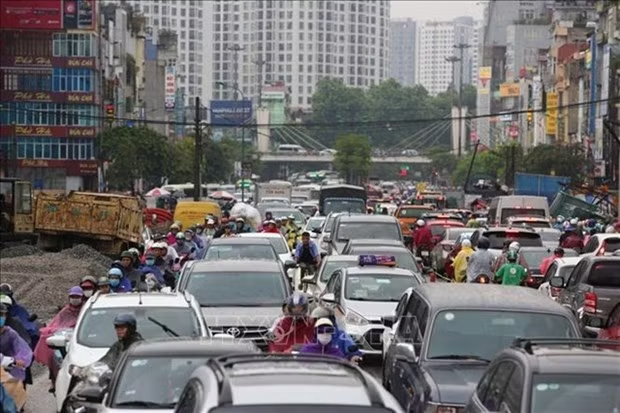
Traffic congestion is one of major challenges that Asian cities, including Hanoi, have to cope with given the constraints of current infrastructure and city development. (Source: VNA)

Traffic congestion is one of major challenges that Asian cities, including Hanoi, have to cope with given the constraints of current infrastructure and city development. (Source: VNA)

The Ministry of Transport will continue activities to enhance environmentally sustainable transport in Vietnam, said Deputy Minister of Transport Le Anh Tuan.

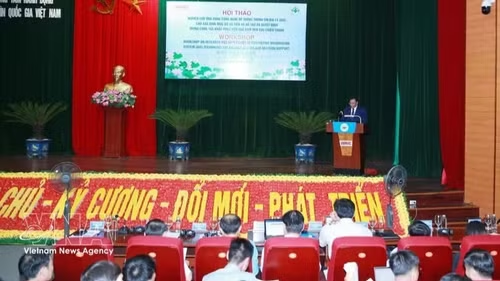
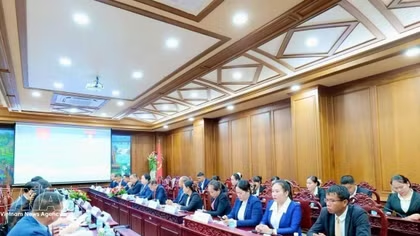
Tuan was speaking at the 12th Intergovernmental Regional Environmentally Sustainable Transport (EST) Forum in Asia recently held in Hanoi.

“The ministry will be proactive in working with other countries in the region and the world to exchange experience, improve capacity and technology transfer on the deployment of smart transport systems and low carbon emissions in cities, fulfilling the contents set by the Hanoi Declaration,” he said.

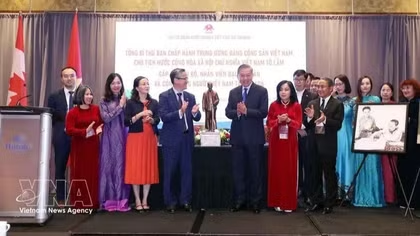
Representatives of 15 Asian cities signed a Hanoi Addendum to the Kyoto Declaration to promote environmentally sustainable transport towards the realisation of smart cities.

A Hanoi Declaration on the realisation of smart cities in Asia through sustainable transport was also adopted at the forum.

“It showed the common concern of Asian countries and the community in promoting sustainable transportation and reducing emissions, contributing to the implementation of sustainable development goals of UN 2030 Agenda,” he said.

The deputy minister suggested the participants continue working to promote cooperation, technology transfer and mobilise resources to realise the Hanoi Declaration.

UN Centre for Regional Development (UNCRD) would collaborate with countries and international organisations to explore potential sources and co-operation in capacity-building activities to push up the development of urban spaces in Asia in a comprehensive and sustainable manner as well as meet the needs of all people.

Earlier, at a discussion on 'The role of EST with the development of smart, sustainable and adaptable city', Tuan emphasised the relationship between the development of intelligent transport systems, low carbon emissions and the realisation of smart cities, as well as the role of sustainable transport in reducing greenhouse gas emissions and achieving sustainable development goals.

“Good experiences from other countries and new initiatives about smart transport, low carbon technology in transportation were exchanged at the forum to enable countries to study and apply to achieve comprehensive and sustainable urban development,” he said.

Other participants at the forum shared experience, research results and their views on the role of EST and smart cities, as well as the role of intelligent transport system in the realisation of smart cities.

The 13th Intergovernmental Regional Environmentally Sustainable Transport (EST) Forum will be held in Bangkok, Thailand next year.

Established by the UN in 2005, the forum is an important part of the Environmentally Sustainable Transport (EST) initiative. The annual event aims to boost Asian countries’ awareness of environmental protection in the transport sector, as well as build safer, more beautiful and sustainable urban areas and communities.

It has 25 member countries including Afghanistan, Bangladesh, Bhutan, Brunei, Cambodia, China, Indonesia, Japan, the Republic of Korea, Laos, Malaysia, Maldives, Mongolia, Myanmar, Nepal, the Philippines, Thailand, Russia and Vietnam.

VNA

Other News

Hanoi ready to implement Capital Law 2026, unlocking new development momentum

Hanoi ready to implement Capital Law 2026, unlocking new development momentum

The effectiveness of the Capital Law 2026 will be measured not by the number of legal documents issued but by tangible improvements in governance and public administration, better services for people and businesses, faster administrative procedures, stronger investment attraction and higher economic growth.

Vietnamese students earn honours at ROBOG Asia Cup 2026

Vietnamese students earn honours at ROBOG Asia Cup 2026

Three teams from Chu Van An Secondary School in Vietnam’s Thai Nguyen province have earned First Prize honours and advanced to the quarterfinals at the ROBOG Asia Cup 2026, a regional robotics and artificial intelligence (AI) competition for students held in Hong Kong, China.

Hanoi sets out new investment blueprint with century-long development vision

Hanoi sets out new investment blueprint with century-long development vision

As of early June, Hanoi had attracted 74.6 billion USD in foreign direct investment (FDI) through more than 9,250 valid projects. FDI inflows in the first six months were projected at 3.2 billion USD, surpassing the annual target by 116%, while nearly 16,000 new businesses were established in the first five months, up 34.4% year-on-year.

Vietnam promotes legal cooperation and rule of law at global forum

Vietnam promotes legal cooperation and rule of law at global forum

Vietnam’s development and international integration have gone hand in hand with the improvement of its legal system, the incorporation of international commitments into domestic legislation, and legal reforms aimed at fostering development, openness and global integration. The country regards international law as an essential instrument for building fair, mutually beneficial relations among nations.

Hanoi to hold investment promotion event on June 29

Hanoi to hold investment promotion event on June 29

At the event, Hanoi authorities plan to grant investment policy decisions and investment registration certificates to 20 exemplary projects in the fields of transportation infrastructure, industrial parks, urban development, social housing, environment, science and technology, and foreign investment attraction.

Hanoi's Red River urban area development draws widespread attention

Hanoi's Red River urban area development draws widespread attention

Located south of the Red River and extending from the historic inner city to newly developing areas in the south and the west, the central urban area along Red River’s right bank covers approximately 45,317 hectares and is projected to accommodate around 6.365 million residents by 2045 and 6.455 million by 2065.

Hanoi's Red River urban area development draws widespread attention

Hanoi's Red River urban area development draws widespread attention

Located south of the Red River and extending from the historic inner city to newly developing areas in the south and the west, the central urban area along Red River’s right bank covers approximately 45,317 hectares and is projected to accommodate around 6.365 million residents by 2045 and 6.455 million by 2065.

Regional cooperation strengthened to combat cross-border drug crime

Regional cooperation strengthened to combat cross-border drug crime

Vietnam, China, Laos and Myanmar face common challenges as drug syndicates increasingly exploit the Mekong River, cross-border transport networks, e-commerce platforms, international logistics services, cyberspace and cryptocurrencies to organise drug transactions and smuggling operations.