Vietnam could face surplus of 1.5 million men by 2034

It is anticipated that there will be a surplus of approximately 1.5 million men between the age of 15 and 49 by 2034, with the figure set to rise to 2.5 million by 2059, according to data released by the General Statistics Office (GSO).

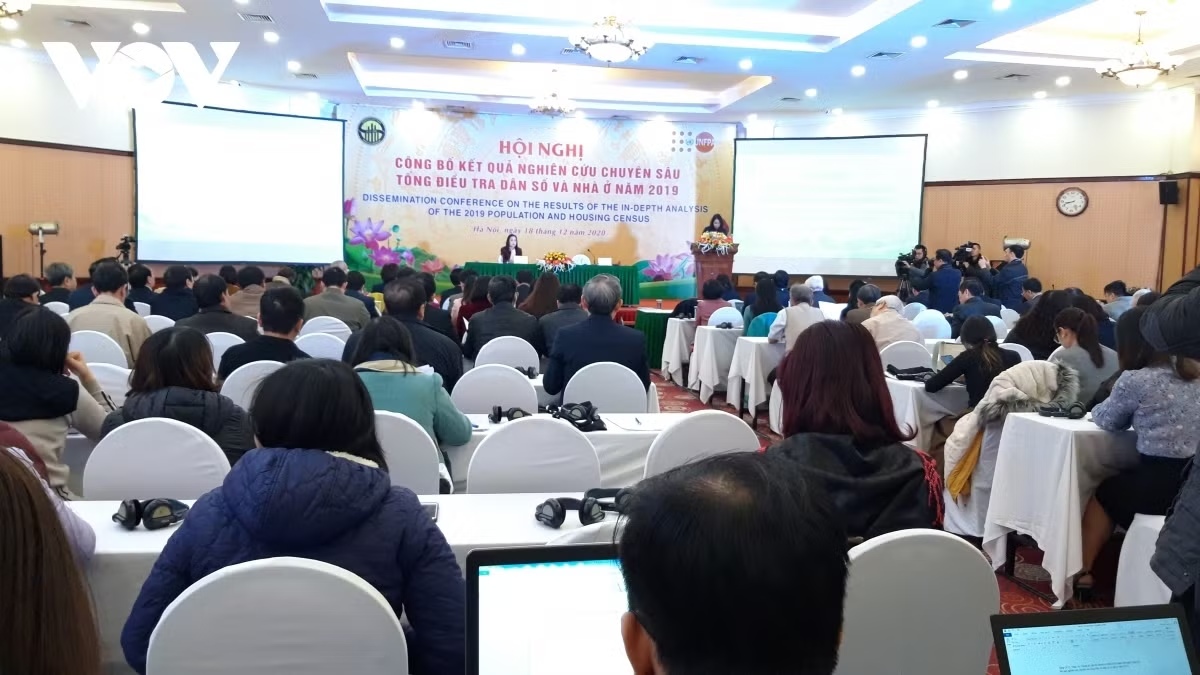
At the conference

At the conference

At a conference held on December 18 in Hanoi to announce the results of research regarding population and and housing census 2019, the GSO said that over the previous 30 years, the nation’s fertility rate has decline by almost half, with the total fertility rate falling from 3.80 children per woman in 1989 to 2.09 children per woman in 2019.

The country has been able to maintain a stable birth rate at a replacement level for more than a decade, whilst the trend of having two children is still common. This indicates that the nation’s successful implementation of the Population and Family Planning scheme has achieved the aim of reducing births.

Studies also show sex imbalances at birth, with the sex ratio at birth in 2019 being 111.5 boys per 100 girls, showing that the imbalance of the sex ratio at birth is still at a very high level.

Most notably, the gender ratio at birth began to increase in 2004, reaching 112 boys per 100 girls, with the ratio levelling off after 2010. Indeed, the lowest birth rate was seen in Ho Chi Minh City and the highest was recorded in the central province of Ha Tinh.

The country’s sex ratio at birth is higher than the natural biological level of 104 to 106 boys per 100 girls, whilst also showing that there was a shortage of 45,900 girls in 2019, accounting for 6.2% of all newly born girls.

This is largely caused by the preferences of couples to have a son and the need to have an additional child. For couples who have two daughters, their possibility of having an additional child is twice as high as that of couples with at least one son.

The birth of an additional child in an effort to have a son is particularly evident in the demographic of people with higher education and better living standards.

Nguyen Thi Huong, general director of the GSO, said, “With the current situation of fertility in population structure as well as the current high sex ratio at birth, the population structure in the future will change towards aging and face shortage of men in some age groups. The current imbalance in the sex ratio at birth will affect the future population structure such as the excess number of young men.”

The population forecast for the 2019 to 2069 period is that the Vietnamese population will reach 104.5 million by 2029, 110.8 million by 2039, and 116.9 million by 2069.
VOV

Other News

Hanoi ready to implement Capital Law 2026, unlocking new development momentum

Hanoi ready to implement Capital Law 2026, unlocking new development momentum

The effectiveness of the Capital Law 2026 will be measured not by the number of legal documents issued but by tangible improvements in governance and public administration, better services for people and businesses, faster administrative procedures, stronger investment attraction and higher economic growth.

Vietnamese students earn honours at ROBOG Asia Cup 2026

Vietnamese students earn honours at ROBOG Asia Cup 2026

Three teams from Chu Van An Secondary School in Vietnam’s Thai Nguyen province have earned First Prize honours and advanced to the quarterfinals at the ROBOG Asia Cup 2026, a regional robotics and artificial intelligence (AI) competition for students held in Hong Kong, China.

Hanoi sets out new investment blueprint with century-long development vision

Hanoi sets out new investment blueprint with century-long development vision

As of early June, Hanoi had attracted 74.6 billion USD in foreign direct investment (FDI) through more than 9,250 valid projects. FDI inflows in the first six months were projected at 3.2 billion USD, surpassing the annual target by 116%, while nearly 16,000 new businesses were established in the first five months, up 34.4% year-on-year.

Vietnam promotes legal cooperation and rule of law at global forum

Vietnam promotes legal cooperation and rule of law at global forum

Vietnam’s development and international integration have gone hand in hand with the improvement of its legal system, the incorporation of international commitments into domestic legislation, and legal reforms aimed at fostering development, openness and global integration. The country regards international law as an essential instrument for building fair, mutually beneficial relations among nations.

Hanoi to hold investment promotion event on June 29

Hanoi to hold investment promotion event on June 29

At the event, Hanoi authorities plan to grant investment policy decisions and investment registration certificates to 20 exemplary projects in the fields of transportation infrastructure, industrial parks, urban development, social housing, environment, science and technology, and foreign investment attraction.

Hanoi's Red River urban area development draws widespread attention

Hanoi's Red River urban area development draws widespread attention

Located south of the Red River and extending from the historic inner city to newly developing areas in the south and the west, the central urban area along Red River’s right bank covers approximately 45,317 hectares and is projected to accommodate around 6.365 million residents by 2045 and 6.455 million by 2065.

Hanoi's Red River urban area development draws widespread attention

Hanoi's Red River urban area development draws widespread attention

Located south of the Red River and extending from the historic inner city to newly developing areas in the south and the west, the central urban area along Red River’s right bank covers approximately 45,317 hectares and is projected to accommodate around 6.365 million residents by 2045 and 6.455 million by 2065.

Regional cooperation strengthened to combat cross-border drug crime

Regional cooperation strengthened to combat cross-border drug crime

Vietnam, China, Laos and Myanmar face common challenges as drug syndicates increasingly exploit the Mekong River, cross-border transport networks, e-commerce platforms, international logistics services, cyberspace and cryptocurrencies to organise drug transactions and smuggling operations.