Vietnam displays int’l responsibility for ensuring human rights

Vietnam has taken specific actions to fulfill her commitments to promoting and protecting human rights at national, regional and international levels as a responsible member of the international community. 
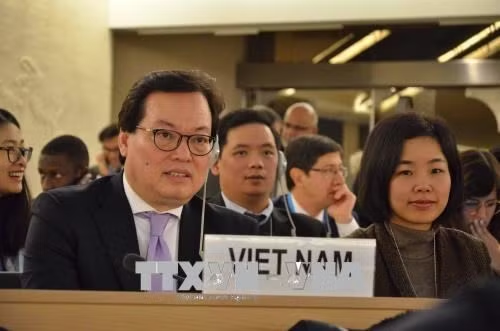
The Vietnamese delegation at the UN Human Rights Council's 37th session in February 2018. (Source: VNA)

 The Vietnamese delegation at the UN Human Rights Council's 37th session in February 2018. (Source: VNA)

The Party and State have seriously realised the consistent policy of taking care of people, protecting legitimate rights and interests of all, and respecting and implementing international treaties on human rights Vietnam has signed or participated in. 

The policy has been institutionalized, as evidenced by the first Constitution the country adopted in 1946 to the 2013 version which devotes 36 out of the 120 articles to cover human rights and citizens’ rights. 

Along with the issuance of relevant legal documents, the Vietnamese State has institutionalised principles on respecting and ensuring human rights, in harmony with international principles and norms. 

The country has been implementing international programmes that put people in the centre, including United Nations development targets which comprise human rights-related contents. 

It is one of the very few countries completing ahead of schedule many of the 2015 Millennium Development Goals (MDGs) set by the UN, especially those regarding poverty reduction. Such achievements have been acknowledged and highly valued by the international community. 

On the sidelines of the sixth Assembly of the Global Environment Facility which took place in Vietnam’s central province of Da Nang last June, UN Development Programme (UNDP) Administrator Achim Steiner described Vietnam as a success example of socio-economic development. 

Vietnam’s success in MDG implementation has helped spur her national economy, thus ensuring that all people fully enjoy human rights, while significantly contributing to the UN’s joint efforts in promoting human rights. 

According to Kamal Malhotra, the UN Resident Coordinator in Vietnam, Vietnam is among the leading countries carrying out the UN’s 2030 Agenda for Sustainable Development Goals (SDGs), which lays stress on eradicating inequality and caring for vulnerable groups.

Besides a national action plan with 17 SDGs, Vietnam inked the One Strategic Programme (OSP) for the 2017-2021 period to implement the SDGs. This is an important milestone that represents Vietnam’s international human rights commitments. 

Vietnam has proactively engaged in international forums on human rights as well as joined seven out of the nine fundamental conventions on human rights of the UN, with the Convention against Torture and other Cruel, Inhuman or Degrading Treatment or Punishment and the Convention on the Rights of Persons with Disabilities as the latest. 

The UN’s Committee Against Torture lauded Vietnam’s efforts in the fight against torture and other cruel when Deputy Mister of Public Security Sen. Lt. Gen Le Quy Vuong delivered the country’s first report on the implementation of the UN Convention against Torture in Geneva, Switzerland in November.

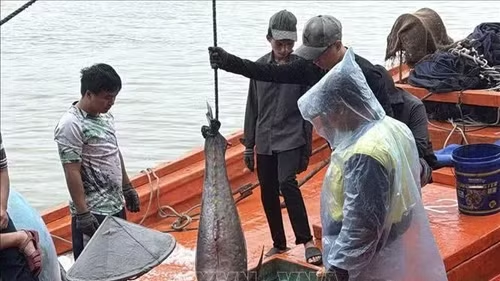
As a member of the UN Human Rights Council (UNHRC) for the 2014-2016 tenure, Vietnam has proposed and acted on initiatives to promote human rights worldwide, including protecting the right to work for disabled people, ensuring safety for workers at sea, and fighting against the trafficking in women and girls.

The Southeast Asian country has implemented 175 out of the 182 recommendations by the UNHRC’s second-cycle Universal Periodic Review (UPR) which it accepted in June 2014. The country completed the third-cycle UPR and submitted to the UNHRC.

Also, the country has held regular human right dialogues and consultations with its partners like the US, Switzerland, Australia, Norway, and the EU.

Concerted efforts and specific actions made in the past time reflect Vietnam as a proactive and responsible country in implementing the UN’s key cooperative pillars on maintaining global peace, security, and cooperation for development, and protecting human rights.
VNA

Other News

Vietnam steps up implementation of ethnic affairs strategy through 2030

Vietnam steps up implementation of ethnic affairs strategy through 2030

To accelerate the implementation of the the Ethnic Affairs Strategy by 2030, with a vision toward 2045, the Prime Minister requested ministries, agencies and local authorities to continue thoroughly carrying out the Party and State’s policies on ethnic affairs, enhancing the effectiveness of State management and strengthening oversight of policy implementation.

Security preparations reviewed for APEC 2027 in Phu Quoc

Security preparations reviewed for APEC 2027 in Phu Quoc

The team examined the APEC 2027 Convention Centre, where main conference activities are scheduled; Sun Serenia Hospital, designated to provide healthcare and emergency medical services for delegates; provincial road DT.975, which connects Phu Quoc International Airport to the convention centre; and the area surrounding Phu Quoc International Airport.

Hanoi accelerates seven Red River bridge projects, many exceed 70% completion

Hanoi accelerates seven Red River bridge projects, many exceed 70% completion

According to the municipal Transport Construction Investment Project Management Board, the city is simultaneously implementing seven projects, namely Tu Lien, Ngoc Hoi, Tran Hung Dao, Thuong Cat, Van Phuc, Hong Ha and Me So bridges. Construction is being carried out on multiple fronts, focusing on bored piles, pile caps, piers and superstructure works.

Dien Bien battlefield legacy powers tourism revival

Dien Bien battlefield legacy powers tourism revival

Seventy-two years after the Dien Bien Phu Victory, its legacy still reverberates. The unity, self-reliance, and resilience forged in that historic triumph remain a powerful internal engine, now propelling Dien Bien toward fast and sustainable development.

Hanoi accelerates shift to green buses, targets 100% by 2030

Hanoi accelerates shift to green buses, targets 100% by 2030

In the 2027–2030 period, the city will accelerate the transition towards the complete phase-out of fossil fuel-powered buses. The share of electric and green energy-fueled buses is projected to reach 79–89% by 2029 and 100% by 2030.

36 fishermen safely rescued after boat breaks down near Truong Sa

36 fishermen safely rescued after boat breaks down near Truong Sa

At 8:00 the same day, KN475 began towing the disabled fishing boat toward Da Tay A island. The towing operation was carried out safely, and by 18:30 both the vessel and its crew had arrived at the island without incident, where repairs and additional support procedures were arranged.

Vietnamese language contest in Laos strengthens youth ties, bilateral friendship

Vietnamese language contest in Laos strengthens youth ties, bilateral friendship

Held in response to the launch of the Vietnamese Language Day among overseas Vietnamese communities, the event aimed to enhance the quality of Vietnamese language teaching and learning in Laos while contributing to the great friendship, special solidarity, comprehensive cooperation and strategic cohesion between the two countries.

Vietnamese language contest in Laos strengthens youth ties, bilateral friendship

Vietnamese language contest in Laos strengthens youth ties, bilateral friendship

Held in response to the launch of the Vietnamese Language Day among overseas Vietnamese communities, the event aimed to enhance the quality of Vietnamese language teaching and learning in Laos while contributing to the great friendship, special solidarity, comprehensive cooperation and strategic cohesion between the two countries.

Hanoi launches 10 electric bus routes from April 1

Hanoi launches 10 electric bus routes from April 1

By the end of April, the number of buses using electricity and other green energy sources in the city is expected to reach 822, including 683 electric buses and 139 compressed natural gas (CNG) buses, representing 42.1% of the total number of vehicles.