Vietnam diversifies supply sources to meet domestic fuel demand

Since the Middle East conflict disrupted crude and refined fuel supply chains, Petrovietnam has swiftly activated a range of response measures while moving decisively to implement the Government’s Resolution 36/NQ-CP dated March 6, 2026 to secure energy supply for the market.

Vietnam diversifies supply sources to meet domestic fuel demand -0
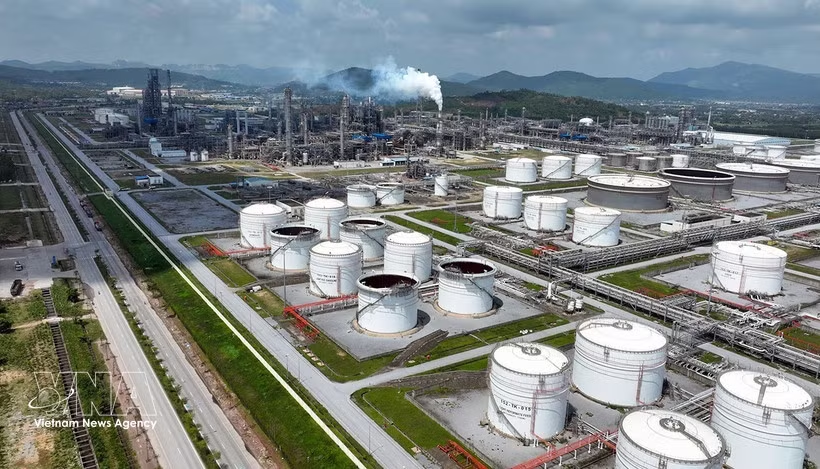
The fuel storage area of the Nghi Son Refinery in Thanh Hoa province (Photo: VNA)

Amid a global fuel crisis driven by impacts of the still-unpredictable conflict in the Middle East, diversifying supply sources to meet domestic demand is an urgent priority alongside longer-term measures, experts have said.

According to Dr. Nguyen Hong Minh, former Deputy Director of the Vietnam Petroleum Institute, an affiliate of Vietnam National Industry–Energy Group (Petrovietnam), under normal conditions Vietnam exports part of its domestically produced crude oil while importing crude feedstock for processing at the Dung Quat Refinery in Quang Ngai and the Nghi Son Refinery in Thanh Hoa.

Since the two refineries came on stream, Vietnam has been able to meet about 70% of its domestic fuel demand, significantly reducing reliance on imported refined products compared with the previous period, he said, adding the remainder is supplemented through imports from overseas markets.

Minh said this reflects a common structure in the global energy industry, where many oil-producing countries both export and import crude to optimise refining, diversify supply sources, enhance the flexibility of their refining systems and safeguard energy security.

Since the Middle East conflict disrupted crude and refined fuel supply chains, Petrovietnam has swiftly activated a range of response measures while moving decisively to implement the Government’s Resolution 36/NQ-CP dated March 6, 2026 to secure energy supply for the market.

Petrovietnam has proposed that the Government consider halting crude oil exports to prioritise domestic refining demand.

At the same time, it has reviewed all feedstock sources, including crude and intermediate products in inventory from both domestic and imported supply, to map out stable operating plans for refineries in the coming months.

It has also engaged with international partners to secure additional crude supplies, while supporting Nghi Son Refining and Petrochemical LLC (NSRP) in signing new crude purchase contracts to sustain operations at the Nghi Son Refinery.

Meanwhile, Binh Son Refining and Petrochemical JSC (BSR), another subsidiary of Petrovietnam, is running the Dung Quat Refinery at above 100% capacity, helping boost fuel supply and standing ready to support NSRP if needed.

In addition, by the end of March, the Dung Quat Refinery is expected to receive fuel ethanol from the Central Biofuels JSC for blending into E10 RON95 gasoline, further lifting domestic output.

Customs data show that in the first 15 days of March, Vietnam imported more than 533,000 tonnes of petroleum products, up 41.4% in volume, with import value surging 89.2% amid global energy price volatility.

Alongside refined fuel, crude imports have also been maintained to secure feedstock for the two refineries.

Thanks to diversified supply sources, proactive import, and flexible use of the fuel price stabilisation fund, the domestic fuel market is now largely meeting demand, helping curb price hikes.

Meanwhile, the Vietnam National Petroleum Group (Petrolimex) and Petrovietnam Oil Corporation (PVOIL) have proactively purchased ethanol from domestic plants and signed import contracts with the US and Brazil, where supply is abundant and unaffected by the Middle East conflict, to secure feedstock for E10 RON95 biofuel blending.

Together controlling nearly 70% of Vietnam’s fuel market, the two firms have also upgraded storage tank systems and increased E10 RON95 blending capacity to accelerate the transition from conventional gasoline to biofuel.

Bui Ngoc Bao, Chairman of the Vietnam Petroleum Association, said that although importing ethanol from the US or Brazil is relatively straightforward, the long transit distances remain a challenge. He suggested the Ministry of Industry and Trade swiftly adopt favourable policies enabling foreign suppliers to ship goods to Vietnam and store fuel or ethanol in bonded warehouses without paying the 1% contractor tax when transferring products out of the bonded zone.

According to energy expert Dao Nhat Dinh, over the long term, Vietnam needs to build an independent national reserve system, separate from commercial storage, gradually scaling fuel and crude reserves to levels approaching international standards to create a “safety buffer” for the economy against energy shocks.

Ha Dang Son, Director of the Centre for Energy and Green Growth Research, said Petrovietnam should be given leeway to expand oil and gas exploration and production activities, while taking a more proactive role in signing long-term crude import contracts to secure stable feedstock for domestic refineries.

He added that a clear coordination mechanism between the State and enterprises is needed to ensure energy security, with Petrovietnam positioned as the central player in the value chain -from exploration and reserves to refining and fuel supply.
VNA

Other News

Private economic sector poised for breakthrough growth

Private economic sector poised for breakthrough growth

More than a year after the Politburo's Resolution No. 68-NQ/TW on private sector development came into effect, expectations now extend beyond increasing the number of enterprises. The goal is to build a stronger business community with greater resilience, larger ambitions and the capacity to compete in global supply chains.

Vietnam remains ASEAN growth leader in 2026 despite global headwinds: WB

Vietnam remains ASEAN growth leader in 2026 despite global headwinds: WB

Vietnam is expected to remain one of ASEAN’s fastest-growing economies in 2026, supported by resilient exports, strong investment inflows and an ambitious reform agenda, despite mounting global uncertainties, according to the World Bank’s latest Vietnam Economic Update released on May 15.

Ministry establishes monitoring framework for carbon market

Ministry establishes monitoring framework for carbon market

Under a new circular, the exchange of greenhouse gas emission quotas and carbon credits is conducted on the domestic carbon credit exchange through the carbon trading system, which is interconnected with the national registration system.

Biofuel ready for nationwide rollout

Biofuel ready for nationwide rollout

For biofuels, particularly E10, to develop successfully, stronger and more coordinated policies are needed, especially pricing mechanisms capable of creating a sufficiently attractive gap between E10 and mineral-based petrol, an expert has said.

Vietnamese farm produce promoted at African investment, trade forum

Vietnamese farm produce promoted at African investment, trade forum

The 12th Africa Forum for Investment & Commerce (AFIC 12) opened in Algiers, the capital of Algeria, on May 9, drawing around 2,000 participants, including officials, economists, businesses, financial and development organizagtions from 43 African countries and international partners, including Vietnam.

Int'l medical, pharmaceutical expo opens in Hanoi

Int'l medical, pharmaceutical expo opens in Hanoi

The exhibition, which runs until May 9 at the Hanoi International Centre for Exhibition, showcases advanced products and technologies across a range of fields, including pharmaceuticals, drug manufacturing machinery and equipment, medical devices, hospital and clinic services and dental equipment.

Mega projects to transform Ho Chi Minh City urban landscape

Mega projects to transform Ho Chi Minh City urban landscape

Leading the charge in this massive building spree is the new central city square in the core of the Thu Thiem new urban area. Spanning more than 20 ha, it’s the crown jewel of the Central Square and new administrative center complex.

Vietnam establishes itself as one of region’s most dynamic manufacturing and supply bases

Vietnam establishes itself as one of region’s most dynamic manufacturing and supply bases

The country’s stable political and economic environment provides a critical foundation for long-term sourcing strategies. At the same time, Vietnam has demonstrated a strong ability to scale up manufacturing, supported by a continuously expanding industrial base capable of meeting both high-volume demand and increasingly complex technical and quality requirements.

Vietnamese pomelos gain broader access to Australian market

Vietnamese pomelos gain broader access to Australian market

The update by Australia’s Department of Agriculture, Fisheries and Forestry to its Biosecurity Import Conditions system (BICON) on April 10, officially setting out import conditions for Vietnamese pomelos, is regarded as a major milestone in market access efforts.

Vietnam's industry spearheads transition to circular economy

Vietnam's industry spearheads transition to circular economy

The circular economy is no longer just a policy choice. It has become an inevitable trend for delivering sustainable and green growth, sharpening competitiveness at home and abroad, and meeting Vietnam’s net-zero emissions target by 2050. It is now a prerequisite to sustain long-term economic expansion, particularly in industrial production and supporting industries.

Nearly 100 tonnes of Vietnamese fruits, vegetables airlifted to UAE

Nearly 100 tonnes of Vietnamese fruits, vegetables airlifted to UAE

Vietnamese fresh produce and processed foods are increasingly recognised for their quality, with items such as cashew nuts, coffee and spices gaining popularity among Middle East consumers. In 2025, Vietnam’s farm produce exports to the UAE exceeded 445 million USD, up nearly 24% year-on-year.