Vietnam formulates strategy to reduce COVID-19 related deaths

Vietnam will continue to speed up COVID-19 vaccinations and access treatment medication in an effort to reduce numbers of critically-ill patients and deaths linked to the SARS-CoV-2 virus.

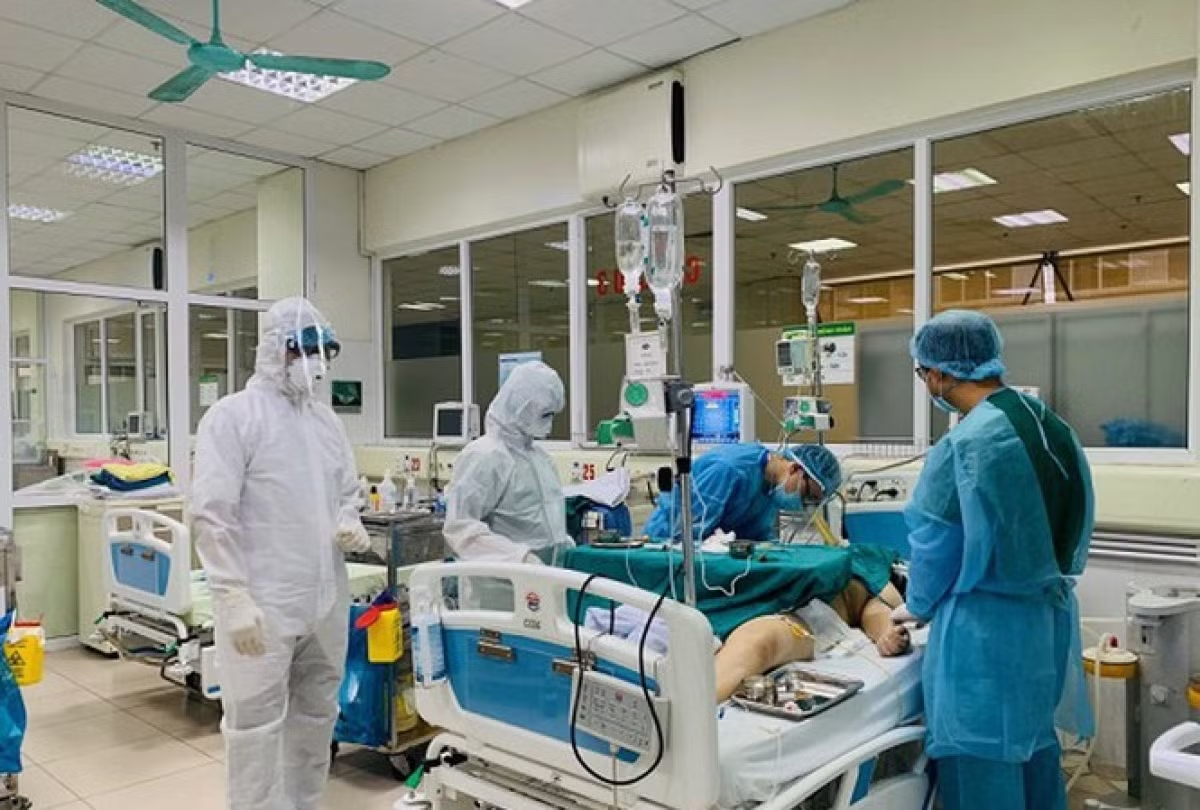
Giving treatment to a critically-ill COVID-19 patient in the intensive care unit.

Giving treatment to a critically-ill COVID-19 patient in the intensive care unit.

The goal is part of a strategy the Ministry of health has formulated to reduce the fatality rate in Vietnam which was unveiled by MoH Do Xuan Tuyen in Hanoi on December 8.

According to data from the MoH, approximately 130 million COVID-19 vaccine doses have been administered nationwide, with 97% of people aged 18 and above receiving their first shot and 70% given their second shot. However, the fatality rate remains high, standing at around 200 cases daily.

Tuyen affirmed the local mortality rate is much lower compared to the rest of the world, and explained that the majority of deaths involved COVID-19 patients with underlying or chronic diseases, or elderly people in poor health.

To better protect people from virus infection and reduce numbers of critically ill patients and deaths, he said Vietnam will give people a booster jab, with priority to be given to high-risk groups, including the elderly and those with underlying illnesses.

Asymptomatic and mild cases will be allowed to receive treatment at home, and only serious cases are transferred to hospitals to ease pressure on quarantine and medical facilities. 

In addition, the MoH is trying to access COVID-19 drugs to support treatment for infection cases. Currently, Vietnam is using several kinds of drugs for COVID-19 treatment such as Molnupiravir, Remdesivir, and Favipiravir. 

Recently, the MoH also permitted the use of Xuyen Tam Lien (Andrographis paniculata), a familiar traditional medicine, as part of COVID-19 treatment.

The country is in the process of conducting phase one, two, and three clinical trials on traditional medicines such as herbs against COVID-19, said Tuyen.

The health official revealed six local companies have so far registered to produce drugs against the virus, with a production capacity of at least one million doses per day.

As of 06pm on December 8 Vietnam has detected more than 1.35 million COVID-19 cases since the start of the first outbreak in January 2020, ranking 33rd out of 223 countries and territories worldwide.

Of the total, 1,036,393 patients have been discharged from hospital after making a full recovery from the disease.

As many as 26,930 patients have died of the virus, making up 2% of the total number of infections. 
VOV

Other News

Hanoi ready to implement Capital Law 2026, unlocking new development momentum

Hanoi ready to implement Capital Law 2026, unlocking new development momentum

The effectiveness of the Capital Law 2026 will be measured not by the number of legal documents issued but by tangible improvements in governance and public administration, better services for people and businesses, faster administrative procedures, stronger investment attraction and higher economic growth.

Vietnamese students earn honours at ROBOG Asia Cup 2026

Vietnamese students earn honours at ROBOG Asia Cup 2026

Three teams from Chu Van An Secondary School in Vietnam’s Thai Nguyen province have earned First Prize honours and advanced to the quarterfinals at the ROBOG Asia Cup 2026, a regional robotics and artificial intelligence (AI) competition for students held in Hong Kong, China.

Hanoi sets out new investment blueprint with century-long development vision

Hanoi sets out new investment blueprint with century-long development vision

As of early June, Hanoi had attracted 74.6 billion USD in foreign direct investment (FDI) through more than 9,250 valid projects. FDI inflows in the first six months were projected at 3.2 billion USD, surpassing the annual target by 116%, while nearly 16,000 new businesses were established in the first five months, up 34.4% year-on-year.

Vietnam promotes legal cooperation and rule of law at global forum

Vietnam promotes legal cooperation and rule of law at global forum

Vietnam’s development and international integration have gone hand in hand with the improvement of its legal system, the incorporation of international commitments into domestic legislation, and legal reforms aimed at fostering development, openness and global integration. The country regards international law as an essential instrument for building fair, mutually beneficial relations among nations.

Hanoi to hold investment promotion event on June 29

Hanoi to hold investment promotion event on June 29

At the event, Hanoi authorities plan to grant investment policy decisions and investment registration certificates to 20 exemplary projects in the fields of transportation infrastructure, industrial parks, urban development, social housing, environment, science and technology, and foreign investment attraction.

Hanoi's Red River urban area development draws widespread attention

Hanoi's Red River urban area development draws widespread attention

Located south of the Red River and extending from the historic inner city to newly developing areas in the south and the west, the central urban area along Red River’s right bank covers approximately 45,317 hectares and is projected to accommodate around 6.365 million residents by 2045 and 6.455 million by 2065.

Hanoi's Red River urban area development draws widespread attention

Hanoi's Red River urban area development draws widespread attention

Located south of the Red River and extending from the historic inner city to newly developing areas in the south and the west, the central urban area along Red River’s right bank covers approximately 45,317 hectares and is projected to accommodate around 6.365 million residents by 2045 and 6.455 million by 2065.

Regional cooperation strengthened to combat cross-border drug crime

Regional cooperation strengthened to combat cross-border drug crime

Vietnam, China, Laos and Myanmar face common challenges as drug syndicates increasingly exploit the Mekong River, cross-border transport networks, e-commerce platforms, international logistics services, cyberspace and cryptocurrencies to organise drug transactions and smuggling operations.