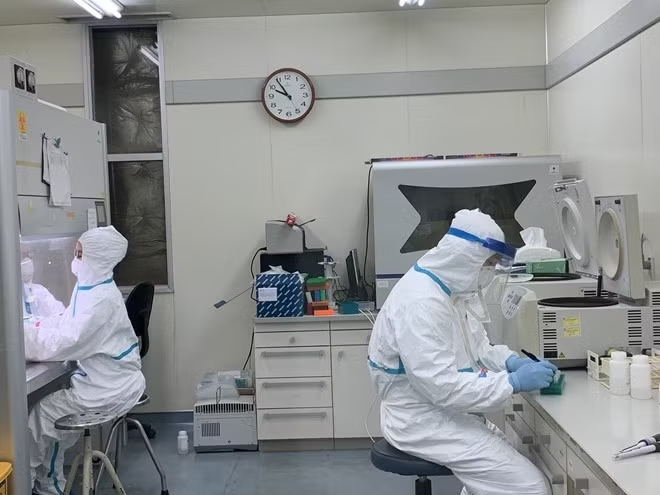
Vietnam masters two COVID-19 testing methods

Members of the National Steering Committee on COVID-19 Prevention and Control on April 27 discussed the testing for detection of SARS-CoV-2 virus.

At present, the two main methods to screen COVID-19 in the world include PCR and antibody tests.

The PCR tests can detect the presence of an antigen, so at the time of being positive the patient is probably infected with SARS-CoV-2. However, this method requires highly specialized actions or experts to perform with many complex machines and takes several hours to come to conclusion.

Meanwhile, the rapid test method for antibodies takes less time, simple operation, requires no special expertise or equipment. However, this method has a much lower sensitivity and specificity than PCR, as a result, it is easier to make mistakes.

Deputy Minister of Health Nguyen Thanh Long said that Vietnam has developed a very good PCR test bio-product to replace foreign ones. The bio-products, developed by the Military Medical Academy and Viet A Company, has been used primarily in Vietnam to test for SARS-CoV-2.

Up to now, Vietnam has carried out about COVID-19 212,000, detected some 270 positive cases. Vietnam is among countries with the highest detection rate of positive cases in the world.

There are currently 112 Realtime - PCR laboratories nationwide capable of testing and detecting SARS-CoV-2, with the maximum capacity of testing more than 27,000 samples a day. 48 labs have been allowed to test and confirm COVID-19 cases, with the maximum capacity of testing about 14,300 samples a day.

The PCR test kit of Vietnam has been recognized by the WHO, UK and can be used around the world.

As the fifth country in the world to successfully produce antibody test bio-products, the Ministry of Health has evaluated that the made-in-Vietnam rapid diagnostic bio-product has many advantages such as ease of use for all levels and facilities; high level of safety; and more importantly, the sensitivity and specificity of Vietnamese bio-products is about 95%, while foreign products only reach about 70-75%.

Additionally, made-in-Vietnam bio-product is much cheaper than imported one.

The Ministry of Health affirmed that Vietnam's rapid test bio-products could completely replace similar foreign ones.

The Steering Committee members highly appreciated the efforts of scientific research facilities, and agreed and recommended the Government to use this more bio-products to conducting rapid tests in the prevention and control of COVID-19 pandemic.

By Duy Tien

Other News

Hanoi ready to implement Capital Law 2026, unlocking new development momentum

Hanoi ready to implement Capital Law 2026, unlocking new development momentum

The effectiveness of the Capital Law 2026 will be measured not by the number of legal documents issued but by tangible improvements in governance and public administration, better services for people and businesses, faster administrative procedures, stronger investment attraction and higher economic growth.

Vietnamese students earn honours at ROBOG Asia Cup 2026

Vietnamese students earn honours at ROBOG Asia Cup 2026

Three teams from Chu Van An Secondary School in Vietnam’s Thai Nguyen province have earned First Prize honours and advanced to the quarterfinals at the ROBOG Asia Cup 2026, a regional robotics and artificial intelligence (AI) competition for students held in Hong Kong, China.

Hanoi sets out new investment blueprint with century-long development vision

Hanoi sets out new investment blueprint with century-long development vision

As of early June, Hanoi had attracted 74.6 billion USD in foreign direct investment (FDI) through more than 9,250 valid projects. FDI inflows in the first six months were projected at 3.2 billion USD, surpassing the annual target by 116%, while nearly 16,000 new businesses were established in the first five months, up 34.4% year-on-year.

Vietnam promotes legal cooperation and rule of law at global forum

Vietnam promotes legal cooperation and rule of law at global forum

Vietnam’s development and international integration have gone hand in hand with the improvement of its legal system, the incorporation of international commitments into domestic legislation, and legal reforms aimed at fostering development, openness and global integration. The country regards international law as an essential instrument for building fair, mutually beneficial relations among nations.

Hanoi to hold investment promotion event on June 29

Hanoi to hold investment promotion event on June 29

At the event, Hanoi authorities plan to grant investment policy decisions and investment registration certificates to 20 exemplary projects in the fields of transportation infrastructure, industrial parks, urban development, social housing, environment, science and technology, and foreign investment attraction.

Hanoi's Red River urban area development draws widespread attention

Hanoi's Red River urban area development draws widespread attention

Located south of the Red River and extending from the historic inner city to newly developing areas in the south and the west, the central urban area along Red River’s right bank covers approximately 45,317 hectares and is projected to accommodate around 6.365 million residents by 2045 and 6.455 million by 2065.

Hanoi's Red River urban area development draws widespread attention

Hanoi's Red River urban area development draws widespread attention

Located south of the Red River and extending from the historic inner city to newly developing areas in the south and the west, the central urban area along Red River’s right bank covers approximately 45,317 hectares and is projected to accommodate around 6.365 million residents by 2045 and 6.455 million by 2065.

Regional cooperation strengthened to combat cross-border drug crime

Regional cooperation strengthened to combat cross-border drug crime

Vietnam, China, Laos and Myanmar face common challenges as drug syndicates increasingly exploit the Mekong River, cross-border transport networks, e-commerce platforms, international logistics services, cyberspace and cryptocurrencies to organise drug transactions and smuggling operations.