Vietnam, New Zealand expect trade value of 1.7 billion USD in 2020

Vietnam and New Zealand are eyeing 1.7 billion USD in two-way trade this year.
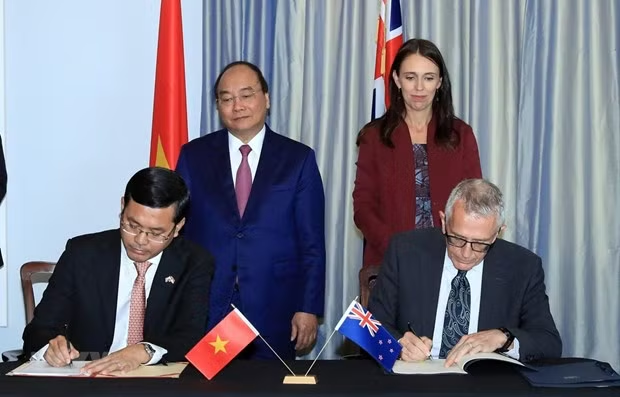
At the signing ceremony between the Vietnamese Ministry of Education and Training and the Education New Zealand in 2018 (Photo: VNA)

At the signing ceremony between the Vietnamese Ministry of Education and Training and the Education New Zealand in 2018 (Photo: VNA)

Vietnam and New Zealand are eyeing 1.7 billion USD in two-way trade this year.

According to the Vietnamese Trade Office in New Zealand, Vietnam is currently New Zealand’s 16th largest trade partner. Bilateral trade enjoyed a three-fold increase in the decade since the two countries established their comprehensive partnership, from 320 million USD in 2009 to over 1 billion USD in 2018.

The figure is expected to rise to 1.7 billion USD as the two are working to upgrade relations to a strategic partnership and both are members of the Comprehensive and Progressive Agreement for Trans-Pacific Partnership (CPTPP).

The two economies also possess numerous advantages in complementing and supporting each other. New Zealand needs to import commodities which Vietnam holds strengths, such as garment and textiles, footwear, wood, tropical farm produce, and fisheries products, while Vietnam needs to import milk and dairy products, wine, lamb, fruit, and raw materials for garment and textiles and footwear from New Zealand.

Of note, New Zealand has permitted the import of three types of fresh Vietnamese fruit - mango, dragon fruit, and rambutan. Vietnam is also seeking to export fresh lemons and passionfruit to the country.

In return, Vietnam has opened its doors to New Zealand exporters of potatoes, beef, kiwi fruit, and apples.

Keith Conway, Chargé d’Affaires at the New Zealand Embassy in Vietnam, said the country welcomes the ratification of the CPTPP, as it is an important step in improving trade principles and will contribute to boosting investment and business between the two countries.

2020 is significant for both countries, as Vietnam is the ASEAN Chair and celebrations are underway for the 45th anniversary of bilateral diplomatic ties.

New Zealand Prime Minister Jacinda Ardern is scheduled to take part in the ASEAN-New Zealand Leaders’ Summit, which is viewed as a good opportunity for leaders to discuss measures to expand bilateral cooperation, especially in trade.

To expand the market share of Vietnamese exports in New Zealand, Le Hoang Oanh, Director of the Ministry of Industry and Trade’s Asia-Africa Market Department, suggested Vietnamese companies pay greater attention to trade and product promotions.

The ministerial-level Economic and Trade Joint Committee, established in 2005, is expected to convene its seventh meeting in the fourth quarter of this year in New Zealand to seek additional measures to expand bilateral trade.

Meanwhile, the Regional Comprehensive Economic Partnership (RCEP), once signed by the ten ASEAN member states and Australia, China, India, Japan, the Republic of Korea, and New Zealand, will form the largest free trade bloc in the world, with around 3.5 billion people and 30 percent of global GDP.

Minister of Industry and Trade Tran Tuan Anh said the agreement will bring about opportunities for Vietnamese businesses to boost exports, participate in new value chains, and attract more investment from New Zealand.

He recently asked New Zealand to support Vietnam in developing hi-tech agriculture and fostering sustainable growth.
VNA

Other News

Vietnam accelerates innovation to boost growth, competitiveness

Vietnam accelerates innovation to boost growth, competitiveness

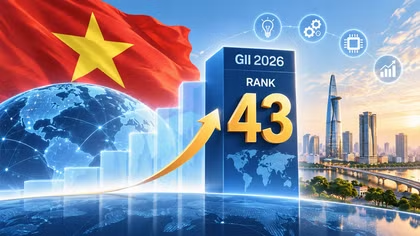
By 2030, Vietnam aims to rank among the world’s top 40 in the GII; raise total social investment in R&D to at least 2% of GDP, with non-State funding accounting for over 60%; increase international scientific publications by an average of 10% annually; and raise the number of patent applications and granted patents by an average of 16-18% annually.

Vietnam sees high growth prospects

Vietnam sees high growth prospects

Experts from the Institute of Vietnam and World Economy under the Vietnam Academy of Social Sciences noted the quality of recent growth as the high growth rate has been recorded against an increasingly higher comparative base.

Vietnam seeks bigger share of global Halal market

Vietnam seeks bigger share of global Halal market

Vietnam's Halal exports remain modest at around 900 million USD a year, accounting for less than 1% of the global market. Most exports are still raw agricultural and seafood products. Only around 1,000–1,300 Vietnamese businesses obtained or maintained Halal certification during 2024–2026.

Hanoi sets up inter-agency mechanism to operate carbon market

Hanoi sets up inter-agency mechanism to operate carbon market

Under a decision of the municipal People’s Committee on establishing an inter-agency working group, departments and agencies are responsible for identifying facilities subject to greenhouse gas inventories, developing emissions-reduction plans and studying projects capable of generating carbon credits.

Shrimp exports reach 3.3 billion USD in eight months

Shrimp exports reach 3.3 billion USD in eight months

According to data from the Vietnam Customs cited by the Vietnam Association of Seafood Exporters and Producers (VASEP), shrimp exports reached 478.5 million USD in August, up 4.2% from the same month last year. The eight-month total stood at 3.3 billion USD, representing a year-on-year increase of 12%.

Russian investors explore opportunities in Vietnam's real estate market

Russian investors explore opportunities in Vietnam's real estate market

Vietnam is seen as a potential market, with considerable room for growth in real estate, particularly commercial property, compared with some regional markets. Strong Vietnam-Russia ties and opportunities to establish foreign-invested enterprises are also considered favourable for Russian investors.

Phu Quoc airport planning adjusted to serve APEC 2027

Phu Quoc airport planning adjusted to serve APEC 2027

For 2021-2030, the Civil Aviation Authority of Vietnam proposed bringing forward the investment in a parallel taxiway system and a connecting taxiway north of Runway No. 2 at Phu Quoc International Airport, in order to connect with the aircraft maintenance and repair facility (hangar) planned for the northern area of ​​the airport.

Policy, infrastructure emerge as new advantages in FDI attraction

Policy, infrastructure emerge as new advantages in FDI attraction

From policy and infrastructure to industrial real estate, Vietnam’s FDI advantages are broadening towards a more integrated production ecosystem, offering investors a stronger combination of conditions for high-value, technology-intensive and long-term projects.

Logistics upgrade vital to 1-trillion-USD trade target: experts

Logistics upgrade vital to 1-trillion-USD trade target: experts

As trade expands, systemic bottlenecks across transport networks, warehousing, ports, border gates, and industrial zones are becoming more apparent. Experts emphasise the need to shift from a fragmented, project-by-project approach toward strategic management structured around trade corridors and integrated supply chains.

Ample room for Vietnam, US to deepen cooperation

Ample room for Vietnam, US to deepen cooperation

Do Ngoc Hung, Trade Counsellor and head of the Vietnam Trade Office in the US, said what stands out is not only the growth in trade volume but also the increasingly deep economic ties between the two countries.

Flexible fiscal policy helps drive economic growth

Flexible fiscal policy helps drive economic growth

According to the Ministry of Finance, State budget revenue in the first eight months of 2026 was estimated at 2.02 quadrillion VND (77.7 billion USD), equivalent to 80% of the annual estimate and up 16% year-on-year. Domestic revenue reached 1.75 quadrillion VND, accounting for 86.6% of total revenue and rising 16.6%.

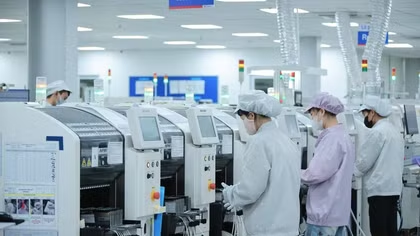
Electronic components are produced at a factory in Hanoi. (Photo: VNA)

Hanoi's imports surge 41% in first eight months of 2026

Hanoi aims to achieve average annual export growth of at least 12% during 2026-30, with the city seeking to diversify export markets, boost high-tech and value-added products and reduce reliance on traditional markets.