Vietnam has proactively participated in trade and investment cooperation activities in the Greater Mekong Subregion (GMS), which comprises Cambodia, China’s Yunnan and Guangxi provinces, Laos, Myanmar, Thailand and Vietnam, over the past 25 years.

The successful hosting of the 6th GMS Summit (GMS-6) and the 10th Cambodia-Laos-Vietnam (CLV) Summit on Development Triangle Area (CLV-10) in Hanoi from March 29-31, 2018 demonstrated Vietnam’s contributions to regional economic cooperation mechanisms.
Key achievements
A unique characteristic of GMS cooperation is that member countries share land borders, which is convenient for land transport connectivity and economic corridor development.
Vietnam holds key nodes in three GMS economic corridors: the Southern Coastal Corridor (GMS-SCC) which links Thailand to southern Vietnam via Cambodia; the East-West Economic Corridor (EWEC) that links Myanmar to Vietnam via central Thailand and Laos; and the North-South Economic Corridor (NSEC) with sections linking China and Vietnam.
By the end of December 2017, roughly US$6 billion had been poured into GMS cooperation projects in Vietnam, equivalent 30% of the total value of GMS loans and financial aid. Of the amount, transport accounted for 87%, followed by urban development (7.9%), agriculture and natural resources (3.7%), healthcare and social welfare (2.7%), industry and trade (0.4%) and trade facilitation and transport (0.2%).
In 2009, Vietnam commenced the construction of a 264km expressway connecting the capital city of Hanoi and the northern border province of Lao Cai with a total investment of US$1.2 billion sourced from the Asian Development Bank (ADB). It was put into operation in September 2014.
The expressway, the longest of its kind in Vietnam, is considered a strategic part of the Kunming (China)-Lao Cai-Hanoi-Hai Phong road corridor under the GMS cooperation programme. The road has significant impacts on the country’s economic efficiency as it helps reduce the travelling time between Hanoi and Lao Cai from seven hours to three hours.
It is not only important to Vietnam but also the whole GMS region by changing the economic panoramic of localities in northern Vietnam and southern China through enhancing transport connectivity, commercial exchanges, investment and tourism cooperation.
Vietnam signed the GMS Cross-Border Transport Facilitation Agreement (CBTA) in 1999 and has ratified all CBTA annexes, enabling the reduction of time spent at border gates for vehicles, goods and passengers and facilitating trade. Since 2012, Vietnam and China have facilitated each other’s vehicles crossing the shared border on the Kunming-Hanoi-Hai Phong and Hanoi-Nanning-Shenzhen routes. The same year, Vietnam, Thailand and Laos signed a Memorandum of Understanding to expand roads connecting the capital cities of the three countries with two large sea ports – Laem Chabang (Thailand) and Hai Phong (Vietnam) on the EWEC.
The mechanism of Single Stop Inspection (SSI) has been carried out at Lao Bao-Dansavanh border gate between Vietnam and Laos since 2015. The launching of the SSI at the Lao Bao-Dansavanh border gate has helped transform landlocked Laos into a transit hub in the GMS and enabled the provinces of Quang Tri (Vietnam) and Savannakhet (Laos), to utilise their advantages for economic development. The SSI is being developed at other border gates along the EWEC and NSEC.
Free trade relations
Addressing the first-ever GMS Business Summit initiated by Vietnam on the sidelines of the GMS-6 and CLV-10 summits, Prime Minister Nguyen Xuan Phuc said Vietnam is accelerating the signing and ratification of two new-generation free trade agreements, namely the Comprehensive and Progressive Agreement for Trans-Pacific Partnership (CPTPP) and the EU-Vietnam Free Trade Agreement (EVFTA) in 2018 and 2019.
The country has also worked to effectively implement 10 FTAs currently in effect and accelerate negotiations for the Regional Comprehensive Economic Partnership (RCEP) and other agreements.
Once the CPTPP and EVFTA come into effect, Vietnam will have highly preferential, free trade relations with the markets of nearly 40 developed countries, the PM said.
PM Phuc stressed that Vietnam continued to maintain its high economic growth in the top of Asia in 2017 with trade turnover reaching a record level of US$425 billion, and foreign reserves exceeding US$60 billion. At present, there are about 25,000 foreign direct investment (FDI) projects in Vietnam with total registered investment capital of more than US$320 billion, he added.
According to the World Bank (WB), Vietnam’s Ease of Doing Business Index (DB) last year jumped 14 places to 68th among 190 economies, while the World Economic Forum (WEF) placed Vietnam’s Global Competitiveness Index (GCI) at 55th out of 137 countries, five places higher than the previous year. The World Intellectual Property Organization (WIPO) ranked Vietnam’s Global Innovation Index (GII) at 47th out of 127 countries, leaping 12 places.
To a certain extent, these achievements have shown the trust and enthusiasm of investors and entrepreneurs toward the Vietnamese Government’s efforts for stronger reforms and innovation over the past years, the PM said.
According to Vice Chairman of the Central and Eastern European Chamber of Commerce in Vietnam Csaba Bundik, the GMS countries as a subregion of the Association of Southeast Asian Nations (ASEAN) have many similarities especially the role of agriculture is very significant in every country.
Vietnam’s economic growth is outstanding and the country is one of the engines of the bloc’s development, he said.
Particularly, the EVFTA will be the next significant step for a closer economic cooperation between the members of the European Union (EU) and Vietnam as the EU is a key export partner and source of technology, machinery and pharmaceuticals amongst other products, he said.
Most importantly for Vietnamese citizens, companies and government, the EVFTA will help to have higher salaries, further significant economic growth, more exports and profits, he added.
New drivers for growth
Amidst the profound transformations underway in the world economy and development environment, the GMS needs to find more robust drivers for its development, according to PM Nguyen Xuan Phuc.
The GMS needs to maintain its unique identity as an effective mechanism with “3C” Strategy of Connectivity, Community and Competitiveness to amplify the determination and efforts of all sides in order to generate new resources to settle differences, and broaden and deepen the sphere for economic cooperation, he said.
He called on member economies to create a favourable business environment to harness all the potential and innovation of businesses and people.
The fourth industrial revolution (Industry 4.0) and its new technologies carry potential for connecting the GMS and CLV economies in non-traditional methods, which will surpass the bounds of GMS founders’ imagination from 25 years ago, PM Phuc said.
Nonetheless, to develop a prosperous, sustainable and integrated GMS, the countries need to ensure sustainable and harmonious development, he added, emphasising that “growth must go hand-in-hand with protection of the ecology and natural resources, especially the sustainable management and use of the Mekong River.”
As “harmony” is a traditional value of Asia, every national development plan, investment or business activity, or cooperation programme between the GMS countries needs to ensure the harmony and balance of interests among countries, governments, businesses and people, the Vietnamese government leader noted.
Vietnam is increasing the flow of investment in transport infrastructure on the main GMS economic corridors, he said, adding that the Government of Vietnam is currently translating initiatives into reality through prioritising investment in connectivity infrastructure to support cross-border trade, investment, tourism, agriculture and economy, as well as other forms of cross-border economic cooperation.
Bundik said cooperation is inevitable and link of networks and infrastructure will support the member countries to reduce production costs and further improve competitiveness.
Based on its strategic location and speed of development, Vietnam has a key role in the regional economic cooperation, according to Bundik.
“Vietnam is such a large and diverse country, and very complex issues should be managed. The economic growth is outstanding, the big metropolis like Hanoi and Ho Chi Minh City have eminent positions in many international comparison, the growth of the wealth of High Net Worth Individuals is the highest in the world. However, in the rural areas still so many things to support and change, even in terms of access to electricity,” he said.
Industry 4.0, especially robotics, are key challenges for every emerging markets in the 21st century, but even for developed countries it can be a game changer, he said.
“Education is the key, we in Europe has the latest technology, and we are very happy to bring these technologies to Vietnam, also we have state-of-the-art education and we traditionally partners of Vietnam in this fields,” he added.
“Good education, competitive, creative labour force will be the answer for the challenges of Industry 4.0”, he suggested.
Vietnamese Deputy Minister of Industry and Trade Tran Quoc Khanh said: “We should all acknowledge that the economic development of the GMS countries has benefited greatly from the increased flow of cross-border trade in goods and services. In this regard, the GMS countries should continue to draw on trade liberalisation, and offer support for open trade and regional multilateral trading system.”
Since e-commerce or digital economy can be a key growth driver if the right policies are in place, the GMS countries need to improve cross-border payment systems to make payment faster and more efficient; facilitate cross-border e-commerce customs procedures for low value shipments; and improve e-commerce supporting service systems, he recommended.
Mekong – river of cooperation and development
The 4,800 km-long Mekong River flows through China, Myanmar, Laos, Thailand, Cambodia, and Vietnam. Its basin spreads over 795,000 square kilometres in the four countries of Cambodia, Laos, Thailand and Vietnam.
The GMS economies have become more and more integrated with each other thanks to the subregion’s pursuance of more liberal trade policies. The intra-GMS trade shares increased from 5.7% in 2010 (US$201 billion) to 9.1% in 2016 (US$414 billion). Total GMS foreign direct investment inflows among the member nations increased from US$436 million in 2010 to US$1.28 billion in 2016.
Throughout its 25 years of development, the GMS has never seen a standstill. As reported by the ADB, over the last quarter of the century, the annual economic growth of the subregion averaged 6.3%.
ADB President Takehiko Nakao said he has a great optimistic view about the future continuous growth of the GMS countries.
There are six reasons for this, he said. First, Vietnam, Cambodia, Laos, and Myanmar are growing at a pace of 7%. That means in ten years, the size of their economies will double.
Secondly, this growth is the result of strong value chains in East Asia and the world and it is more based on domestic and regional demand, instead of just exports to other regions.
Thirdly, this growth has been supported by good policies, such as sound macroeconomic policies, open trade and investment regimes, and market-oriented reforms.
Fourthly, the GMS countries are well positioned geographically to connect South Asia, East Asia, and Southeast Asia.
Fifthly, the growth from innovation will benefit the GMS countries, building on a well-educated and hard-working population.
Last but not least, the GMS countries’ development is backed by a strong sense of cooperation and frameworks for working together through such mechanisms as the GMS.
The GMS Programme has supported projects worth US$21 billion since its establishment in 1992 in sectors such as transport, tourism, health, urban development, environment, human resource development, agriculture, and energy. About 40% of the financing for the projects have come from the ADB, 25% from the GMS governments, and the rest from bilateral and multilateral development partners. Each GMS country programme is designed to suit its unique situation.
Based on the Hanoi Action Plan and Regional Investment Framework, which were adopted at the 6th GMS Summit, the programme is expected to support 227 projects worth US$66 billion from 2018 to 2022, of which the ADB will finance US$7 billion. The Plan calls for an expansion of economic corridors to boost connectivity between countries, as well as between rural and urban centres, to ensure a more equitable distribution of the benefits of economic growth.
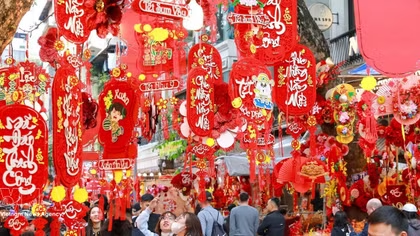
Under Document No. 10065/VPCP-KGVX, the Deputy PM agreed with proposals by the Ministry of Home Affairs for a one-day holiday for Vietnamese Culture Day in 2026, and a seven-day Tet holiday and a four-day National Day holiday in 2027.
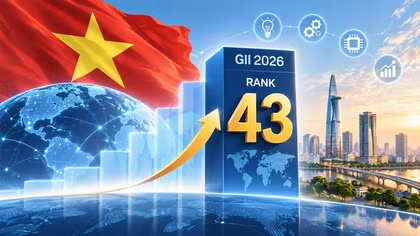
By 2030, Vietnam aims to rank among the world’s top 40 in the GII; raise total social investment in R&D to at least 2% of GDP, with non-State funding accounting for over 60%; increase international scientific publications by an average of 10% annually; and raise the number of patent applications and granted patents by an average of 16-18% annually.
The State Bank of Vietnam set the daily reference exchange rate at 25,624 VND/USD on October1, down 3 VND from the previous day.
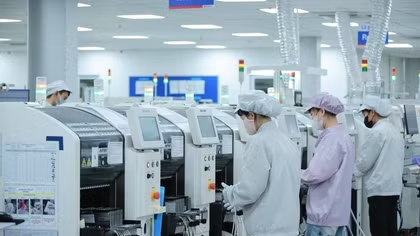
Quang Ninh's GRDP grew 15.04% in the third quarter, also leading the country.
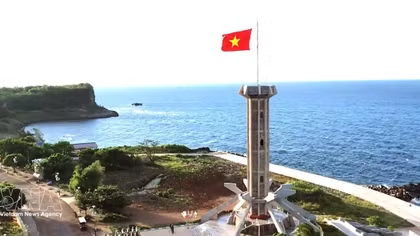
Vietnam needs flexible incentives and specialised green financial instruments, stronger inter-sectoral coordination, improved local governance capacity and a more complete MRV data system, said Ramla Khalidi, Resident Representative of the United Nations Development Programme (UNDP) in Vietnam.
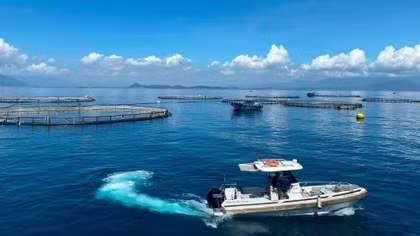
As the country enters a new development phase with greater demands for stronger marine-economy growth, institutional bottlenecks have emerged and need to be addressed.
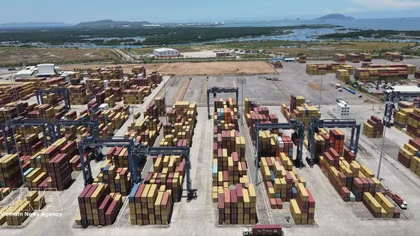
Experts from the Institute of Vietnam and World Economy under the Vietnam Academy of Social Sciences noted the quality of recent growth as the high growth rate has been recorded against an increasingly higher comparative base.
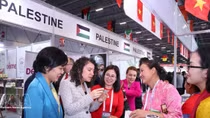
Vietnam's Halal exports remain modest at around 900 million USD a year, accounting for less than 1% of the global market. Most exports are still raw agricultural and seafood products. Only around 1,000–1,300 Vietnamese businesses obtained or maintained Halal certification during 2024–2026.
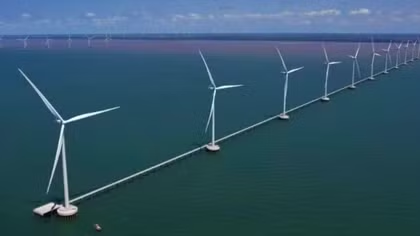
Vietnam needs a comprehensive policy framework to remove legal and procedural bottlenecks and create conditions for offshore wind power projects to access long-term investment capital, helping to unlock the country’s substantial offshore wind potential, said insiders.
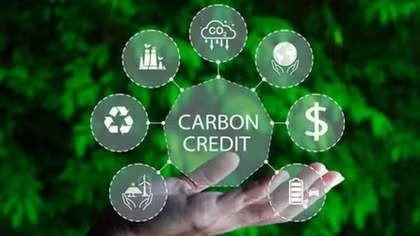
Under a decision of the municipal People’s Committee on establishing an inter-agency working group, departments and agencies are responsible for identifying facilities subject to greenhouse gas inventories, developing emissions-reduction plans and studying projects capable of generating carbon credits.
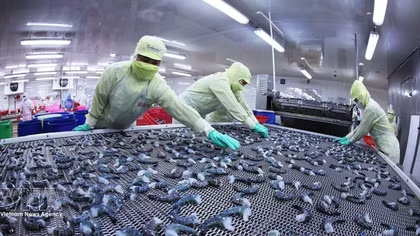
According to data from the Vietnam Customs cited by the Vietnam Association of Seafood Exporters and Producers (VASEP), shrimp exports reached 478.5 million USD in August, up 4.2% from the same month last year. The eight-month total stood at 3.3 billion USD, representing a year-on-year increase of 12%.
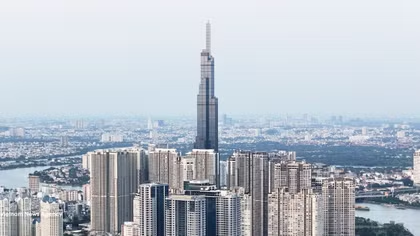
Vietnam is seen as a potential market, with considerable room for growth in real estate, particularly commercial property, compared with some regional markets. Strong Vietnam-Russia ties and opportunities to establish foreign-invested enterprises are also considered favourable for Russian investors.
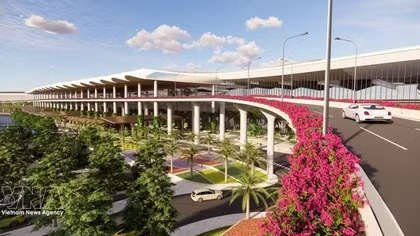
For 2021-2030, the Civil Aviation Authority of Vietnam proposed bringing forward the investment in a parallel taxiway system and a connecting taxiway north of Runway No. 2 at Phu Quoc International Airport, in order to connect with the aircraft maintenance and repair facility (hangar) planned for the northern area of the airport.
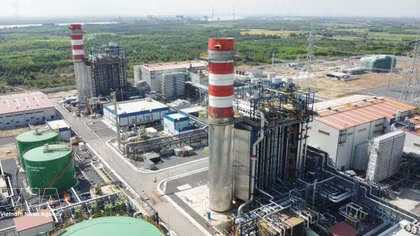
For LNG-fired power to fulfill its role in Vietnam’s energy transition, bottlenecks in institutions, infrastructure, electricity pricing, PPAs, power dispatch and financing must be addressed together.
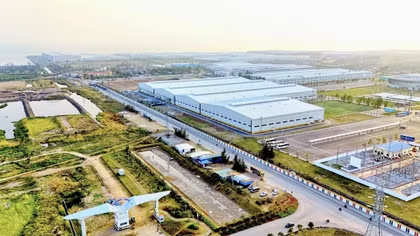
From policy and infrastructure to industrial real estate, Vietnam’s FDI advantages are broadening towards a more integrated production ecosystem, offering investors a stronger combination of conditions for high-value, technology-intensive and long-term projects.
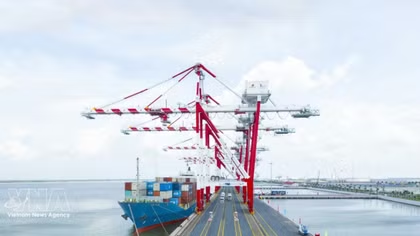
As trade expands, systemic bottlenecks across transport networks, warehousing, ports, border gates, and industrial zones are becoming more apparent. Experts emphasise the need to shift from a fragmented, project-by-project approach toward strategic management structured around trade corridors and integrated supply chains.
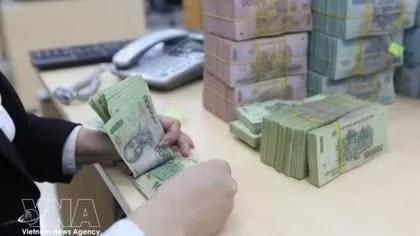
The company will buy non-performing loans from credit institutions and foreign bank branches, recover and dispose of debts and collateral, restructure loans and support lenders in resolving bad debts.
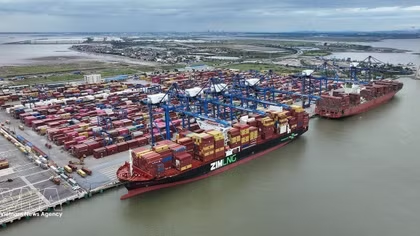
Do Ngoc Hung, Trade Counsellor and head of the Vietnam Trade Office in the US, said what stands out is not only the growth in trade volume but also the increasingly deep economic ties between the two countries.
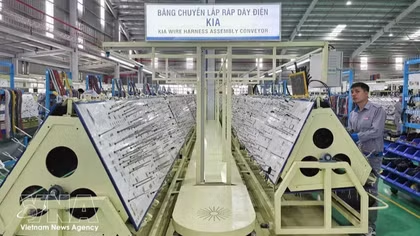
According to the Ministry of Finance, State budget revenue in the first eight months of 2026 was estimated at 2.02 quadrillion VND (77.7 billion USD), equivalent to 80% of the annual estimate and up 16% year-on-year. Domestic revenue reached 1.75 quadrillion VND, accounting for 86.6% of total revenue and rising 16.6%.
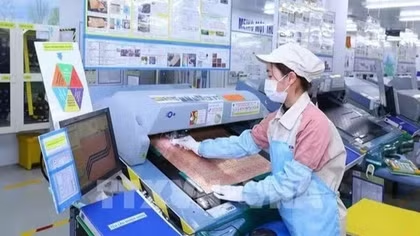
Hanoi aims to achieve average annual export growth of at least 12% during 2026-30, with the city seeking to diversify export markets, boost high-tech and value-added products and reduce reliance on traditional markets.