Vietnam praised for efforts to harmonise domestic law with international human rights commitments

Vietnam has been widely commended for its increasingly proactive and responsible approach to aligning domestic legislation and policies with international human rights standards, particularly through dialogue, cooperation and experience-sharing with international partners.

Speaking at a workshop held in Quang Ninh on January 6, Federica Dispenza, Deputy Resident Representative and Head of Governance and Participation at United Nations Development Programme (UNDP) in Vietnam, highlighted the country’s steady progress in engaging with the global human rights system.

“Over recent years, Vietnam has demonstrated a growing openness to dialogue, cooperation and mutual learning. By ratifying seven out of the nine core international human rights conventions, the Vietnamese Government has accumulated valuable experience in harmonising its legal and policy framework with global commitments”, she said.

Vietnam Praised for Efforts to Harmonise Domestic Law with International Human Rights Commitments -0
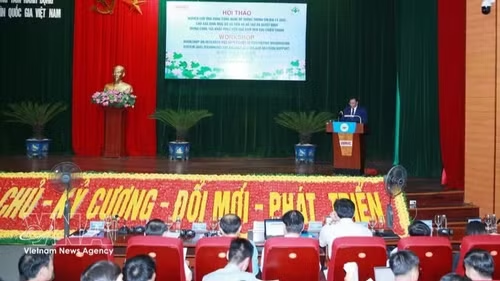
Overview of the workshop on ICPPED in Quang Ninh on January 6.

Sharing from international experts

Beyond introducing the International Convention for the Protection of All Persons from Enforced Disappearance (ICPPED), the workshop—co-organised by Vietnam’s Ministry of Public Security and UNDP—created a substantive forum for open dialogue. International experts and representatives from countries that have ratified the Convention shared practical experiences, offered positive assessments of Vietnam’s approach, and discussed the careful, responsible manner in which Vietnam is studying the possibility of accession.

Participants emphasised that ratifying the ICPPED is not a symbolic act but a long-term process requiring thorough legal preparation and strong institutional capacity.

Representing Switzerland, Aldo de Luca, Chargé d’Affaires ad interim at the Swiss Embassy in Vietnam, noted that Switzerland’s main challenge stemmed from its federal system, where cantons enjoy extensive autonomy over policing, justice and prison administration. Implementing the Convention therefore required not only amendments at the federal level to criminalise enforced disappearance, but also ensuring consistent understanding and application across all cantons.


Vietnam Praised for Efforts to Harmonise Domestic Law with International Human Rights Commitments -1
Mr. Aldo De Luca, Chargé d'Affaires ad interim of the Swiss Embassy in Vietnam delivering speech at the workshop.
Vietnam Praised for Efforts to Harmonise Domestic Law with International Human Rights Commitments -2
Mrs. Mette Moglestue, Deputy Ambassador of Norway to Vietnam, stated that the three key pillars for effective implementation of ICPPED are domestication, training, and transparency.

Only after confirming that both the legal framework and enforcement capacity were fully prepared did Switzerland proceed with ratification, in order to guarantee feasibility and credibility in fulfilling its international obligations, he said.

From Norway’s experience, Mette Moglestue, Deputy Ambassador of Norway to Vietnam, identified three key pillars for effective implementation of the ICPPED: domestic incorporation, training and transparency. This includes revising the Criminal Code to clearly define enforced disappearance in line with international standards, strengthening training for law-enforcement officials, prosecutors and judges, and maintaining accurate detention records while promptly informing families of persons deprived of liberty—measures considered crucial for prevention.

Vietnam Praised for Efforts to Harmonise Domestic Law with International Human Rights Commitments -3
Ms. Gabriella Citroni, Chair of the U.N. Working Group on Enforced or Involuntary Disappearances speaking at the workshop.

From the United Nations’ expert perspective, Gabriella Citroni, Chair of the UN Working Group on Enforced or Involuntary Disappearances, stressed that education and training—enshrined in Article 23 of the Convention—are often underestimated obligations. Enhancing awareness and understanding among authorities at all levels, she said, is fundamental to the effective implementation of all other provisions, alongside prevention measures, modern investigative standards and the right of families to know the truth.  

Vietnam’s proactive and cautious approach

At the workshop, representatives from the Ministry of Public Security, the Ministry of Foreign Affairs and legal experts reaffirmed that Vietnam is approaching the ICPPED through a comprehensive, objective and context-appropriate assessment. Consideration of accession is embedded within Vietnam’s consistent policy of respecting, protecting and promoting human rights, in parallel with deepening international integration.

Vietnam Praised for Efforts to Harmonise Domestic Law with International Human Rights Commitments -4
Lieutenant Colonel Dao Anh Toi, Deputy Director of the Department of Legal Affairs and Administrative and Judicial Reform under the Ministry of Public Security, speaking at the workshop.

Any decision to join the Convention, they stressed, must be accompanied by continued legal reform, strengthened institutional capacity and adequate resources to ensure that obligations can be implemented effectively, substantively and sustainably.

Lieutenant Colonel Dao Anh Toi, Deputy Director of the Department of Legal Affairs and Administrative and Judicial Reform under the Ministry of Public Security, said the discussions and insights gained at the workshop constituted valuable reference material for relevant authorities in shaping appropriate orientations and roadmaps for Vietnam’s continued study of the Convention.
Vietnam Praised for Efforts to Harmonise Domestic Law with International Human Rights Commitments -5
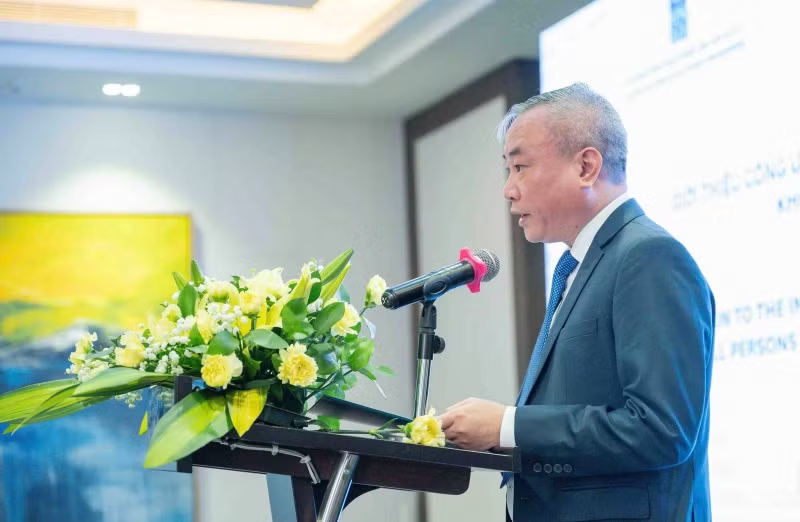
Senior Colonel Nguyen Thuan, Deputy Director of Quang Ninh Provincial Police, underscored that protecting human rights is a foundation for peace, stability and sustainable development.

Meanwhile, Senior Colonel Nguyen Thuan, Deputy Director of Quang Ninh Provincial Police, underscored that protecting human rights is a foundation for peace, stability and sustainable development. He noted that Quang Ninh province has consistently pursued a people-centred development approach, linking economic growth with social progress, fairness and the protection of citizens’ legitimate rights and interests.

Under the leadership of the Party committees and authorities at both central and local levels, Quang Ninh police have implemented numerous measures to enhance human rights protection, including administrative reform, expanded e-government services, strengthened public dialogue, safeguards for detainees’ rights, and improved training in legal knowledge, professional ethics and standards of conduct.
Vietnam Praised for Efforts to Harmonise Domestic Law with International Human Rights Commitments -6
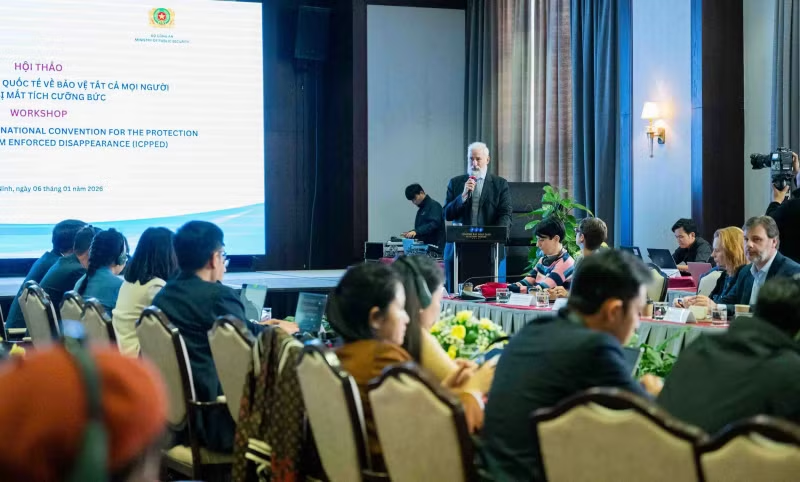
Overview of the workshop.

From UNDP’s viewpoint, Ms Dispenza concluded that the workshop marked a constructive and forward-looking step in Vietnam’s ongoing engagement with the international human rights system. The timely organisation of the event, she said, reflects Vietnam’s genuine interest in understanding the ICPPED and learning from the diverse experiences—both successes and challenges—of other countries in implementing the Convention.


By Kim Khanh

Other News

Hanoi ready to implement Capital Law 2026, unlocking new development momentum

Hanoi ready to implement Capital Law 2026, unlocking new development momentum

The effectiveness of the Capital Law 2026 will be measured not by the number of legal documents issued but by tangible improvements in governance and public administration, better services for people and businesses, faster administrative procedures, stronger investment attraction and higher economic growth.

Vietnamese students earn honours at ROBOG Asia Cup 2026

Vietnamese students earn honours at ROBOG Asia Cup 2026

Three teams from Chu Van An Secondary School in Vietnam’s Thai Nguyen province have earned First Prize honours and advanced to the quarterfinals at the ROBOG Asia Cup 2026, a regional robotics and artificial intelligence (AI) competition for students held in Hong Kong, China.

Hanoi sets out new investment blueprint with century-long development vision

Hanoi sets out new investment blueprint with century-long development vision

As of early June, Hanoi had attracted 74.6 billion USD in foreign direct investment (FDI) through more than 9,250 valid projects. FDI inflows in the first six months were projected at 3.2 billion USD, surpassing the annual target by 116%, while nearly 16,000 new businesses were established in the first five months, up 34.4% year-on-year.

Vietnam promotes legal cooperation and rule of law at global forum

Vietnam promotes legal cooperation and rule of law at global forum

Vietnam’s development and international integration have gone hand in hand with the improvement of its legal system, the incorporation of international commitments into domestic legislation, and legal reforms aimed at fostering development, openness and global integration. The country regards international law as an essential instrument for building fair, mutually beneficial relations among nations.

Hanoi to hold investment promotion event on June 29

Hanoi to hold investment promotion event on June 29

At the event, Hanoi authorities plan to grant investment policy decisions and investment registration certificates to 20 exemplary projects in the fields of transportation infrastructure, industrial parks, urban development, social housing, environment, science and technology, and foreign investment attraction.

Hanoi's Red River urban area development draws widespread attention

Hanoi's Red River urban area development draws widespread attention

Located south of the Red River and extending from the historic inner city to newly developing areas in the south and the west, the central urban area along Red River’s right bank covers approximately 45,317 hectares and is projected to accommodate around 6.365 million residents by 2045 and 6.455 million by 2065.

Hanoi's Red River urban area development draws widespread attention

Hanoi's Red River urban area development draws widespread attention

Located south of the Red River and extending from the historic inner city to newly developing areas in the south and the west, the central urban area along Red River’s right bank covers approximately 45,317 hectares and is projected to accommodate around 6.365 million residents by 2045 and 6.455 million by 2065.

Regional cooperation strengthened to combat cross-border drug crime

Regional cooperation strengthened to combat cross-border drug crime

Vietnam, China, Laos and Myanmar face common challenges as drug syndicates increasingly exploit the Mekong River, cross-border transport networks, e-commerce platforms, international logistics services, cyberspace and cryptocurrencies to organise drug transactions and smuggling operations.