 |
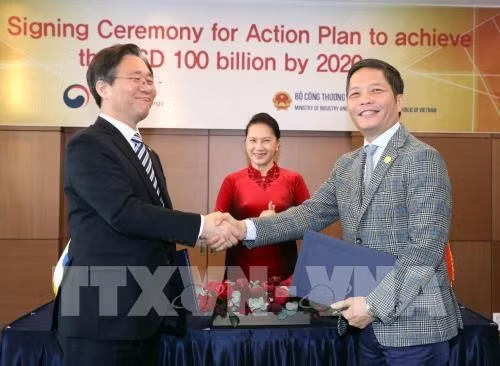
| Vietnamese Minister of Industry and Trade Tran Tuan Anh (R) and Korean Minister of Trade, Industry, and Energy Sung Yunmo signed a MoU in Seoul on December 6 on an action plan for attaining 100 billion USD in bilateral trade by 2020 (Photo: VNA) |
The signing was witnessed by National Assembly Chairwoman Nguyen Thi Kim Ngan, who is on an official visit to the Republic of Korea from December 4 – 7.
The MoU is important as it reflects the commitment of the two ministries to further lift two-way trade as agreed by the two countries’ top leaders at the APEC Economic Leaders’ Week held in Da Nang last year.
Under the action plan, the two sides will cooperate to support Vietnamese enterprises in enhancing their competitiveness in the fields of spare part manufacturing, automobiles, garment and textiles, footwear, and electronics. They agreed to facilitate the trade of agricultural products with the establishment of a working group among the Vietnamese Ministry of Industry and Trade; the RoK’s Ministry of Trade, Industry, and Energy; and relevant ministries from both sides.
The Korean side also agreed to help build the capacity of Vietnamese officials in trade policymaking and improve the skills and competence of Vietnamese engineering workers and specialists in basic industries.
After the signing ceremony, Anh and Sung co-chaired the mid-term meeting of the Vietnam-RoK Joint Committee for cooperation in nuclear power, energy, industry, and trade.
The two sides reviewed the progress of their cooperation since the eighth meeting in Ho Chi Minh City in February. Both ministers conveyed satisfaction as most of the agreements reached during the last meeting have been effectively implemented.
The two ministries have inked a variety of MoUs on cooperation in the supporting industry, automobile, garment-textiles and footwear, energy saving, electricity, trade defence, intellectual property, and most recently the action plan for raising bilateral trade to 100 billion USD by 2020.
Regarding training, this year the Korean Ministry of Trade, Industry, and Energy has so far organised more than 20 training courses for Vietnamese officials, focusing on trade policy, retailing, SME management, policy for supporting industry development and manufacturing techniques in automobiles, mechanics and metallurgy, electricity and electronics, garment-textiles, and more.
The RoK has completed and transferred the 21.1-million-USD Korea-Vietnam Incubator Park (KVIP) to the Mekong Delta City of Can Tho; approved official development assistance (ODA) funding for a Vietnam-Korea technological consultancy and solution centre (VITASK); and partnered with the Vietnamese Ministry of Industry and Trade to survey the demand for support industry products from large Korean corporations.
It has also made a list of qualified Vietnamese producers to help them enhance capacity in manufacturing electronic and automobile parts so they would be able to join supply chains of Korean enterprises in Vietnam.
Furthermore, the two ministries agreed that the Governments of Vietnam and the RoK must improve the business climate and policies, as well as strengthen cooperation mechanisms to make enterprises of both sides a driver of economic growth in the two countries. They also agreed that they need to further expand new areas of partnership in the fields of trade, industry, and energy.
The RoK is currently Vietnam’s biggest foreign investor; the second largest supplier of official development assistance (ODA), just behind Japan; and the third largest trade partner of Vietnam, behind China and the European Union (EU).
Bilateral cooperation mechanisms have been maintained such as the Vietnam-RoK Inter-Governmental Committee on Economic, Scientific, and Technological Cooperation and the Ministerial-level Inter-Committee on cooperation in nuclear power, energy, and industry.
In the first 10 months of the year, two-way trade hit 54.2 billion USD. As of October 2018, the RoK was the biggest investor among the 128 countries and territories investing in Vietnam, running 7,323 projects worth 62.1 billion USD and accounting for 18.3 percent of the total figure.
The RoK is the second largest recipient of Vietnamese guest workers, behind Taiwan, while Vietnam is the second largest exporter of labourers to the country, behind China. The RoK launched the Employment Permit System (EPS) in 2004 under the memorandum of understanding on labour cooperation which is extended each year. Both sides are piloting the dispatch of workers from several Vietnamese localities to the RoK for seasonal agriculture jobs.
In recent years, the RoK has emerged as the second largest source of tourist arrivals in Vietnam, behind China. Last year, more than 2.5 million Korean tourists arrived in Vietnam, up 56 percent year-on-year. In 2017, the number of Vietnamese visitors to the RoK neared 325,000, up 29 percent annually.
During the January-October period, 2.8 million Korean visitors landed in Vietnam, up 48.3 percent annually, while more than 440,000 Vietnamese people visited the RoK, up 37.3 percent.