Vietnam suggested building trust in the Food Chain

PSNews - How to inspect and monitor food origins? Hopefully, the experiences shared by experts from the Netherlands, Denmark and Sweden will help answer the question. 

Role of press and media

Food plays an important role in our daily life. The higher income people have, the more they are concerned about their health. People also care for not only the quantity or taste of food but also the reliable origin of food or food safety.

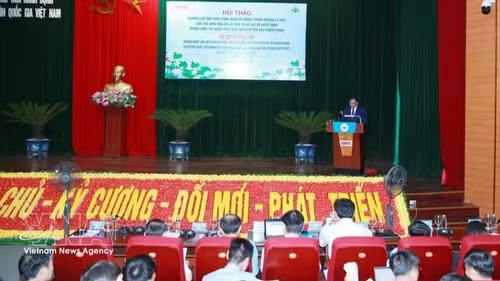
The embassies of Sweden, the Netherlands and Denmark held a Diplohack workshop theme " How to build trust in the Food Chain" on December 14th, for the first time in Hanoi.
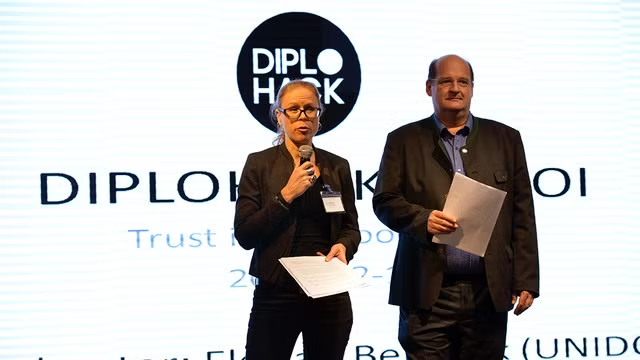
Ms. Camilla Bjelkas, cultural officer at the Swedish Embassy sharing experience at the workshop

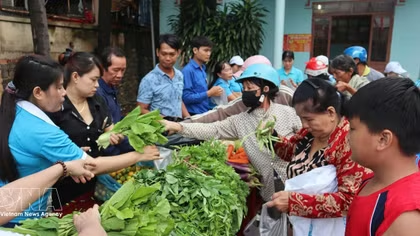
According to the Hanoi Municipal Department of Health, to meet the daily need of millions of people for food, Hanoi has about 60,000 food businesses; as well as more than 400 markets and 90 supermarkets. But, when purchasing food, people do not really know which food suppliers they can trust.

At the workshop, non - governmental organizations (NGOs), Diplomats, technology experts and food producers amongst consumer protection groups discussed and developed ideas to promote trust in the food chain.

Ms. Camilla Bjelkas, cultural officer at the Swedish Embassy said that one of the Sweden's experiences in ensuring food safety is contributions of media and press agencies.

The media and press well performed in popularizing information about food quality, raising public awareness of food security in general and food safety in particular. In addition, these agencies can help food management units and consumers detect dirty food and food of unknown origins.

Currently, clean and safe food is one of the priorities of modern consumers. To ensure their rights to safe food, consumers should report press and media on food situations. All issues relating to low-quality, unsafe and fake food should be brought to light, avoiding passive behavior.

"From Farm to Fork"

Vietnam is on the list of the countries with high rates of cancers in the world. According to experts, one of the reasons for the situation is unsafe food. Therefore, many business in the food sector are realizing the concept "From Farm to Fork".

Sharing her practical experience, Ms. Camilla Bjelkas said: " Around 20 years ago, Europe experienced some major crises regarding food and animal feed, caused in part by the mad cow disease. The crisis led to a profound reform in the European Union's food safety policy.
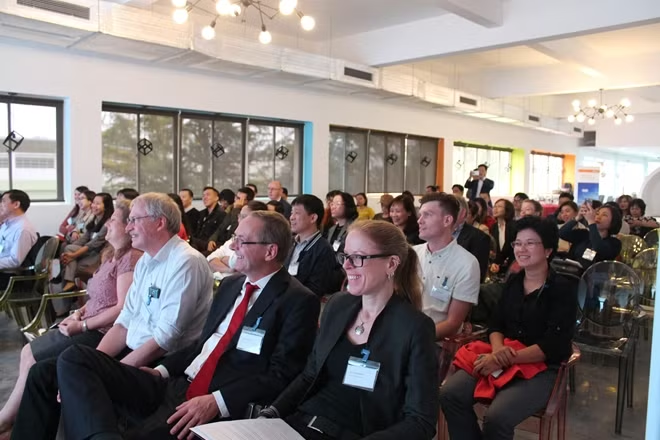
Participants at the Diplohack

This was the start of the strategy 'From Farm to Fork", which has ensured a high level of safety for all food products in both EU production and distribution. She also provided some typical food scandals for illustration.

A producer in Sweden claimed that they only sold eco - friendly and locally produced meat. However, in 2016, results of the investigation by the National Food Agency showed that, its products were meat imported from other countries. In other cases, they used horse meat instead of beef; fake olive oil, fake honey and many other low - quality products.

Mr. Arie Veldhuizen, Agricultural Counsellor at the Embassy of the Netherlands said: "Vietnam needs a value chain to guarantees food safety. Therefore, relevant agencies should together be connected and all phases of the value chain should be scrutinized.

According to a representative of the Ministry of Agriculture and Rural Development, Vietnam should establish a clear legal framework to build a sustainable value chain of food safety.

Vietnam should cooperate and exchange experiences with developed countries as well as set up reliable food management agencies, shape food quality monitoring mechanisms and frequently check food quality. Meanwhile, the press and media and wise consumers will contribute significantly to eliminating the situation of dirty food and food of unknown origins, for the health and the future of the Vietnamese race.

By Linh Bui

Other News

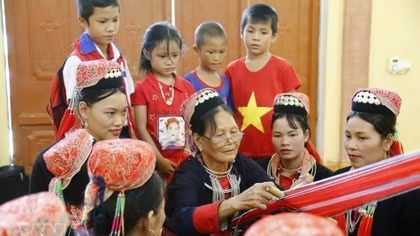
Vietnam steps up implementation of ethnic affairs strategy through 2030

Vietnam steps up implementation of ethnic affairs strategy through 2030

To accelerate the implementation of the the Ethnic Affairs Strategy by 2030, with a vision toward 2045, the Prime Minister requested ministries, agencies and local authorities to continue thoroughly carrying out the Party and State’s policies on ethnic affairs, enhancing the effectiveness of State management and strengthening oversight of policy implementation.

Security preparations reviewed for APEC 2027 in Phu Quoc

Security preparations reviewed for APEC 2027 in Phu Quoc

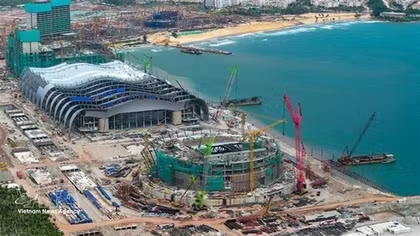
The team examined the APEC 2027 Convention Centre, where main conference activities are scheduled; Sun Serenia Hospital, designated to provide healthcare and emergency medical services for delegates; provincial road DT.975, which connects Phu Quoc International Airport to the convention centre; and the area surrounding Phu Quoc International Airport.

Hanoi accelerates seven Red River bridge projects, many exceed 70% completion

Hanoi accelerates seven Red River bridge projects, many exceed 70% completion

According to the municipal Transport Construction Investment Project Management Board, the city is simultaneously implementing seven projects, namely Tu Lien, Ngoc Hoi, Tran Hung Dao, Thuong Cat, Van Phuc, Hong Ha and Me So bridges. Construction is being carried out on multiple fronts, focusing on bored piles, pile caps, piers and superstructure works.

Dien Bien battlefield legacy powers tourism revival

Dien Bien battlefield legacy powers tourism revival

Seventy-two years after the Dien Bien Phu Victory, its legacy still reverberates. The unity, self-reliance, and resilience forged in that historic triumph remain a powerful internal engine, now propelling Dien Bien toward fast and sustainable development.

Hanoi accelerates shift to green buses, targets 100% by 2030

Hanoi accelerates shift to green buses, targets 100% by 2030

In the 2027–2030 period, the city will accelerate the transition towards the complete phase-out of fossil fuel-powered buses. The share of electric and green energy-fueled buses is projected to reach 79–89% by 2029 and 100% by 2030.

36 fishermen safely rescued after boat breaks down near Truong Sa

36 fishermen safely rescued after boat breaks down near Truong Sa

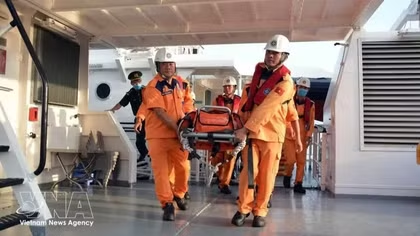
At 8:00 the same day, KN475 began towing the disabled fishing boat toward Da Tay A island. The towing operation was carried out safely, and by 18:30 both the vessel and its crew had arrived at the island without incident, where repairs and additional support procedures were arranged.

Vietnamese language contest in Laos strengthens youth ties, bilateral friendship

Vietnamese language contest in Laos strengthens youth ties, bilateral friendship

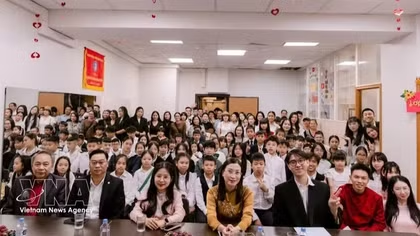
Held in response to the launch of the Vietnamese Language Day among overseas Vietnamese communities, the event aimed to enhance the quality of Vietnamese language teaching and learning in Laos while contributing to the great friendship, special solidarity, comprehensive cooperation and strategic cohesion between the two countries.

Vietnamese language contest in Laos strengthens youth ties, bilateral friendship

Vietnamese language contest in Laos strengthens youth ties, bilateral friendship

Held in response to the launch of the Vietnamese Language Day among overseas Vietnamese communities, the event aimed to enhance the quality of Vietnamese language teaching and learning in Laos while contributing to the great friendship, special solidarity, comprehensive cooperation and strategic cohesion between the two countries.

Hanoi launches 10 electric bus routes from April 1

Hanoi launches 10 electric bus routes from April 1

By the end of April, the number of buses using electricity and other green energy sources in the city is expected to reach 822, including 683 electric buses and 139 compressed natural gas (CNG) buses, representing 42.1% of the total number of vehicles.