Vietnamese puppetry seeks renewal amid preservation challenges

Although widely regarded as a cultural “speciality” attracting tourists, Vietnamese puppetry is facing multiple challenges in preservation and development, requiring renewed efforts to both safeguard its identity and adapt to contemporary cultural currents.

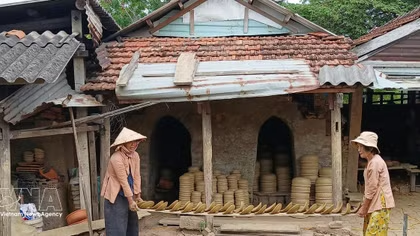
Amid rapid urbanisation, performance spaces for many traditional water puppetry guilds have gradually narrowed. People’s Artist Nguyen Hoang Tuan, Chairman of the Hanoi Theatre Association, noted that while northern Vietnam had 27 puppetry guilds in 1986, only 14 remain today. Many traditional plays and original scripts have been lost, hurting restoration and preservation efforts.
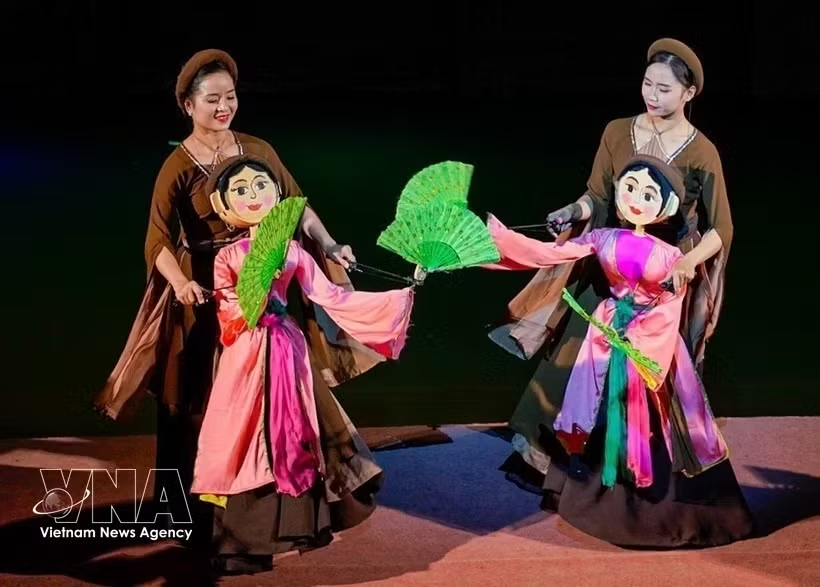
Vietnamese puppetry seeks renewal amid preservation challenges -0
Vietnamese puppetry faces pressure to adapt to modern lifestyles, particularly amid growing competition from diverse entertainment forms (Photo: VNA)

Meanwhile, the severe shortage of researchers, theorists and critics in theatre studies has created a significant gap in the knowledge foundation necessary for the long-term development of the art form.

At Dao Thuc puppetry guild in Thu Lam commune, Hanoi, guild head Dang Minh Hung expressed concern that despite annual training courses funded by the city, young participants rarely pursue puppetry as a long-term career after completing their studies. Limited remuneration for artisans and irregular performance opportunities make it difficult to retain practitioners and sustain the craft.

Vietnamese puppetry also faces pressure to adapt to modern lifestyles, particularly amid growing competition from diverse entertainment forms. Current audiences are largely international visitors, with water puppetry drawing the greatest attention thanks to its uniqueness as a folk theatre form found only in Vietnam. Domestic audiences, however, remain limited, except for schoolchildren who attend performances through educational programmes.

Experts suggest that for puppetry to remain relevant in contemporary cultural life, greater attention should be given to developing creative cultural spaces within traditional puppetry villages - the very places where the heritage originated and where performance practices and storytelling traditions have been passed down through generations.

Hung emphasised the need for stronger institutional support, including investment in equipment, upgraded facilities, and improved policies to support artisans in practising, preserving and transmitting their craft.

Many experts also stress the urgency for local authorities to systematically review, document and preserve traditional puppet repertoires as a foundation for research, education and creative innovation.

Meritorious Artist Le Van Ngo, former Director of the Thang Long Water Puppet Theatre, noted that preservation efforts should not focus solely on the 17 classical performances currently staged in urban theatres, while hundreds of traditional plays still exist in folk communities. With many guilds now unable to produce puppets themselves and forced to rent them, he proposed increased investment in puppet craftsmanship and the establishment of dedicated preservation centres to archive historical materials and traditional puppet designs for future generations.

Regarding audience development, People’s Artist Trinh Thuy Mui, Chairwoman of the Vietnam Theatre Artists Association, underscored that introducing puppetry into schools is a sustainable solution to nurture young audiences’ appreciation for the art form. Theatres and puppetry guilds should harness creativity to bring cultural and historical lessons to life on stage in ways that resonate with students.

With its distinctive storytelling language and strong visual appeal, Vietnamese puppetry holds significant potential to become part of the cultural industry value chain. With systematic investment and innovation, the art form could evolve into a defining cultural brand of Vietnam.

VNA

Other News

Vietnam secure berth at FIFA U17 World Cup 2026 for first time

Vietnam secure berth at FIFA U17 World Cup 2026 for first time

Vietnam national U17 football team secured a place at the FIFA U17 World Cup 2026 for the first time after defeating United Arab Emirates national U17 football team 3-2 on in the final Group C match of the AFC U17 Asian Cup 2026 in Saudi Arabia on early May 14 (Vietnam time).

Vietnam’s most beautiful railway station twins with French counterpart

Vietnam’s most beautiful railway station twins with French counterpart

A twinning agreement between Da Lat Railway Station in Vietnam and Trouville-Deauville Railway Station in France was signed at the French Embassy in Vietnam on May 7, creating new opportunities for cooperation in station management and operations, as well as cultural and tourism promotion between the two sides.

Hanoi gains two more craft villages in World Crafts Cities network

Hanoi gains two more craft villages in World Crafts Cities network

The recognition of Chuyen My and Son Dong craft villages as members of the World Crafts Cities network represents international acknowledgement of the cultural value, artisanal techniques, creativity and sustainable vitality of Vietnam’s traditional craft villages, he said.

Thang Long - Hanoi Festival 2026 to return in September

Thang Long - Hanoi Festival 2026 to return in September

Co-hosted by the municipal People’s Committee, the Department of Culture and Sports, and domestic and foreign agencies, the whole spectacle is meant to honour the city’s millennia-old heritage while reafffirming its strategy of establishing culture as a development engine.

Spreading Vietnamese cultural identity in digital space

Spreading Vietnamese cultural identity in digital space

In the context of deep international integration, cultural identity serves as both a “shield” against assimilation and a defining marker of a nation’s image. Protecting and promoting uniquely Vietnamese cultural values has therefore become a pressing task, particularly in an increasingly complex digital environment.

ITE HCMC 2026 to promote Vietnam’s tourism on global map

ITE HCMC 2026 to promote Vietnam’s tourism on global map

With its large scale, the ITE HCMC 2026 aims to promote tourism cooperation between Vietnam and priority markets such as Northeast Asia, Western Europe, North America, Southeast Asia, and Oceania while also boosting visitor arrivals from the Indian market

Project on digital transformation in cultural sector approved

Project on digital transformation in cultural sector approved

By 2030, the project targets the establishment of shared digital platforms across 100% of cultural sectors. All digitised cultural heritage will be standardised under the national data framework and shared in accordance with regulations, while 80% of public digital heritage assets are expected to receive digital identifiers to clarify ownership and management, encouraging organisations and individuals to do the same and support market development.

Vietnam eyes becoming region’s leading tourism destination

Vietnam eyes becoming region’s leading tourism destination

Vietnam has in recent years undergone a notable transformation in its tourism development strategy, placing a strong emphasis on nature-based and eco-tourism. This shift is not merely aligned with global trends, but represents a necessary step towards safeguarding valuable natural resources, while appealing to a growing segment of environmentally conscious travellers.

Vietnam serves 6.76 million foreign arrivals in Q1

Vietnam serves 6.76 million foreign arrivals in Q1

China and the Republic of Korea (RoK) continued to lead as Vietnam’s largest source markets in the quarter, with 1.4 million and 1.3 million visitors respectively, accounting for around 40% of total arrivals.