Vietnam’s agricultural sector records progress

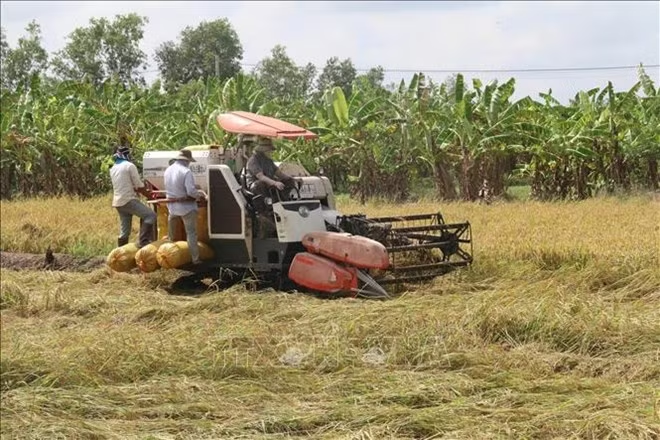
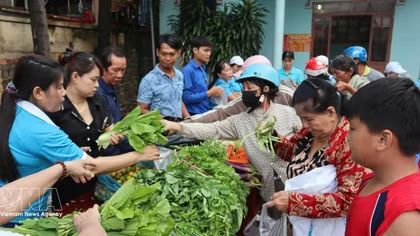
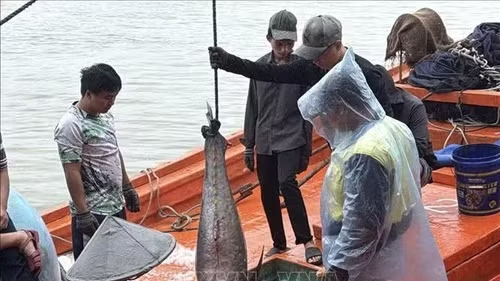
Over the past years, Vietnam’s agricultural sector has reaped marked achievements, helping ensure national food security.

Vietnamese staples such as coffee, rice, rubber, cashew nuts, pepper, fruit, seafood, wood and timber products have gained firm foothold in the global market. 

Statistics show that the sector’s gross domestic product (GDP) grows about 2.5 percent while its production value expands by 2.73 percent each year. 

During the 2013-2017 period, the sector’s total export turnover reached 153 billion USD, with 36.2 billion USD earned in 2017. Seven out of the 10 major products saw export turnover exceeding 1 billion USD. 

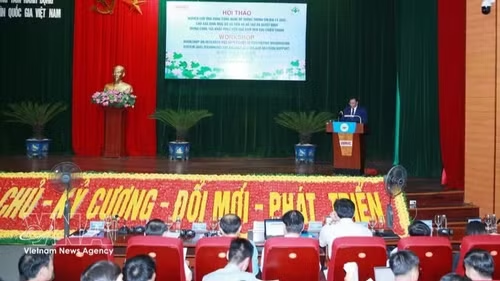
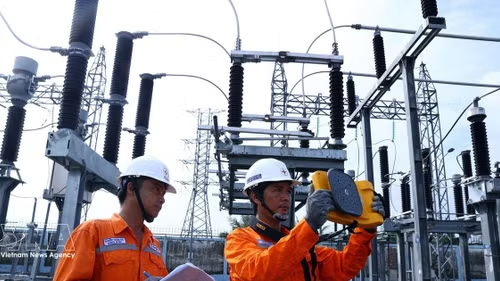
To create impressive changes in agricultural production, the Vietnam Farmers’ Union (VFU) has signed a cooperation programme with the Ministry of Science and Technology, under which the two sides join hands in implementing scientific and technological tasks during the 2016-2020 period, according to Thao Xuan Sung, Chairman of the VFU Central Committee.

The union’s chapters have carried out technology transfer and scientific application in production, he added. 

Thanks to emulation campaigns, many household businesses, farms, small- and medium-sized enterprises and cooperatives have been formed, helping hundreds of thousands of households escape from poverty. 

The project on vocational training for rural labourers by 2020, approved by the Prime Minister in 2009, has proven effective since nearly 210,000 people had received vocational training as of 2017, the vocational training management department under the Ministry of Agriculture and Rural Development reported. 

Leu Vu Dieu, Vice Chairman of the VFU Central Committee, said the union’s chapters have paid due attention to expanding and improving the quality of vocational training services. 

They have organised more than 300,000 training courses on scientific and technological application in production for 15 million members and built over 60,000 Vietgap (Vietnam Good Agricultural Practices) models, he said. 

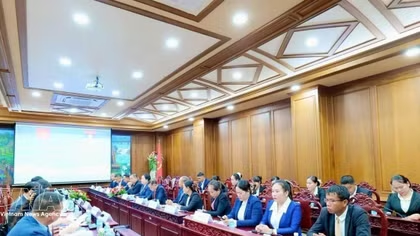
At a recent working session with the VFU, head of the Party Central Committee’s Economic Commission Nguyen Van Binh highlighted the important role of the union in the sustainable development of the agriculture-based economy. 

The official urged the union’s chapters to support farmers in developing large-scale production, applying high-tech and ensuring quality and high added values of products, thus meeting requirements of the international integration. 

To that end, it is necessary to connect farmers with cooperatives and businesses, he stressed. 

Binh also asked the VFU to closely coordinate with ministries, agencies and localities in order to encourage farmers to realise the Party and State’s policies on agricultural restructuring in tandem with the efforts in new-style rural area building and sustainable poverty reduction. 

At the same time, the union should pay more attention to improving knowledge and capacity of its members, and protecting their legitimate rights and interests, making them the subject of the industrialisation and modernisation of agriculture and rural areas, he stressed.
VNA

Other News

Hanoi ready to implement Capital Law 2026, unlocking new development momentum

Hanoi ready to implement Capital Law 2026, unlocking new development momentum

The effectiveness of the Capital Law 2026 will be measured not by the number of legal documents issued but by tangible improvements in governance and public administration, better services for people and businesses, faster administrative procedures, stronger investment attraction and higher economic growth.

Vietnamese students earn honours at ROBOG Asia Cup 2026

Vietnamese students earn honours at ROBOG Asia Cup 2026

Three teams from Chu Van An Secondary School in Vietnam’s Thai Nguyen province have earned First Prize honours and advanced to the quarterfinals at the ROBOG Asia Cup 2026, a regional robotics and artificial intelligence (AI) competition for students held in Hong Kong, China.

Hanoi sets out new investment blueprint with century-long development vision

Hanoi sets out new investment blueprint with century-long development vision

As of early June, Hanoi had attracted 74.6 billion USD in foreign direct investment (FDI) through more than 9,250 valid projects. FDI inflows in the first six months were projected at 3.2 billion USD, surpassing the annual target by 116%, while nearly 16,000 new businesses were established in the first five months, up 34.4% year-on-year.

Vietnam promotes legal cooperation and rule of law at global forum

Vietnam promotes legal cooperation and rule of law at global forum

Vietnam’s development and international integration have gone hand in hand with the improvement of its legal system, the incorporation of international commitments into domestic legislation, and legal reforms aimed at fostering development, openness and global integration. The country regards international law as an essential instrument for building fair, mutually beneficial relations among nations.

Hanoi to hold investment promotion event on June 29

Hanoi to hold investment promotion event on June 29

At the event, Hanoi authorities plan to grant investment policy decisions and investment registration certificates to 20 exemplary projects in the fields of transportation infrastructure, industrial parks, urban development, social housing, environment, science and technology, and foreign investment attraction.

Hanoi's Red River urban area development draws widespread attention

Hanoi's Red River urban area development draws widespread attention

Located south of the Red River and extending from the historic inner city to newly developing areas in the south and the west, the central urban area along Red River’s right bank covers approximately 45,317 hectares and is projected to accommodate around 6.365 million residents by 2045 and 6.455 million by 2065.

Hanoi's Red River urban area development draws widespread attention

Hanoi's Red River urban area development draws widespread attention

Located south of the Red River and extending from the historic inner city to newly developing areas in the south and the west, the central urban area along Red River’s right bank covers approximately 45,317 hectares and is projected to accommodate around 6.365 million residents by 2045 and 6.455 million by 2065.

Regional cooperation strengthened to combat cross-border drug crime

Regional cooperation strengthened to combat cross-border drug crime

Vietnam, China, Laos and Myanmar face common challenges as drug syndicates increasingly exploit the Mekong River, cross-border transport networks, e-commerce platforms, international logistics services, cyberspace and cryptocurrencies to organise drug transactions and smuggling operations.