Vietnams eyes sustainable development of coastal cities

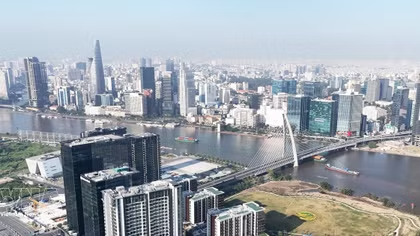
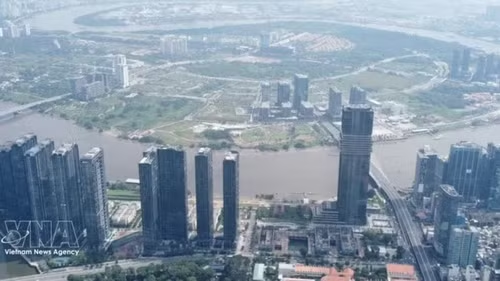
Vietnam aims for a model of coastal eco-cities that are smart, climate-resilient, and sustainably developed, where urban planning for coastal areas will centre around people, said insiders.

Vietnams eyes sustainable development of coastal cities -0
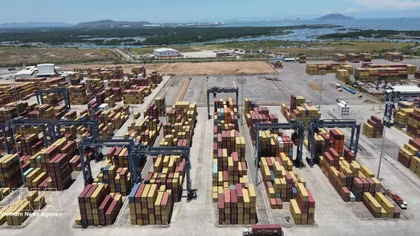
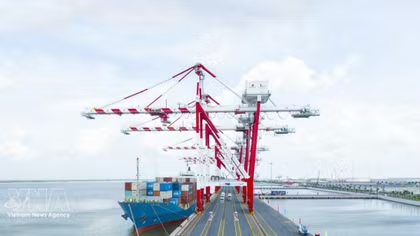
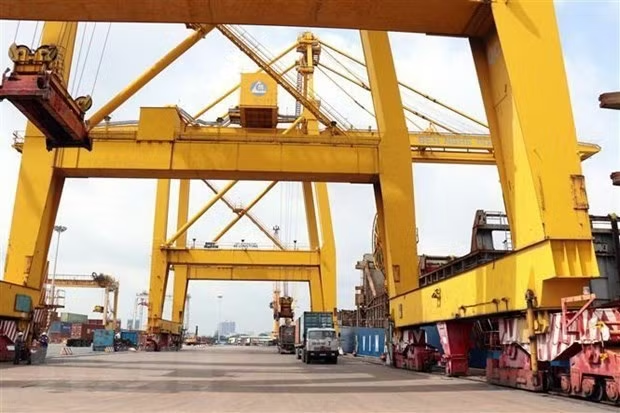
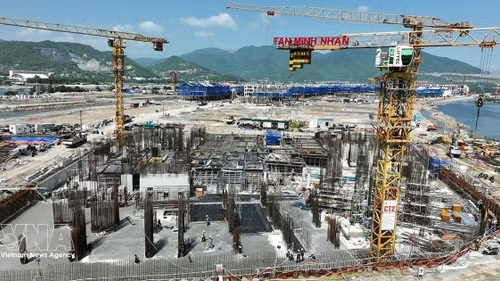
A view of Tan Cang Cat Lat port (Photo: VNA)

Vietnam aims for a model of coastal eco-cities that are smart, climate-resilient, and sustainably developed, where urban planning for coastal areas will centre around people, said insiders.

According to planning and architecture experts, it is necessary to select and make a rational and balanced land allocation commensurate with economic objectives; and ensure a well-organised system of public spaces and seaside squares within urban areas of various sizes.

Assoc. Prof Do Tu Lan and Dr. Dao Ngoc Nhu from the Urban Development Agency under the Ministry of Construction (MOC), underlined the necessity for urban design in coastal areas, especially the spaces in front of the sea.

Architectural works near the coast should have designs that are suitable for climate conditions, they said.

Experts and managers should identify focal points for coastal urban areas, especially entrance spaces, areas near seaports, and central squares, which adhere to green and smart construction standards, they added.

With more than 3,200 km of coastline, about 3,000 islands of all sizes, hundreds of beautiful beaches, and pristine bays, Vietnam boasts great potential for marine economic development, Lan said.

Urban areas in general, and coastal urban areas in particular, are playing a significant role in the socioeconomic development of each locality, region, and the entire nation.

Efficient planning, management, and development of coastal urban areas are closely linked with environmental protection and adaptation to climate change. These are crucial issues that contribute to the sustainable development of the maritime economy, while simultaneously facilitating the transition towards industrialisation and modernisation in the economic structure, she noted.
Vietnams eyes sustainable development of coastal cities -0

Taking into account tourism development in coastal cities, Assoc. Prof. Pham Trung Luong, Vice President of the Vietnam Association for the Protection of Marine Resources and Environment and a member of the National Planning Advisory Group, emphasised the importance of promoting sustainable and smart marine tourism urban development, saying that this element creates convenience and attractiveness for tourists, aligning with the global and regional trends in developing tourism destinations.

It is necessary to improve the system for collecting and processing waste from tourism to minimise negative impacts on the environment in general, and the coastal environment in particular, he said.

The Politburo issued Resolution No.06-NQ/TW dated January 24, 2022 on planning, construction, management, and sustainable development of urban areas in Vietnam till 2030, with a vision toward 2045, affirming urbanisation is an objective necessity and a crucial driving force for rapid and sustainable socioeconomic development in the coming years.

According to the strategy for sustainable development of Vietnam's marine economy until 2030 with a vision to 2045, pure marine economic sectors will account for about 10% of the national GDP by 2030; and The economies of 28 coastal cities and provinces are estimated to mark up 65-70% of the GDP.

By 2045, Vietnam will become a strong maritime nation characterised by sustainable development, prosperity, security, and safety, and its marine economy will play a crucial role in the national economy.

These ambitious goals serve as significant directions, opening up opportunities and providing a driving force for coastal areas, including coastal cities.

Currently, there are over 40 coastal cities across the country, including HCM City, Da Nang, Nha Trang, Vung Tau, Rach Gia, Phu Quoc. The urban areas, including coastal ones, account for approximately 70% of the national GDP growth, and increasingly demonstrate their importance for the nation’s socioeconomic development. Economic growth in urban areas averages between 12% - 15%, 1.2 to 1.5 times higher than the national average growth rate.

Urban development serves as a motivation for economic growth, contributing to developing an independent, self-reliant, and integrated economy.
VNA

Other News

Private economic sector poised for breakthrough growth

Private economic sector poised for breakthrough growth

More than a year after the Politburo's Resolution No. 68-NQ/TW on private sector development came into effect, expectations now extend beyond increasing the number of enterprises. The goal is to build a stronger business community with greater resilience, larger ambitions and the capacity to compete in global supply chains.

Vietnam remains ASEAN growth leader in 2026 despite global headwinds: WB

Vietnam remains ASEAN growth leader in 2026 despite global headwinds: WB

Vietnam is expected to remain one of ASEAN’s fastest-growing economies in 2026, supported by resilient exports, strong investment inflows and an ambitious reform agenda, despite mounting global uncertainties, according to the World Bank’s latest Vietnam Economic Update released on May 15.

Ministry establishes monitoring framework for carbon market

Ministry establishes monitoring framework for carbon market

Under a new circular, the exchange of greenhouse gas emission quotas and carbon credits is conducted on the domestic carbon credit exchange through the carbon trading system, which is interconnected with the national registration system.

Biofuel ready for nationwide rollout

Biofuel ready for nationwide rollout

For biofuels, particularly E10, to develop successfully, stronger and more coordinated policies are needed, especially pricing mechanisms capable of creating a sufficiently attractive gap between E10 and mineral-based petrol, an expert has said.

Vietnamese farm produce promoted at African investment, trade forum

Vietnamese farm produce promoted at African investment, trade forum

The 12th Africa Forum for Investment & Commerce (AFIC 12) opened in Algiers, the capital of Algeria, on May 9, drawing around 2,000 participants, including officials, economists, businesses, financial and development organizagtions from 43 African countries and international partners, including Vietnam.

Int'l medical, pharmaceutical expo opens in Hanoi

Int'l medical, pharmaceutical expo opens in Hanoi

The exhibition, which runs until May 9 at the Hanoi International Centre for Exhibition, showcases advanced products and technologies across a range of fields, including pharmaceuticals, drug manufacturing machinery and equipment, medical devices, hospital and clinic services and dental equipment.

Mega projects to transform Ho Chi Minh City urban landscape

Mega projects to transform Ho Chi Minh City urban landscape

Leading the charge in this massive building spree is the new central city square in the core of the Thu Thiem new urban area. Spanning more than 20 ha, it’s the crown jewel of the Central Square and new administrative center complex.

Vietnam establishes itself as one of region’s most dynamic manufacturing and supply bases

Vietnam establishes itself as one of region’s most dynamic manufacturing and supply bases

The country’s stable political and economic environment provides a critical foundation for long-term sourcing strategies. At the same time, Vietnam has demonstrated a strong ability to scale up manufacturing, supported by a continuously expanding industrial base capable of meeting both high-volume demand and increasingly complex technical and quality requirements.

Vietnamese pomelos gain broader access to Australian market

Vietnamese pomelos gain broader access to Australian market

The update by Australia’s Department of Agriculture, Fisheries and Forestry to its Biosecurity Import Conditions system (BICON) on April 10, officially setting out import conditions for Vietnamese pomelos, is regarded as a major milestone in market access efforts.

Vietnam's industry spearheads transition to circular economy

Vietnam's industry spearheads transition to circular economy

The circular economy is no longer just a policy choice. It has become an inevitable trend for delivering sustainable and green growth, sharpening competitiveness at home and abroad, and meeting Vietnam’s net-zero emissions target by 2050. It is now a prerequisite to sustain long-term economic expansion, particularly in industrial production and supporting industries.

Nearly 100 tonnes of Vietnamese fruits, vegetables airlifted to UAE

Nearly 100 tonnes of Vietnamese fruits, vegetables airlifted to UAE

Vietnamese fresh produce and processed foods are increasingly recognised for their quality, with items such as cashew nuts, coffee and spices gaining popularity among Middle East consumers. In 2025, Vietnam’s farm produce exports to the UAE exceeded 445 million USD, up nearly 24% year-on-year.