The Vietnamese law-governed socialist state’s consistency in pursuing the policy of ensuring the right to freedom of belief and religion for all citizens.
The right to freedom of belief and religion is stipulated in Vietnam’s 2013 Constitution, Article 24 as “1. Everyone shall enjoy freedom of belief and religion; he or she can follow any religion or follow none. All religions are equal before the law. 2. The State respects and protects freedom of belief and of religion.”
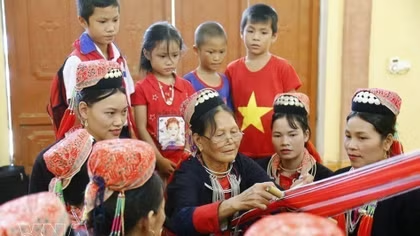
With that spirit, the Vietnamese State has always respected and created favorable conditions for all people to exercise the right to freedom of religion and belief and is making every effort to ensure the best practice of freedom to religion and belief and ensure equality between religions.
The 14th National Assembly adopted the Law on Belief and Religion in 2016. The government issued the Decree on detailing some articles and measures to enforce the Law on Belief and Religion.
In addition, activities concerning education and training of religious dignitaries, repair and construction of worshipping establishments, humanitarian activities, and social protection have been adjusted in a number of related laws including the Civil Law, the Land Law, the Heritage Law, and the Education Law in order to match with regulations on freedom of belief and religion.
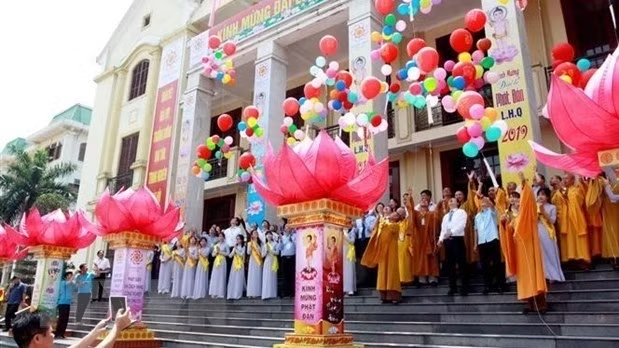
95% of Vietnamese people follow a religion, and 16 religions with 43 organizations are recognized by the State including Buddhism, Christianity, Protestant, Caodaism, Hoa Hoa Buddhism, Muslim, Baha'l religion, Buddhist association, Adventist, Buddhism of the Tu An Hieu Nghia, Minh Su Dao, Minh Ly Dao - Tam Tong Mieu, Brahmanism, Mormon, Buddhism Hieu Nghia Ta Long and Buu Son Ky Huong.
More than 26.5 million people are religious followers accounting for 28% of the population. There are tens of thousands of religious worshiping establishments nationwide.
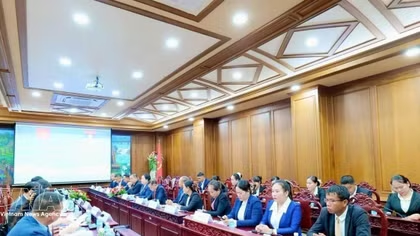
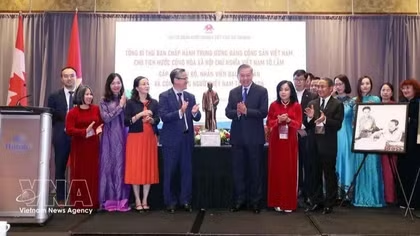
In addition to creating favorable conditions for the people to practice belief and religion, the State encourages and creates conditions for religious organizations to strengthen international exchanges. Every year, hundreds of delegations of Vietnamese religious organizations go overseas for exchanges, while many foreign religious dignitaries have visited Vietnam and practiced religion here.
Vietnam has disseminated information on its freedom of religion and belief at meetings, forums, and dialogue channels on human rights with the US, Australia, Norway, and other European countries.
Despite the ample evidence of the freedom of religious life in Vietnam, some organizations like the USCIRF are unwilling to look at the facts and have regularly made biased statements on Vietnam.
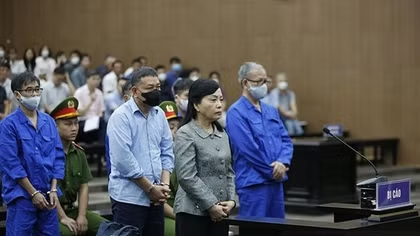
Most recently, USCIRF released an “update report on freedom of religion in Vietnam in 2021” with inaccurate, biased information saying that the enforcement of the Law on Belief and Religion in many localities is ineffective and functional agencies continue oppressing, disrupting the practice of religion, that many religious organizations have not been recognized and that Vietnam arrested, prosecuted and tried religious activists and prisoners of conscience like Nguyen Bac Truyen, who violated the law and was convicted.
USCIRF asked the US State Department to bring Vietnam to the list of countries of particular concern. Information used in the USCIRF report was collected from reactionary organizations like Boat People SOS (BPSOS), Vietnam Multi-religion Roundtable, Montagnard Stands for Justice MSFJ and reactionary organizations in Vietnam.
Biased, distorted assessment of the USCIRF denied Vietnams’ efforts to fine-tune the legal system and enforce policies to ensure and promote the freedom of religion for all.
In any country, religious activities need to be adjusted and practiced under the law. Vietnam has demonstrated its goodwill and openness in sharing information with other countries and organizations that concern human rights issue and freedom of religion and belief.
Vietnam has invited delegations including from of the USCIRF to visit Vietnam to witness Vietnam’s efforts and achievements in ensuring the rights to freedom of belief and religion.
With USCIRF, Vietnam suggested the organization access correct and objective information and develop a constructive attitude in producing annual reports on freedom of religion not only in Vietnam but also other countries. This should be the guideline and true purpose of an organization that wants to promote the right to freedom of religion.