 |
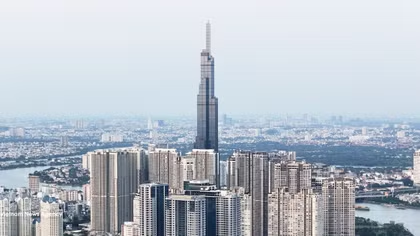
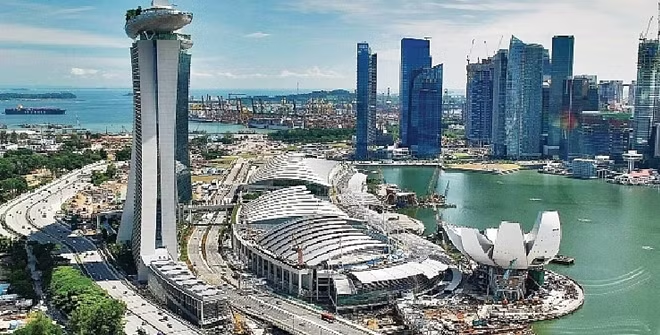
| A leader of the regional wave of green development, Singapore already had 3,000 green buildings in 2017 (Photo: Marina Bay Sands) |
Grounds for green development
In order to answer this question, it is necessary to look back at the history of the development of buildings from thousands of years ago. In the early days, when energy remained scarce, all the construction and operation of housing were carried out manually, posing little impact on the surrounding environment. However, moving to the industrial era (1880-1970), the myriad breakthroughs in science and technology allowed people to build high-rise buildings with more amenities.
Due to the heavy emphasis on improving the functionality and facility of these buildings, construction works had underestimated climate adaptability and were heavily reliant on fossil energy sources—a cheap and huge energy source at the time. Moreover, the unrestrained exploitation of fossil fuels by cities during this period also lead to unprecedented pollution.
Since the early 1970s, architects and environmentalists have started embracing “green buildings.” On the first Earth Day held in April 1970, the concept of green buildings was officially publicised. However, it was not until 1973, when the global oil crisis took place, that the efforts to build green buildings really began.
In the US, the American Institute of Architects (AIA) formed a Committee on Energy that broke into two schools of thought. One group looked towards passive solutions such as reflective roofing materials and environmentally beneficial siting to achieve energy savings, while the other concentrated more on technological solutions such as the use of triple-glazed windows.
In the wake of the oil crisis, green buildings received little attention, but there were still a number of key architects who continued to advocate and promote the concept. A couple of notable buildings constructed during the seventies which utilised green design concepts are The Willis Faber and Dumas Headquarters in England, which utilised a grass roof, day-lighted atrium, and mirrored windows, as well as the Gregory Bateson Building in California, which used energy-sensitive photovoltaic (solar) cells, under-floor rockstore cooling systems, and area climate control devices.
Besides reducing reliance on major fossil fuel powerhouses, the utilisation of this energy source also exerts significantly positive impacts on the environment. In particular, it helps tackle climate change challenges, which have raised concerns among governments, and thus encourages them to be more active in the development of green buildings.
In 1990, the UK’s Building Research Establishment (BRE) introduced BRE Environmental Assessment Method (BREEAM). This is considered the first green building rating system in the world.
In the US, the US Green Building Council (USGBC) was founded in 1993 and in the same year US President Bill Clinton launched the “Greening the White House” programme with solutions to improve energy efficient in the building and other government facilities.
Vietnam’s greener future
Although “green buildings” have become a worldwide trend a few decades ago, in Vietnam, they appeared about a decade ago and have only started garnering real interest in the past three years. This was when the awareness of “green living” started to grow and became more visible.
In 2007, some American factories investing in Vietnam employed the standards of the LEED (Leadership in Energy and Environmental Design) rating system to comply with the parent companies’ policies. Also around this time, the Vietnam Green Building Council (VGBC), a non-governmental organisation supporting the development of green buildings in Vietnam, was officially established. With the active support of foreign and local experts and organisations, VGBC has researched and launched the LOTUS green building rating system. It consists of all the criteria set by the biggest rating systems in the world adjusted to conditions in Vietnam.
During this period, the Green Mark system was introduced by Singaporean investors to a number of investment projects in Vietnam. Then, several Vietnamese organisations, including the Vietnam Association of Architects and the Vietnam Association of Construction Environment, have set their own criteria. Most recently, in April 2015, International Finance Corporation (IFC), the financial arm of the World Bank Group, officially announced a green building certification system for emerging markets, EDGE (Excellence in Design for Greater Efficiencies).
IFC’s new report “Creating Markets for Climate Business” predicts that along with the strong growth momentum of the Asian construction market, the presence of green trends, standards, and technologies will bring tremendous opportunities to widen the market for green buildings. In East Asia alone, the total investment demand for green buildings may reach $3 trillion by 2025, $726 billion of which will go for commercial buildings and $2.4 trillion for housing projects.
To date, there have been nearly 100 registered works nationwide and more than half of them have achieved prestigious green building certifications. In addition, green criteria have become an integral part of architectural-planning competitions or architectural awards. However, the implementation of green construction criteria in Vietnam is still lagging behind other countries in the region, such as Singapore or Malaysia.
In the five countries of Vietnam, the Philippines, Cambodia, Myanmar, and Laos, there are more than 300 green buildings in total—a modest number compared to other developed countries in the region, such as Singapore with 3,000 green buildings alone (June 2017).
As it is fully voluntary and non-compulsory, the motivation for green buildings in Vietnam largely comes from a sense of social responsibility and the need to reduce the operating costs of businesses. It also raises awareness and draws attention from local firms such as Tien Phat Corporation, Nam Long Group or Capital House, as well as foreign companies like Citra Westlake City Development Co., Ltd., Big C, Intel or Coca-Cola, just to name a few.
Sadly, a large number of investors and developers in the country do not understand the issue of initial investment costs or the benefits that green buildings can yield. Many investors think that in order to achieve the green credentials for a certification, the project’s investment cost will have to increase by 20-30 per cent.
In fact, experience in green construction in Vietnam and other countries in the region show that the cost of investment increases by no more than 5 per cent. In addition, if architects bring out green ideas right from the beginning to create a green living environment and improve the efficiency of energy, water, and materials usage, the construction of green buildings without additional investment is absolutely feasible.
Another barrier to green buildings lies in the attitude of Vietnamese homebuyers, who often consider price as a determining factor when choosing a residential or investment product. Meanwhile, a couple of factors that have long-term effects on the health and well-being of most communities, like the quality of construction, work efficiency, environment-friendliness and sustainability, do not receive much attention.
Dreams come true
The desire to develop green buildings, in combination with the determination to act, will bring us green buildings of real value. For green buildings to grow and flourish, the associated values must be shared by the whole society, instead of relying on the limited support of some pioneering investors and experts. Once the whole society joins, green buildings will be quickly replicated and become a model for green communities and green cities, thus bringing great economic and spiritual value to the residential community.
Given the current state of the real estate market in Vietnam, the expansion of green buildings is no longer impossible, as advanced countries with similar natural conditions and development experience have been helping us to perfect green technologies and practices. Just like the LED bulbs—a product that only a few years drew doubts over its quality and price. Now, it has a firm foothold in the market with higher quality, diversified styles, and ever-decreasing prices. The cost of green technologies will also decrease as the scale of output increases.
In addition, thanks to the pioneering investors who have built several green buildings over the past years, the market has accumulated a lot of experience in deploying “green” criteria on different types of construction works while at the same time building a team of experts with the capability to operate green buildings.
With a rather solid foundation, what is lacking is a small impact to foster market development. This force can be generated by the government through the implementation of policies that recognise the importance and encourage the construction of green buildings to bring real benefits to the whole society as well as the environment.
However, longer-term motivation must come from the consumers themselves. When consumers are aware of the benefits and incentives that green buildings can bring to themselves and their families, the “need” for green buildings will be created. At that time, the market will grow further to develop green buildings with higher quality and satisfy the increasingly arduous demands of customers.