VN urged to adopt conflict-management tools to stop disputes

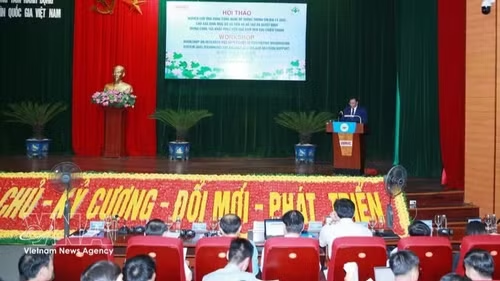
A new set of tools that emphasise employee-employer dialogue, neutral evaluations and sustainable compliance with labour regulations are needed to resolve workplace conflicts in Vietnam, experts said at recent workshop held in HCM City.

Dang Thi Hai Ha, founder of Respect Vietnam, which develops workplace-improvement programmes, said that wildcat strikes and disputes in the country had been triggered by prolonged or unsettled conflicts in the workplace.

Resolving disputes when they have already occurred "is only the tip of the iceberg", she said at the workshop, which examined how to effectively manage conflicts between employees and employers.

"Integrated conflict management" offers lasting solutions, she said, adding that dialogue between employees and employers in Vietnam had been poor and that a system for identifying and solving conflicts had yet to be developed.

Ha suggested a set of tools called WE@WORK that helps employers and employees work together to build a lasting integrated conflict-management system.

Such a system improves daily sustainable compliance and continuous enhancement of workplace efficiency, helping to prevent disputes, she said. 

It also assists companies in complying with labour laws and international labour regulations in a sustainable manner.

For instance, the tool WeTALK is used for continuous conflict identification, decoding and resolution tracking, according to Ha.

The tool includes one set of codified and standardised forms. Workers who have questions or complaints about problems related to their jobs submit their ideas on forms to managers via a box.

The managers read the forms and provide feedback on a yellow form that is attached to the factory’s employee noticeboard.

The tool has been used with positive results in factories in Nha Trang and the provinces of Binh Duong and Binh Phuoc, Ha said.

At the workshop, Vu Minh Tien, deputy head of the Institute for Workers and Trade Unions at the Vietnam General Federation of Labour, told Vietnam News that nearly 300 strikes had occurred last year.

Tien said that economic growth had been stable in the last several years, and that provincial and city authorities had created conditions for trade unions to operate for the benefit of workers.

Free trade agreements signed between Vietnam and other countries in recent years have urged the use of integrated conflict management in order to protect jobs and incomes as well as improve workplace efficiency and competitiveness.

The workshop was organised by Respect Vietnam, the Scheinman Institute on Conflict Resolutions at Cornell University (US) and Ton Duc Thang University in HCM City.

VNA

Other News

Hanoi ready to implement Capital Law 2026, unlocking new development momentum

Hanoi ready to implement Capital Law 2026, unlocking new development momentum

The effectiveness of the Capital Law 2026 will be measured not by the number of legal documents issued but by tangible improvements in governance and public administration, better services for people and businesses, faster administrative procedures, stronger investment attraction and higher economic growth.

Vietnamese students earn honours at ROBOG Asia Cup 2026

Vietnamese students earn honours at ROBOG Asia Cup 2026

Three teams from Chu Van An Secondary School in Vietnam’s Thai Nguyen province have earned First Prize honours and advanced to the quarterfinals at the ROBOG Asia Cup 2026, a regional robotics and artificial intelligence (AI) competition for students held in Hong Kong, China.

Hanoi sets out new investment blueprint with century-long development vision

Hanoi sets out new investment blueprint with century-long development vision

As of early June, Hanoi had attracted 74.6 billion USD in foreign direct investment (FDI) through more than 9,250 valid projects. FDI inflows in the first six months were projected at 3.2 billion USD, surpassing the annual target by 116%, while nearly 16,000 new businesses were established in the first five months, up 34.4% year-on-year.

Vietnam promotes legal cooperation and rule of law at global forum

Vietnam promotes legal cooperation and rule of law at global forum

Vietnam’s development and international integration have gone hand in hand with the improvement of its legal system, the incorporation of international commitments into domestic legislation, and legal reforms aimed at fostering development, openness and global integration. The country regards international law as an essential instrument for building fair, mutually beneficial relations among nations.

Hanoi to hold investment promotion event on June 29

Hanoi to hold investment promotion event on June 29

At the event, Hanoi authorities plan to grant investment policy decisions and investment registration certificates to 20 exemplary projects in the fields of transportation infrastructure, industrial parks, urban development, social housing, environment, science and technology, and foreign investment attraction.

Hanoi's Red River urban area development draws widespread attention

Hanoi's Red River urban area development draws widespread attention

Located south of the Red River and extending from the historic inner city to newly developing areas in the south and the west, the central urban area along Red River’s right bank covers approximately 45,317 hectares and is projected to accommodate around 6.365 million residents by 2045 and 6.455 million by 2065.

Hanoi's Red River urban area development draws widespread attention

Hanoi's Red River urban area development draws widespread attention

Located south of the Red River and extending from the historic inner city to newly developing areas in the south and the west, the central urban area along Red River’s right bank covers approximately 45,317 hectares and is projected to accommodate around 6.365 million residents by 2045 and 6.455 million by 2065.

Regional cooperation strengthened to combat cross-border drug crime

Regional cooperation strengthened to combat cross-border drug crime

Vietnam, China, Laos and Myanmar face common challenges as drug syndicates increasingly exploit the Mekong River, cross-border transport networks, e-commerce platforms, international logistics services, cyberspace and cryptocurrencies to organise drug transactions and smuggling operations.