- Trump changes tack, backs 'one China' policy in call with Xi
- Trump breaks ice with China's Xi in letter seeking 'constructive' ties
China's navy has been taking an increasingly prominent role in recent months, with a rising star admiral taking command, its first aircraft carrier sailing around self-ruled Taiwan and new Chinese warships popping up in far-flung places.
Now, with President Donald Trump promising a U.S. shipbuilding spree and unnerving Beijing with his unpredictable approach on hot button issues including Taiwan and the South and East China Seas, China is pushing to narrow the gap with the U.S. Navy.
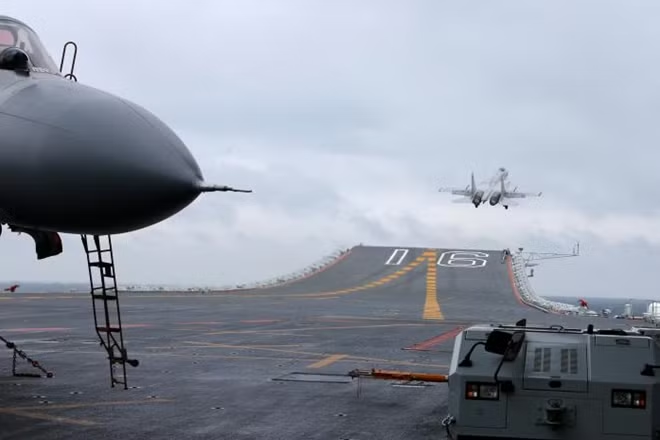 |
| FILE PHOTO: J-15 fighters from China's Liaoning aircraft carrier conduct a drill in an area of South China Sea, January 2, 2017. Picture taken January 2, 2017. REUTERS/Mo Xiaoliang/File Photo |
"It's opportunity in crisis," said a Beijing-based Asian diplomat, of China's recent naval moves. "China fears Trump will turn on them eventually as he's so unpredictable and it's getting ready."
Beijing does not give a breakdown for how much it spends on the navy, and the overall official defense spending figures it gives - 954.35 billion yuan ($139 billion) for 2016 - likely understates its investment, according to diplomats.
China unveils the defense budget for this year at next month's annual meeting of parliament, a closely watched figure around the region and in Washington, for clues to China's intentions.
China surprised last year with its lowest increase in six years, 7.6 percent, the first single-digit rise since 2010, following a nearly unbroken two-decade run of double-digit jumps.
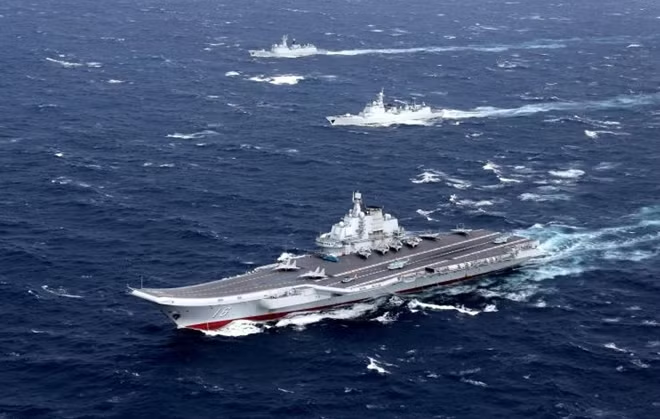 |
| FILE PHOTO: China's Liaoning aircraft carrier with accompanying fleet conducts a drill in an area of South China Sea, in this undated photo taken December, 2016. REUTERS/Stringer/File photo |
"Certainly, the PLA Navy has really been the beneficiary of a lot of this new spending in the past 15 years," said Richard Bitzinger, Senior Fellow and Coordinator of the Military Transformations Programme at the S.Rajaratnam School of International Studies in Singapore.
"We don't how much they spend on the navy, but simply extrapolating from the quantity and the quality of things that are coming out of their shipyards, it's pretty amazing."
RAPID DEVELOPMENT
The Chinese navy, once generally limited to coastal operations, has developed rapidly under President Xi Jinping's ambitious military modernization.
It commissioned 18 ships in 2016, including missile destroyers, corvettes and guided missile frigates, according to state media.
Barely a week goes by without an announcement of some new piece of equipment, including an electronic reconnaissance ship put into service in January.
Still, the PLA Navy significantly lags the United States, which operates 10 aircraft carriers to China's one, the Soviet-era Liaoning.
Xu Guangyu, a retired major general in the People's Liberation Army now senior adviser to the government-run China Arms Control and Disarmament Association, said China was keenly aware of the U.S. ability to project power at sea.
"It's like a marathon and we're falling behind. We need to step on the gas," Xu said.
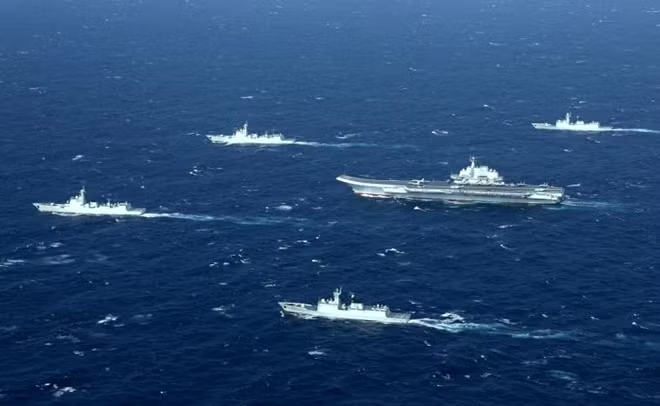 |
| FILE PHOTO: China's Liaoning aircraft carrier with accompanying fleet conducts a drill in an area of South China Sea in this undated photo taken December, 2016. REUTERS/Stringer/File Photo |
Trump has vowed to increase the U.S. Navy to 350 ships from the current 290 as part of "one of the "greatest military buildups in American history", a move aides say is needed to counter China's rise as a military power.
"We’ve known this is a 15-20 year project and every year they get closer to being a blue-water navy with global aspirations," said a U.S. administration official, speaking on the condition of anonymity.
"What you have seen this last year and what I think you will see with the new budget is that they are moving ahead with the short-term goal of being the premier naval force in the South China Sea and the East China Sea, with the mid-term goal, of extending all the way to the Indian Ocean."
In January, China appointed new navy chief, Shen Jinlong, to lead that push.
Shen has enjoyed a meteoric rise and is close to Xi, diplomatic and leadership sources say.
"The navy has gotten very lucky with Shen," said a Chinese official close to the military, speaking on condition of anonymity. "Now they know for certain their support goes all the way to the top."
Recent PLA Navy missions have included visits to Gulf states, where the United States has traditionally protected sea lanes, and to the South China Sea, Indian Ocean and Western Pacific, in what the state-run website StrongChina called Shen's "first show of force against the United States, Japan and Taiwan".
Last month, a Chinese submarine docked at a port in Malaysia's Sabah state, which lies on the South China Sea, only the second confirmed visit of a Chinese submarine to a foreign port, according to state media.
The submarine had come from supporting anti-piracy operations off the coast of Somalia, where China has been learning valuable lessons about overseas naval operations since 2008.
Chinese warships have also been calling at ports in Pakistan, Bangladesh and Myanmar, unnerving regional rival India.
"It's power projection," said a Beijing-based Western diplomat, of China's navy.