Workshop seeks solutions to air pollution

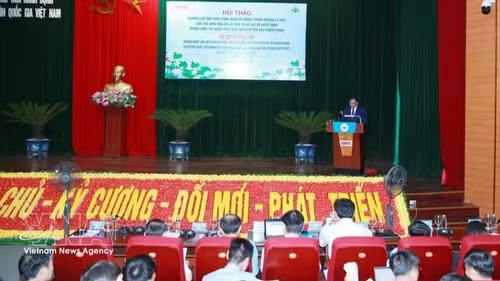
The Office of the National Assembly (NA) and the Hanns Seidel Foundation of Germany co-organised a workshop in Hanoi on April 25 to seek solutions to air pollution.

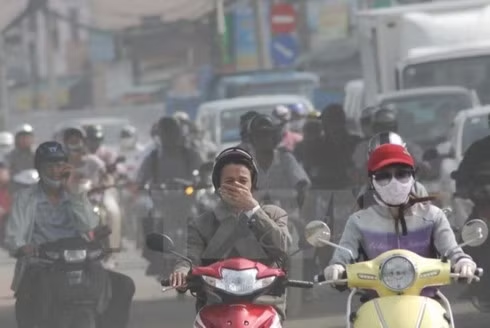
Air pollution has reached alarming levels in some areas of Hanoi

The event was designed to provide more information for NA deputies while debating the country’s socio-economic development and making important decisions related to the environmental and climate change.

Deputy Head of the NA Office Do Manh Hung, who chaired the event, reiterated the World Health Organisation’s warnings about Vietnam’s air pollution compared with Asian and Pacific nations, saying that Vietnam has more than a half of the days in a year with poor air conditions.

Studies conducted by the Institute of Strategy and Policy on Natural Resources and Environment (ISPONRE) under the Ministry of Natural Resources and Environment, showed that air pollution is mainly caused by transport, industrial production, construction, daily activities, agriculture, trade village and waste treatment.

According to the Ministry of Health, Vietnam has recorded the highest increase of respiratory diseases, largely caused by air pollution. Air pollution is also a major cause of global issues, including ozone layer depletion, atmosphere warming, and acid accumulation.

Nguyen Van Thuy, Director of the Centre for Environmental Monitoring under the General Department of Environment, said Hanoi and Ho Chi Minh City’s air is the most polluted due to socio-economic development activities. Other industrial provinces, such as Quang Ninh, Thai Nguyen and Dong Nai are suffering from air pollution.

ISPONRE Deputy Director Nguyen Trung Thang suggested that relevant legal documents should be revised in line with the reality, particularly in urban areas, industrial zones, and trade villages.

Management should be tightened in the sectors that are likely to cause air pollution, such as transport, construction, trade villages, and waste treatment, Thang said, adding that mechanisms are needed to reduce gas emissions while offering incentives for technological application to reduce air pollution.

Participants urged for the prompt promulgation of a law to control air pollution with specific regulations and ensure enforcement of the law, specifying responsibilities and obligations of stakeholders, particularly state management agencies.

Communication campaigns should be promoted to raise the awareness of impacts of air pollution among people and enterprises, thus enhancing environmental protection, they noted.
VNA

Other News

Hanoi ready to implement Capital Law 2026, unlocking new development momentum

Hanoi ready to implement Capital Law 2026, unlocking new development momentum

The effectiveness of the Capital Law 2026 will be measured not by the number of legal documents issued but by tangible improvements in governance and public administration, better services for people and businesses, faster administrative procedures, stronger investment attraction and higher economic growth.

Vietnamese students earn honours at ROBOG Asia Cup 2026

Vietnamese students earn honours at ROBOG Asia Cup 2026

Three teams from Chu Van An Secondary School in Vietnam’s Thai Nguyen province have earned First Prize honours and advanced to the quarterfinals at the ROBOG Asia Cup 2026, a regional robotics and artificial intelligence (AI) competition for students held in Hong Kong, China.

Hanoi sets out new investment blueprint with century-long development vision

Hanoi sets out new investment blueprint with century-long development vision

As of early June, Hanoi had attracted 74.6 billion USD in foreign direct investment (FDI) through more than 9,250 valid projects. FDI inflows in the first six months were projected at 3.2 billion USD, surpassing the annual target by 116%, while nearly 16,000 new businesses were established in the first five months, up 34.4% year-on-year.

Vietnam promotes legal cooperation and rule of law at global forum

Vietnam promotes legal cooperation and rule of law at global forum

Vietnam’s development and international integration have gone hand in hand with the improvement of its legal system, the incorporation of international commitments into domestic legislation, and legal reforms aimed at fostering development, openness and global integration. The country regards international law as an essential instrument for building fair, mutually beneficial relations among nations.

Hanoi to hold investment promotion event on June 29

Hanoi to hold investment promotion event on June 29

At the event, Hanoi authorities plan to grant investment policy decisions and investment registration certificates to 20 exemplary projects in the fields of transportation infrastructure, industrial parks, urban development, social housing, environment, science and technology, and foreign investment attraction.

Hanoi's Red River urban area development draws widespread attention

Hanoi's Red River urban area development draws widespread attention

Located south of the Red River and extending from the historic inner city to newly developing areas in the south and the west, the central urban area along Red River’s right bank covers approximately 45,317 hectares and is projected to accommodate around 6.365 million residents by 2045 and 6.455 million by 2065.

Hanoi's Red River urban area development draws widespread attention

Hanoi's Red River urban area development draws widespread attention

Located south of the Red River and extending from the historic inner city to newly developing areas in the south and the west, the central urban area along Red River’s right bank covers approximately 45,317 hectares and is projected to accommodate around 6.365 million residents by 2045 and 6.455 million by 2065.

Regional cooperation strengthened to combat cross-border drug crime

Regional cooperation strengthened to combat cross-border drug crime

Vietnam, China, Laos and Myanmar face common challenges as drug syndicates increasingly exploit the Mekong River, cross-border transport networks, e-commerce platforms, international logistics services, cyberspace and cryptocurrencies to organise drug transactions and smuggling operations.