World Food Day, FAO’s 40-year presence in Vietnam celebrated

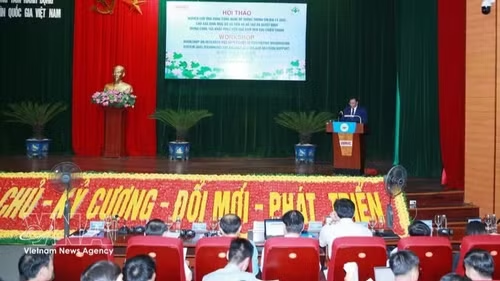
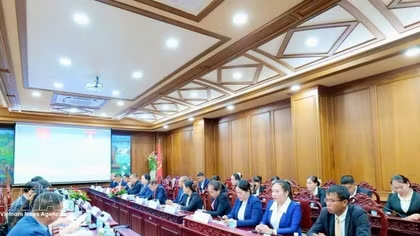
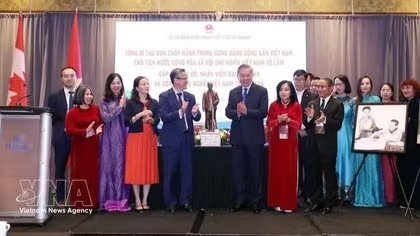
A ceremony was held in Hanoi on October 16 to mark the 38th World Food Day and 40 years of the UN Food and Agriculture Organisation (FAO)’s presence in Vietnam.
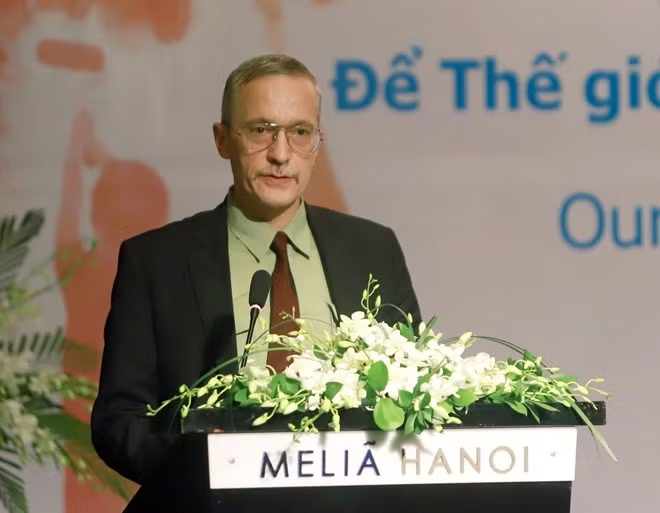
FAO Vietnam representative Albert Lieberg addresses the ceremony in Hanoi on October 16 (Photo: VNA)

FAO Vietnam representative Albert Lieberg addresses the ceremony in Hanoi on October 16 (Photo: VNA) 

This year’s World Food Day message “Our actions are our future. A Zero Hunger world by 2030 is possible” is also at the heart of FAO’s mandate in Viet Nam, with action to ensure food security and nutritious diets for all an important area of work for FAO since it began operations in the country in 1978.

World Food Day and its Zero Hunger goal also reflect the spirit of FAO and the Government of Viet Nam’s fruitful partnership over the past four decades to transform the country from a large net food importer to the world’s third largest exporter of rice and ensure its population now has access to enough high-quality food to lead active and healthy lives.

The importance of partnerships to achieve Zero Hunger on global and national scales was underlined, especially with world hunger on the rise again and the number of undernourished people having increased in 2017 for the third consecutive year. Last year, 821 million people suffered from hunger - 11 percent of the world’s population or one-in-nine people on the planet. Meanwhile, other forms of malnutrition have also increased, with at least 1.5 billion people in 2017 having suffered from micronutrient deficiencies that undermined their health and lives.

“A world without hunger seemed to be a utopia for humankind until recently. However, unprecedented economic development over the last two decades in many parts of the world has opened up the possibility to realistically achieving this goal in the near future,” said Mr. Albert T. Lieberg, FAO Representative in Viet Nam.

In response, FAO urges all stakeholders to work collaboratively to achieve Zero Hunger goals, with public and private investments, risk-informed policies and interventions to ensure the poor and most vulnerable benefit from growth and employment opportunities.

Importantly, Zero Hunger is also key to achieving the 2030 Agenda for Sustainable Development. Many Sustainable Development Goals (SDGs), such as quality education and good health for all, cannot be achieved without first eliminating hunger. Food and agriculture also lie at the heart of the 2030 Agenda to end poverty, hunger and malnutrition to sustain natural resources and respond to climate change.

“Agricultural development is considered the most effective solution to Zero Hunger and poverty reduction initiatives in Viet Nam, which make a contribution to the SDG on ending hunger, achieving food security, improving nutrition and promoting sustainable agriculture,” said Mr. Le Quoc Doanh, Vice Minister of MARD.

These goals are also key features of FAO’s current work in Viet Nam and build on the solid foundations set during the 40 years of FAO engagement in the country. Having entered Viet Nam soon after a period of conflict that had devastated the nation’s physical, economic and institutional capital, FAO quickly became an important partner and main contributor of agricultural sector technical assistance. 

 This partnership has seen FAO play leading roles in the implementation of almost 500 projects to support hunger eradication, poverty reduction, ensure food and nutrition security in areas such as crop production, animal husbandry, animal and plant health, forestry and fisheries.

PSNews

Other News

Hanoi ready to implement Capital Law 2026, unlocking new development momentum

Hanoi ready to implement Capital Law 2026, unlocking new development momentum

The effectiveness of the Capital Law 2026 will be measured not by the number of legal documents issued but by tangible improvements in governance and public administration, better services for people and businesses, faster administrative procedures, stronger investment attraction and higher economic growth.

Vietnamese students earn honours at ROBOG Asia Cup 2026

Vietnamese students earn honours at ROBOG Asia Cup 2026

Three teams from Chu Van An Secondary School in Vietnam’s Thai Nguyen province have earned First Prize honours and advanced to the quarterfinals at the ROBOG Asia Cup 2026, a regional robotics and artificial intelligence (AI) competition for students held in Hong Kong, China.

Hanoi sets out new investment blueprint with century-long development vision

Hanoi sets out new investment blueprint with century-long development vision

As of early June, Hanoi had attracted 74.6 billion USD in foreign direct investment (FDI) through more than 9,250 valid projects. FDI inflows in the first six months were projected at 3.2 billion USD, surpassing the annual target by 116%, while nearly 16,000 new businesses were established in the first five months, up 34.4% year-on-year.

Vietnam promotes legal cooperation and rule of law at global forum

Vietnam promotes legal cooperation and rule of law at global forum

Vietnam’s development and international integration have gone hand in hand with the improvement of its legal system, the incorporation of international commitments into domestic legislation, and legal reforms aimed at fostering development, openness and global integration. The country regards international law as an essential instrument for building fair, mutually beneficial relations among nations.

Hanoi to hold investment promotion event on June 29

Hanoi to hold investment promotion event on June 29

At the event, Hanoi authorities plan to grant investment policy decisions and investment registration certificates to 20 exemplary projects in the fields of transportation infrastructure, industrial parks, urban development, social housing, environment, science and technology, and foreign investment attraction.

Hanoi's Red River urban area development draws widespread attention

Hanoi's Red River urban area development draws widespread attention

Located south of the Red River and extending from the historic inner city to newly developing areas in the south and the west, the central urban area along Red River’s right bank covers approximately 45,317 hectares and is projected to accommodate around 6.365 million residents by 2045 and 6.455 million by 2065.

Hanoi's Red River urban area development draws widespread attention

Hanoi's Red River urban area development draws widespread attention

Located south of the Red River and extending from the historic inner city to newly developing areas in the south and the west, the central urban area along Red River’s right bank covers approximately 45,317 hectares and is projected to accommodate around 6.365 million residents by 2045 and 6.455 million by 2065.

Regional cooperation strengthened to combat cross-border drug crime

Regional cooperation strengthened to combat cross-border drug crime

Vietnam, China, Laos and Myanmar face common challenges as drug syndicates increasingly exploit the Mekong River, cross-border transport networks, e-commerce platforms, international logistics services, cyberspace and cryptocurrencies to organise drug transactions and smuggling operations.