- Deputy Minister Bui Van Nam chairs meeting of Security and Health Subcommittee ahead of AIPA-41
- Vietnam works to promote role of AIPA
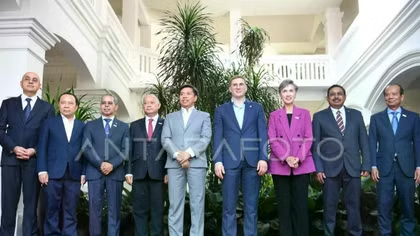
The virtual event, hosted by Vietnam, was attended by leaders of the 10 AIPA member parliaments, parliamentary leaders of country observers of AIPA, the AIPA Secretary-General and Secretariat, the Secretary-General of the Inter-Parliamentary Union, the ASEAN Secretary-General, along with representatives of the UN Secretary-General and guest parliaments of the host country.
Addressing the first plenary session, Speaker of the Legislative Council of Brunei Pehin Abdul Rahman Taib said the theme of AIPA 41 this year, “Parliamentary Diplomacy for Cohesive and Responsive ASEAN Community”, is relevant in the current context as the region faces unprecedented challenges in adapting to the new norm.
“The theme further emphasises the role of national parliaments of ASEAN as the voice of the people and the need to stand in solidarity and to respond swiftly to pressing issues, in accordance with the international laws,” he noted.
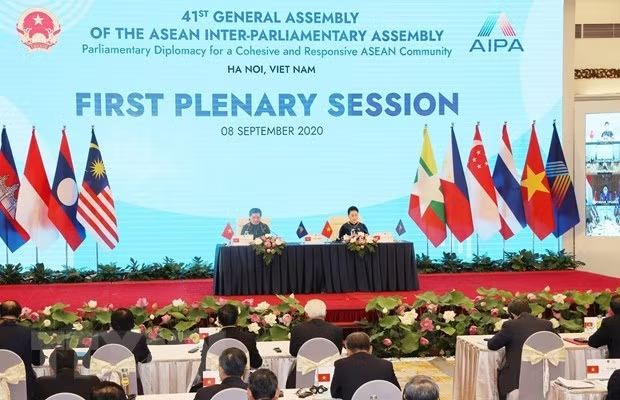 |
| At the first plenary session of the 41st AIPA General Assembly (Photo: VNA) |
Speaker of the House of Representatives of Indonesia Puan Maharani held that the theme of this year’s General Assembly marks the increasingly important role of the parliament, especially in this time of COVID-19 pandemic, which is impacting so many lives and limiting economic activities, causing the region to be in the verge of recession.
She said in this situation, “as parliament we need to encourage ASEAN Member States government to deliver adequate policy to curb the spread of COVID-19, reduce greater economic impact and ensuring social welfare.”
Meanwhile, Chairwoman of the Lao National Assembly Pany Yathotou expressed high valuation of and support for the theme of AIPA 41, which contributes further to implementing the commitment of the 36th ASEAN Summit and reaffirming the importance of close cooperation and partnership among ASEAN member states, and between ASEAN and its dialogue partners with a view to responding to the emerging challenges in the region.
Yathotou showed her confidence that fellow AIPA members will continue to fulfill their role through parliamentary diplomacy with a view to encouraging the governments of ASEAN member states to implement measures and translate commitment of the ASEAN leaders as well as the heads of AIPA towards tangible results.
President of the Thai National Assembly Chuan Leekpai noted at the regional level, it is preferable for AIPA to exchange knowledge and experiences among member parliaments, including knowledge on a new and unexpected way of life under the current and post-COVID-19 situation. Member parliaments in different countries can directly communicate with one another and help parliaments to function more smoothly and effectively.
He added the ASEAN Community building can be essentially strengthened through the harmonisation of laws of the member states. For ASEAN to truly attain a regional community, it is urged to create common legal standards across the region. Each parliament can still maintain its responsibility for the enactment of laws to regulate affairs within its own jurisdiction. Harmonisation is nevertheless essential to ensure that the same or similar rules and regulations are moving in the same direction, most notably trade, investment, and movement of professionals, making the region, not only friendly, but also legally friendly.
Regarding the COVID-19 fight, President of Cambodia’s National Assembly Heng Samrin called for deeper regional integration while the region is struggling to recover from this crisis.
Speaker of the Indonesian House of Representatives Puan Maharani underscored the need to optimise the role as parliaments by performing legislative duty related to the effort of combating COVID-19 and its socio-economic impact, such as laws related to fiscal stimulus or strengthening social safety net. Parliament should also improve oversight to ensure that those laws would be implemented, and their benefits would be felt by the people.
To advance as a cohesive and responsive ASEAN Community, it is necessary to enhance the capacity to respond effectively to emerging regional challenges, including in the context of human security.
She voiced her belief that regional countries as one ASEAN Community will overcome this difficult time and working together in addressing other regional challenges.
Speaker of the House of Representatives of the Malaysian Parliament Datuk Azhar Azizan Harun highlighted that facing COVID-19, it is needed to enhance solidarity and cooperation.
“On behalf of the Parliament of Malaysia, we are ready to provide our undivided support of the remarkable efforts by our fellow AIPA members towards the realisation and collaboration of a greater ASEAN. I look forward to strengthening the relationships of our institutions,” he added.