U.S. Trade Representative Robert Lighthizer and Treasury Secretary Steven Mnuchin will travel to Beijing for talks beginning on April 30, followed by a visit by Chinese Vice Premier Liu He to Washington for more discussions starting on May 8.
Both sides have cited progress on issues including intellectual property and forced technology transfer to help end a conflict marked by tit-for-tat tariffs that have cost the world’s two largest economies billions of dollars, disrupted supply chains and rattled financial markets.
Those issues are still on the table, according to the White House, but U.S. officials say privately that an enforcement mechanism for a deal and timelines for lifting tariffs are sticking points.
Agreeing to a way to enforce a deal is one thing. Ensuring it holds up under ties strained by growing mistrust and geopolitical tensions will be another, say watchers of the relationship.
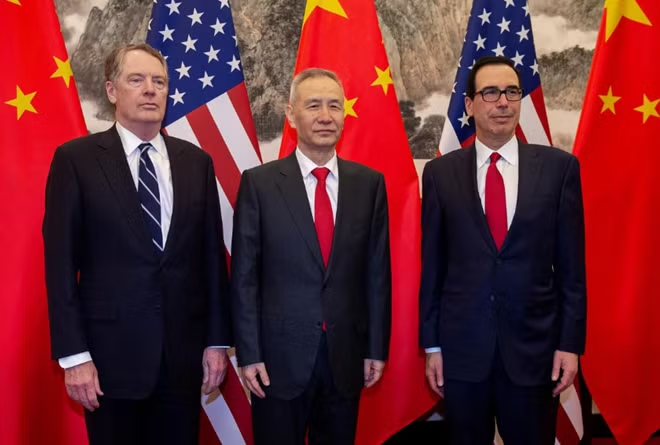 |
| China's Vice Premier Liu He (C) pose for a photo with U.S. Treasury Secretary Steven Mnuchin (R) and U.S. Trade Representative Robert Lighthizer (L) at Diaoyutai State Guesthouse in Beijing on March 29, 2019. Nicolas Asfouri/Pool via REUTERS |
“An effective enforcement echanism will define the deal,” Tim Stratford, chairman of the American Chamber of Commerce in China (AmCham), told Reuters.
“The deal doesn’t need to revamp China’s economy. But it does need to provide a new methodology for dealing with our differences,” said Stratford, a lawyer and former assistant U.S. Trade Representative who has worked in China for more than three decades.
“This is incredibly high stakes. We have a particular window of opportunity, and a lot in the future of U.S.-China relations rests on this,” he said.
Earlier this month, Mnuchin said the two sides had agreed on establishing new “enforcement offices” to police an agreement, although he did not give specifics. On Sunday, he told the New York Times talks are entering a critical point: “We’re getting into the final laps.”
AT A CROSSROADS
U.S. President Donald Trump said on April 4 that the two sides could have a deal worked out in about four weeks. On Thursday, he said he would soon host Chinese President Xi Jinping at the White House - a meeting seen as needed to cement an agreement.
Though a final date for a deal - if there is one - remains unclear, talks have brought China and the United States to a crossroads in their fraught relationship.
China has long defined commerce as the ballast in the relationship.
Now, some warn that the two are teetering toward a new type of “Cold War”, as Beijing asserts its growing military strength in Asia and Washington ramps up scrutiny of Chinese tech companies and cracks down on Chinese espionage and influence campaigns at U.S. institutions and universities.
Beijing sees U.S. actions as efforts to contain its development.
But years of only piecemeal economic reforms in China and continued industrial policies that U.S. companies complain have eroded their competitive edge have weakened key U.S. business sector support for China. AmCham said this month that U.S. businesses could no longer be counted on as a “positive anchor” in bilateral relations.
And U.S. officials, chagrined by what they say have been years of Chinese stalling tactics in annual economic dialogues, have been adamant that a trade deal must have teeth.
Lighthizer has suggested that some form of the tariffs Trump imposed last year on Chinese goods as leverage in the dispute should hang over a deal to ensure compliance.
Any such a mechanism would be fragile, trade experts said.
For one, it would mean continued uncertainty for already trade war-weary businesses and markets.
They also say China’s record of exploiting loopholes at the World Trade Organization suggests it will look aggressively for new areas where it can say the United States isn’t living up to its pledges. If Washington re-establishes tariffs weeks or months down the road, it could lead to retaliation and the collapse of the deal.
In such a case, the two sides would find themselves back at square one, this time without negotiations as a viable way to deescalate disputes.
Because of this, one American trade consultant said: “It takes great imagination and optimism to think we can come up with an effective enforcement mechanism beyond the short term.”
A DURABLE DEAL?
Another source with knowledge of the trade talks argued that if the United States triggered the mechanism, Beijing would be unlikely to “come back to the table with this president”, referring to Trump.
“As long as there is a mechanism of tariffs hanging over the deal, it won’t be durable,” the source said.
Trade advisers in China appear more confident that an agreement would not fall apart quickly because both sides need it politically, particularly Trump, who is seen in China as eager for a détente as the 2020 U.S. presidential election approaches.
Wang Dong, an expert on China-U.S. relations at Peking University, said it would be politically difficult for both sides to return to talks in the wake of a collapsed deal.
“I’m not saying China will end altogether future talks with the Trump administration. But it would take time to build momentum again, to say the least,” Wang said.