Ba Be National Park – natural potential, invaluable heritage

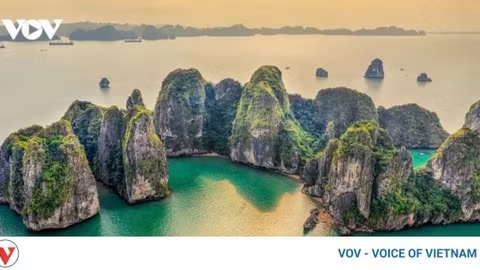
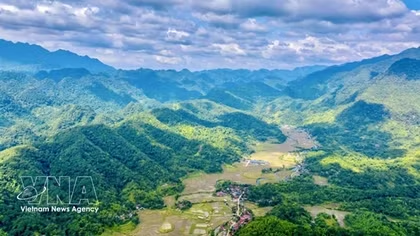
Lying at an altitude of more than 300 metres above sea level, the Ba Be National Park in the northeastern province of Bac Kan is considered a “green lung” in the vast Viet Bac forest and a complex of “river-lake-mountain”.

The Ba Be National Park in the northeastern province of Bac Kan (Photo: monre.gov)

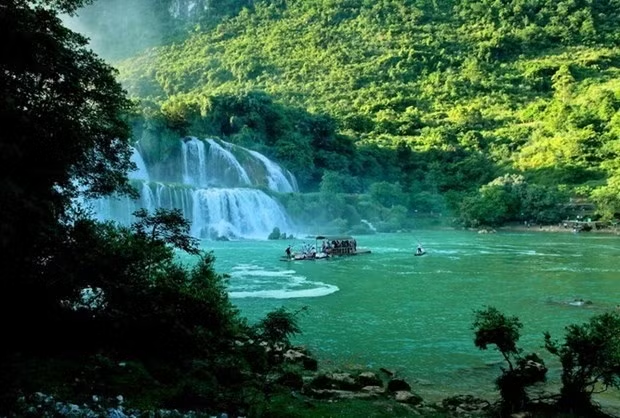
The Ba Be National Park in the northeastern province of Bac Kan (Photo: monre.gov)

The park was established on November 10, 1992, under the Prime Minister’s Decision No.83/1992/QD-TTg. It is located 40 kilometres to the Ra market, spanning seven communes of Ba Be district.

It belongs to the ecosystem on limestone mountains formed in the late Cambrian period (over 200 million years ago).Ba Be is one of the largest natural freshwater lakes in Vietnam, located in the heart of Ba Be National Park.

The lake has a surface area of about 500 hectares and a length of more than 8 kilometres. The widest area is nearly 2 kilometres and the deepest 35 metres.It is called Ba Be because its bed is divided into three lakes: Pe Lam, Pe Lu and Pe Leng.

In March 1995, the World Lake Conference held in the US classified Ba Be Lake as one of the world's 20 special freshwater lakes that need investment and protection. In 1996, the Ba Be National Park was recognised as a national historical and cultural relic site.

In 1997, the UNESCO Vietnam Committee proposed the United Nations Educational, Scientific and Cultural Organisation (UNESCO) recognise the park as a world natural heritage site. The total area of the park’s core area is 7,610 hectares, divided into four functional sub-areas: rocky mountain forest (3,226 hectares); habitat of rare animals, especially langurs; ecological restoration area (3,623 hectares); and specialised area ensuring activities of administrative management and scientific research (450 hectares). In addition, the park has 42,000 hectares of buffer zone.

The flora and fauna system in the Ba Be National Park is very rich and diverse in both numbers and types. According to recent scientific survey data, the Ba Be National Park is classified as type A in terms of biodiversity. There are 650 species of plants belonging to 138 families and 300 genera; 412 animal species including 27 orders, 85 families, 87 species of fish and 46 species of reptile amphibians, as well as 332 species of butterflies.

Many plant and animal species in the Ba Be National Park are particularly rare and valuable species recorded in the Vietnam Red Book. Particularly, there are 20 butterfly species in the park that have just been found for the first time in the Vietnamese butterfly fauna. Tonkin snub-nosed monkeys are classified as type A biodiversity by the International Union for Nature Conservation (IUCN).

The Ba Be National Park is not only rich in biodiversity but also well-known in Vietnam for unique natural scenes such as Na Phoong, Ao Tien, Puong and Tien caves, and Dau Dang waterfall.In addition, this place is also known as a historical site from the time of national building and defence. In the 16th century, a general of the Mac dynasty used Puong cave as a base of resistance against the North’s feudal invaders.

It could be said that the Ba Be National Park is an important natural region in the system of 25 national parks in Vietnam. In the near future, Bac Kan province will make proper investment and planning to help the Ba Be ASEAN Heritage Garden be recognised by UNESCO as a world natural heritage site. Local authorities will pay due attention to the resettlement of locals living in the core area of the park.

VNA

Other News

Vietnam secure berth at FIFA U17 World Cup 2026 for first time

Vietnam secure berth at FIFA U17 World Cup 2026 for first time

Vietnam national U17 football team secured a place at the FIFA U17 World Cup 2026 for the first time after defeating United Arab Emirates national U17 football team 3-2 on in the final Group C match of the AFC U17 Asian Cup 2026 in Saudi Arabia on early May 14 (Vietnam time).

Vietnam’s most beautiful railway station twins with French counterpart

Vietnam’s most beautiful railway station twins with French counterpart

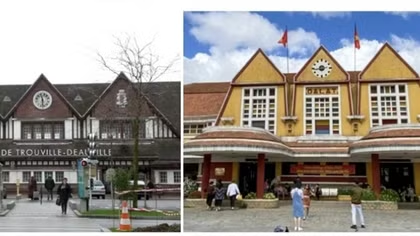
A twinning agreement between Da Lat Railway Station in Vietnam and Trouville-Deauville Railway Station in France was signed at the French Embassy in Vietnam on May 7, creating new opportunities for cooperation in station management and operations, as well as cultural and tourism promotion between the two sides.

Hanoi gains two more craft villages in World Crafts Cities network

Hanoi gains two more craft villages in World Crafts Cities network

The recognition of Chuyen My and Son Dong craft villages as members of the World Crafts Cities network represents international acknowledgement of the cultural value, artisanal techniques, creativity and sustainable vitality of Vietnam’s traditional craft villages, he said.

Thang Long - Hanoi Festival 2026 to return in September

Thang Long - Hanoi Festival 2026 to return in September

Co-hosted by the municipal People’s Committee, the Department of Culture and Sports, and domestic and foreign agencies, the whole spectacle is meant to honour the city’s millennia-old heritage while reafffirming its strategy of establishing culture as a development engine.

Spreading Vietnamese cultural identity in digital space

Spreading Vietnamese cultural identity in digital space

In the context of deep international integration, cultural identity serves as both a “shield” against assimilation and a defining marker of a nation’s image. Protecting and promoting uniquely Vietnamese cultural values has therefore become a pressing task, particularly in an increasingly complex digital environment.

ITE HCMC 2026 to promote Vietnam’s tourism on global map

ITE HCMC 2026 to promote Vietnam’s tourism on global map

With its large scale, the ITE HCMC 2026 aims to promote tourism cooperation between Vietnam and priority markets such as Northeast Asia, Western Europe, North America, Southeast Asia, and Oceania while also boosting visitor arrivals from the Indian market

Vietnamese puppetry seeks renewal amid preservation challenges

Vietnamese puppetry seeks renewal amid preservation challenges

Although widely regarded as a cultural “speciality” attracting tourists, Vietnamese puppetry is facing multiple challenges in preservation and development, requiring renewed efforts to both safeguard its identity and adapt to contemporary cultural currents.

Project on digital transformation in cultural sector approved

Project on digital transformation in cultural sector approved

By 2030, the project targets the establishment of shared digital platforms across 100% of cultural sectors. All digitised cultural heritage will be standardised under the national data framework and shared in accordance with regulations, while 80% of public digital heritage assets are expected to receive digital identifiers to clarify ownership and management, encouraging organisations and individuals to do the same and support market development.

Vietnam eyes becoming region’s leading tourism destination

Vietnam eyes becoming region’s leading tourism destination

Vietnam has in recent years undergone a notable transformation in its tourism development strategy, placing a strong emphasis on nature-based and eco-tourism. This shift is not merely aligned with global trends, but represents a necessary step towards safeguarding valuable natural resources, while appealing to a growing segment of environmentally conscious travellers.