Project on digital transformation in cultural sector approved

By 2030, the project targets the establishment of shared digital platforms across 100% of cultural sectors. All digitised cultural heritage will be standardised under the national data framework and shared in accordance with regulations, while 80% of public digital heritage assets are expected to receive digital identifiers to clarify ownership and management, encouraging organisations and individuals to do the same and support market development.

Deputy Prime Minister Nguyen Chi Dung has signed Decision No. 611/QD-TTg dated April 4 approving the project on digital transformation in the cultural sector to 2030, with a vision to 2045.

The project aims to comprehensively modernise Vietnam’s national digital cultural ecosystem to preserve and promote an advanced Vietnamese culture imbued with national identity, creativity and proactive international integration.

Project on digital transformation in cultural sector approved -0
Visitors enjoy the "Stone History Preserves Memories" exhibition, featuring a traditional format combined with digital technology solutions. Photo: VNA

It also seeks to position digital culture as a new resource for sustainable development, accelerate cultural industries, and expand the digitisation and effective sharing of cultural resources to better serve citizens, businesses and society.

Shared digital platforms across all cultural fields by 2030

By 2030, the project targets the establishment of shared digital platforms across 100% of cultural sectors. All digitised cultural heritage will be standardised under the national data framework and shared in accordance with regulations, while 80% of public digital heritage assets are expected to receive digital identifiers to clarify ownership and management, encouraging organisations and individuals to do the same and support market development.

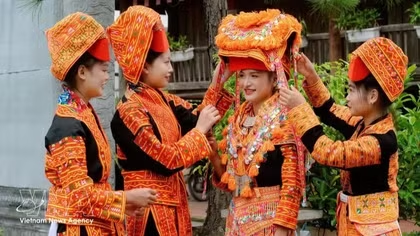
At least 80% of intangible cultural heritage in ethnic minority areas will be digitised and stored in specialised cultural databases.

All state management agencies in the cultural sector will connect and synchronise specialised databases, and all public cultural institutions will develop suitable digital transformation roadmaps.

National libraries, national museums of history and culture, and public museums nationwide will complete digital library and digital museum systems, develop smart operational models, and expand data integration and sharing within domestic and international networks.

At least 70% of museums, libraries, theatres, art troupes, sports federations, tourism sites, press agencies and digital content enterprises are expected to connect their data with the shared infrastructure of the Ministry of Culture, Sports and Tourism.

Expanding public access to digital cultural activities

The project aims to ensure that at least 75% of residents in remote, border and island areas, and 80% of communes in ethnic minority and mountainous regions, can access and participate in cultural activities in digital environments.

All leaders, civil servants, public employees, artists and students in cultural and arts training institutions will receive digital skills training and capacity-building.

By 2045, Vietnam aims to develop a comprehensive, intelligent and highly interactive digital cultural ecosystem that both preserves national identity and promotes Vietnamese culture globally. Digital culture is expected to become a driver of human development and national soft power, with cultural and creative industries contributing about 9% of GDP and digital cultural products accounting for over 80% of total cultural industry output.

The project outlines key tasks and solutions, including improving institutions and policies, mobilising financial resources, developing digital human resources, strengthening digital infrastructure and cybersecurity, and promoting international cooperation in cultural digital transformation.

Specific measures will also be implemented across eight fields: cultural heritage; performing arts and literature; fine arts, photography and exhibitions; cinema; libraries; journalism and communications; grassroots culture; and ethnic minority cultural development./.

VNA

Other News

Vietnam secure berth at FIFA U17 World Cup 2026 for first time

Vietnam secure berth at FIFA U17 World Cup 2026 for first time

Vietnam national U17 football team secured a place at the FIFA U17 World Cup 2026 for the first time after defeating United Arab Emirates national U17 football team 3-2 on in the final Group C match of the AFC U17 Asian Cup 2026 in Saudi Arabia on early May 14 (Vietnam time).

Vietnam’s most beautiful railway station twins with French counterpart

Vietnam’s most beautiful railway station twins with French counterpart

A twinning agreement between Da Lat Railway Station in Vietnam and Trouville-Deauville Railway Station in France was signed at the French Embassy in Vietnam on May 7, creating new opportunities for cooperation in station management and operations, as well as cultural and tourism promotion between the two sides.

Hanoi gains two more craft villages in World Crafts Cities network

Hanoi gains two more craft villages in World Crafts Cities network

The recognition of Chuyen My and Son Dong craft villages as members of the World Crafts Cities network represents international acknowledgement of the cultural value, artisanal techniques, creativity and sustainable vitality of Vietnam’s traditional craft villages, he said.

Thang Long - Hanoi Festival 2026 to return in September

Thang Long - Hanoi Festival 2026 to return in September

Co-hosted by the municipal People’s Committee, the Department of Culture and Sports, and domestic and foreign agencies, the whole spectacle is meant to honour the city’s millennia-old heritage while reafffirming its strategy of establishing culture as a development engine.

Spreading Vietnamese cultural identity in digital space

Spreading Vietnamese cultural identity in digital space

In the context of deep international integration, cultural identity serves as both a “shield” against assimilation and a defining marker of a nation’s image. Protecting and promoting uniquely Vietnamese cultural values has therefore become a pressing task, particularly in an increasingly complex digital environment.

ITE HCMC 2026 to promote Vietnam’s tourism on global map

ITE HCMC 2026 to promote Vietnam’s tourism on global map

With its large scale, the ITE HCMC 2026 aims to promote tourism cooperation between Vietnam and priority markets such as Northeast Asia, Western Europe, North America, Southeast Asia, and Oceania while also boosting visitor arrivals from the Indian market

Vietnamese puppetry seeks renewal amid preservation challenges

Vietnamese puppetry seeks renewal amid preservation challenges

Although widely regarded as a cultural “speciality” attracting tourists, Vietnamese puppetry is facing multiple challenges in preservation and development, requiring renewed efforts to both safeguard its identity and adapt to contemporary cultural currents.

Vietnam eyes becoming region’s leading tourism destination

Vietnam eyes becoming region’s leading tourism destination

Vietnam has in recent years undergone a notable transformation in its tourism development strategy, placing a strong emphasis on nature-based and eco-tourism. This shift is not merely aligned with global trends, but represents a necessary step towards safeguarding valuable natural resources, while appealing to a growing segment of environmentally conscious travellers.

Vietnam serves 6.76 million foreign arrivals in Q1

Vietnam serves 6.76 million foreign arrivals in Q1

China and the Republic of Korea (RoK) continued to lead as Vietnam’s largest source markets in the quarter, with 1.4 million and 1.3 million visitors respectively, accounting for around 40% of total arrivals.