Tay Ninh turns “Don ca tai tu” heritage into distinctive tourism product

As Tay Ninh identifies tourism as a crucial economic pillar, integrating Don ca tai tu into tourism offerings is seen as a strategic move.
Tay Ninh turns “Don ca tai tu” heritage into distinctive tourism product -0
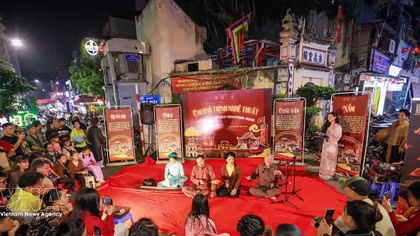
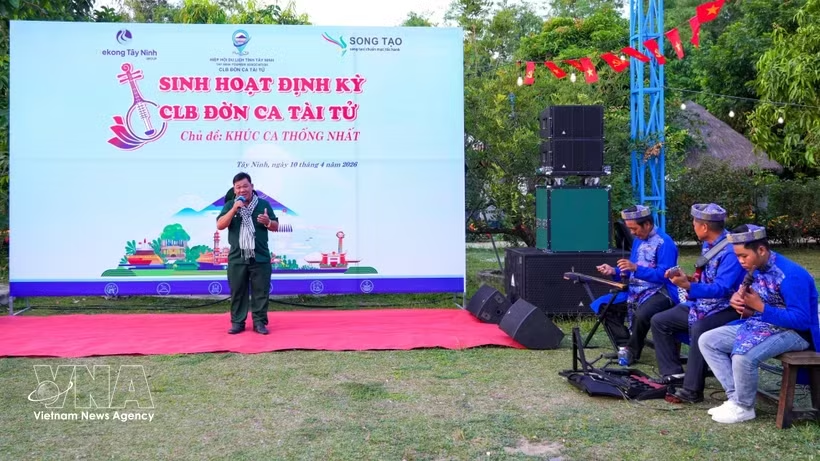
Members of the Don ca tai tu Club under the Tay Ninh Tourism Association perform at a regular event of the club in Binh Minh ward, Tay Ninh province. (Photo: VNA)

Inscribed by UNESCO on the Representative List of the Intangible Cultural Heritage of Humanity, “Don ca tai tu” in southern Vietnam is not only a traditional art form but also a reflection of the region's cultural identity and spiritual life.

In Tay Ninh, efforts to preserve and promote this heritage are being reframed within a tourism-driven strategy, gradually positioning it as a hallmark of the southeastern region.

Linking heritage with tourism

Director of the provincial Department of Culture, Sports and Tourism Tran Anh Minh said Don Ca Tai Tu embodies generations of cultural transmission, blending the sounds of traditional instruments and vocal performance into a distinctive “symphony of rural life”.

Historically, Tay Ninh has played a role in the formation and development of the art since the late 19th century. Today, local clubs serve as key hubs for preservation, serving as “nuclei” in upholding this musical art.

Nguyen Thi Hoang Oanh, head of the Don ca tai tu Club under the Tay Ninh Tourism Association, shared that although established only in May 2025 with 16 members, the club has maintained monthly activities, providing a platform for exchange and sustaining passion among enthusiasts.

However, several challenges remain. Funding is limited, the pool of successors is thin, and formal training programmes are lacking.

Scriptwriter Do Thanh Phuong, a member of the Tay Ninh Literature and Arts Association with over 40 years of experience in this music, stressed the need for systematic investment, including the establishment of training centres, regular competitions, and platforms to discover and nurture young talent.

In reality, attracting younger generations is a major hurdle. Amid the rapid rise of modern music, Don ca tai tu risks being overshadowed.

Le Cong Thuan, a club member, noted that the art form requires a high level of technical mastery – from rhythm and breathing techniques to vocal training, making it less accessible to younger audiences without proper guidance and support.

Expanding value through tourism

As Tay Ninh identifies tourism as a crucial economic pillar, integrating Don ca tai tu into tourism offerings is seen as a strategic move.

Tay Ninh turns “Don ca tai tu” heritage into distinctive tourism product -0
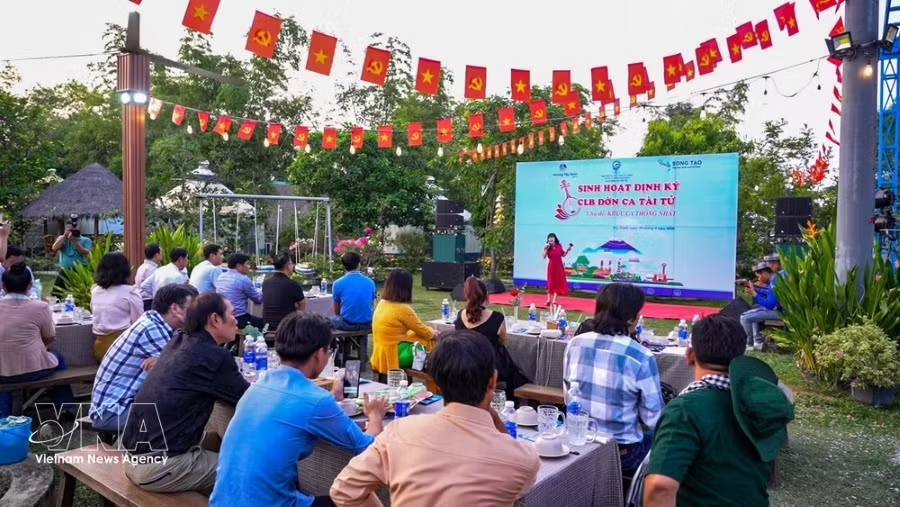
Tourists from Ho Chi Minh City and localities in the Mekong Delta enjoy Don ca tai tu in Binh Minh ward, Tay Ninh province. (Photo: VNA)

For visitors, experiencing the art in its cultural setting enriches travel experiences beyond sightseeing. This aligns with the growing demand for experiential tourism, where visitors seek deeper cultural engagement.

However, for Don ca tai tu to become a signature tourism product, activities need to be more professionally organised and better linked with key destinations.

Duong Van Thua, Vice Chairman of the Tay Ninh Tourism Association, stated that cultural tourism will be central to the province’s development strategy, with Don ca tai tu at its core. Efforts are underway to incorporate the art into gala events and experiential tours.

Businesses are also stepping up engagement. They are working with local associations and clubs to promote the art through tourism products and media platforms, helping to both preserve the heritage and enhance visitor experiences.

Vice Chairman of the People's Committee of Binh Minh ward Nguyen Thanh Nghi highlighted the importance of cultural preservation to strengthening community cohesion and identity, adding Don ca tai tu plays a special role in connecting communities, creating spaces for interaction, and maintaining the local cultural beauty.

Aside from assets such as the Ba Den Mountain national tourist area, Tay Ninh aims to elevate this folk music genre into a distinctive cultural tourism offering.

Thanks to coordinated efforts by authorities, businesses, and communities, Tay Ninh is laying the groundwork to unlock the full potential of Don ca tai tu. Properly invested and promoted, the art is expected to not only endure within community life but also emerge as a defining tourism product, contributing to sustainable socio-economic development and reinforcing the province’s cultural identity.

VNA

Other News

Vietnam secure berth at FIFA U17 World Cup 2026 for first time

Vietnam secure berth at FIFA U17 World Cup 2026 for first time

Vietnam national U17 football team secured a place at the FIFA U17 World Cup 2026 for the first time after defeating United Arab Emirates national U17 football team 3-2 on in the final Group C match of the AFC U17 Asian Cup 2026 in Saudi Arabia on early May 14 (Vietnam time).

Vietnam’s most beautiful railway station twins with French counterpart

Vietnam’s most beautiful railway station twins with French counterpart

A twinning agreement between Da Lat Railway Station in Vietnam and Trouville-Deauville Railway Station in France was signed at the French Embassy in Vietnam on May 7, creating new opportunities for cooperation in station management and operations, as well as cultural and tourism promotion between the two sides.

Hanoi gains two more craft villages in World Crafts Cities network

Hanoi gains two more craft villages in World Crafts Cities network

The recognition of Chuyen My and Son Dong craft villages as members of the World Crafts Cities network represents international acknowledgement of the cultural value, artisanal techniques, creativity and sustainable vitality of Vietnam’s traditional craft villages, he said.

Thang Long - Hanoi Festival 2026 to return in September

Thang Long - Hanoi Festival 2026 to return in September

Co-hosted by the municipal People’s Committee, the Department of Culture and Sports, and domestic and foreign agencies, the whole spectacle is meant to honour the city’s millennia-old heritage while reafffirming its strategy of establishing culture as a development engine.

Spreading Vietnamese cultural identity in digital space

Spreading Vietnamese cultural identity in digital space

In the context of deep international integration, cultural identity serves as both a “shield” against assimilation and a defining marker of a nation’s image. Protecting and promoting uniquely Vietnamese cultural values has therefore become a pressing task, particularly in an increasingly complex digital environment.

ITE HCMC 2026 to promote Vietnam’s tourism on global map

ITE HCMC 2026 to promote Vietnam’s tourism on global map

With its large scale, the ITE HCMC 2026 aims to promote tourism cooperation between Vietnam and priority markets such as Northeast Asia, Western Europe, North America, Southeast Asia, and Oceania while also boosting visitor arrivals from the Indian market

Vietnamese puppetry seeks renewal amid preservation challenges

Vietnamese puppetry seeks renewal amid preservation challenges

Although widely regarded as a cultural “speciality” attracting tourists, Vietnamese puppetry is facing multiple challenges in preservation and development, requiring renewed efforts to both safeguard its identity and adapt to contemporary cultural currents.

Project on digital transformation in cultural sector approved

Project on digital transformation in cultural sector approved

By 2030, the project targets the establishment of shared digital platforms across 100% of cultural sectors. All digitised cultural heritage will be standardised under the national data framework and shared in accordance with regulations, while 80% of public digital heritage assets are expected to receive digital identifiers to clarify ownership and management, encouraging organisations and individuals to do the same and support market development.

Vietnam eyes becoming region’s leading tourism destination

Vietnam eyes becoming region’s leading tourism destination

Vietnam has in recent years undergone a notable transformation in its tourism development strategy, placing a strong emphasis on nature-based and eco-tourism. This shift is not merely aligned with global trends, but represents a necessary step towards safeguarding valuable natural resources, while appealing to a growing segment of environmentally conscious travellers.

Vietnam serves 6.76 million foreign arrivals in Q1

Vietnam serves 6.76 million foreign arrivals in Q1

China and the Republic of Korea (RoK) continued to lead as Vietnam’s largest source markets in the quarter, with 1.4 million and 1.3 million visitors respectively, accounting for around 40% of total arrivals.