Vietnam eyes becoming region’s leading tourism destination

Vietnam has in recent years undergone a notable transformation in its tourism development strategy, placing a strong emphasis on nature-based and eco-tourism. This shift is not merely aligned with global trends, but represents a necessary step towards safeguarding valuable natural resources, while appealing to a growing segment of environmentally conscious travellers.
With its rich natural assets and clearly defined policy direction, Vietnam is steadily asserting itself as one of the region’s foremost eco-tourism destinations, striking a balance between economic growth and environmental preservation.

According to the respected travel publication Travel and Tour World (TTW), Vietnam has in recent years undergone a notable transformation in its tourism development strategy, placing a strong emphasis on nature-based and eco-tourism. This shift is not merely aligned with global trends, but represents a necessary step towards safeguarding valuable natural resources, while appealing to a growing segment of environmentally conscious travellers.

Vietnam eyes becoming region’s leading tourism destination -0
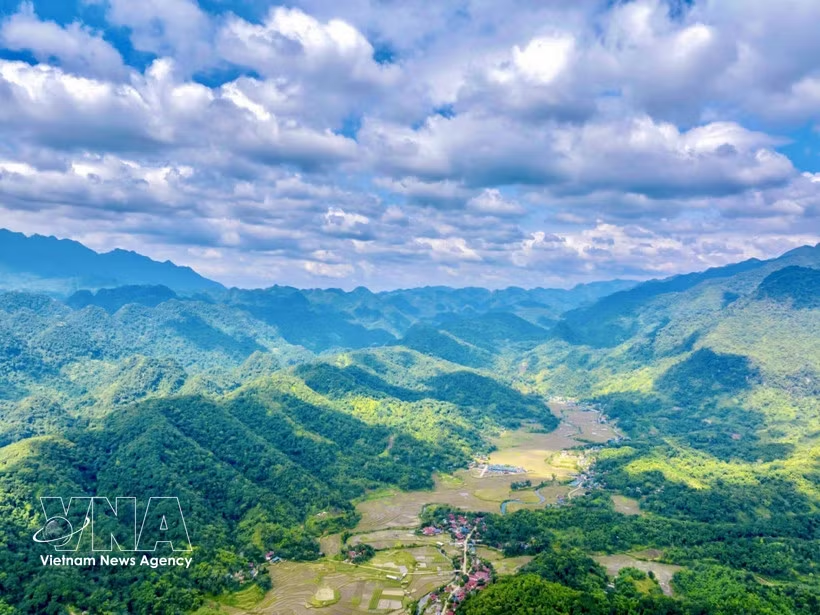
At an elevation of 1,700 metres above sea level, the summit of Pu Luong is increasingly emerging as an ideal destination for trekking - a form of adventure tourism that combines hiking with nature exploration and physical as well as mental endurance. Photo: VNA

Policy as a “green lever”

Recognising both its potential and the challenges ahead, the Vietnamese Government has moved early to shape a sustainable tourism development strategy. The national tourism master plan for 2021–2030, with a vision to 2050, prioritises increasing the share of eco-tourism in tandem with the conservation of natural resources and biodiversity. This direction not only supports economic growth but also calls for minimising environmental impact. Local authorities are encouraged to develop “green tourism” products, while raising awareness among communities and visitors about environmental protection. The integration of development and conservation has become a central guiding principle, helping the industry avoid the pitfalls of overexploitation seen in other parts of the world.

Vietnam is widely regarded as one of the most biodiverse countries globally, ranking among the world’s top 20 in terms of biological resources. A network of more than 30 national parks and dozens of nature reserves stretching from north to south provides a diverse array of destinations.

Sites such as the Phong Nha–Ke Bang, Cuc Phuong and Ba Be National Parks are emerging as key attractions for nature enthusiasts. Visitors are offered not only sightseeing opportunities but also immersive experiences such as trekking, birdwatching, camping and ecological exploration. These activities help foster greater environmental awareness, turning each trip into a journey of learning.

Community-based tourism at heart of eco-tourism

One of the defining factors behind Vietnam’s initial success in eco-tourism lies in the active involvement of local communities. Community-based models not only provide livelihoods but also encourage residents to protect natural resources.

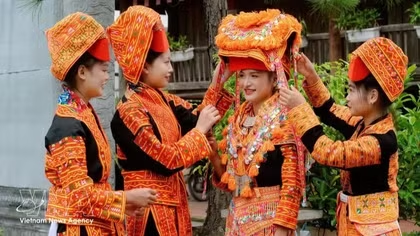
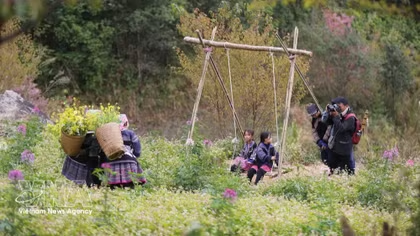
In the famous resort destination of Sa Pa in Vietnam's northern mountainous province of Lao Cai, ethnic minority villages have successfully developed homestays and cultural tourism experiences. Visitors can stay with local families, take part in daily activities and gain deeper insight into indigenous ways of life.

Vietnam eyes becoming region’s leading tourism destination -0
The spectacular and mysterious scenery of En Cave. Photo: VNA

Meanwhile, in the Mekong Delta, eco-tourism linked to riverine landscapes, mangrove forests and agriculture is also gaining momentum. Local residents often serve as guides, directly participating in the tourism value chain, thereby improving incomes and strengthening conservation awareness.

Beyond product development, Vietnamese tourism businesses are also embracing more sustainable practices. Many hotels and resorts are adopting renewable energy, reducing plastic waste and prioritising locally sourced products.

Eco-tourism as a “green driver” of growth

With its abundant natural resources, sound policy direction and strong community engagement, Vietnam is well positioned to become a leading eco-tourism destination in Southeast Asia. Nevertheless, the path ahead will require sustained commitment to environmental protection, careful management of development and continued improvements in service quality. Only by maintaining a balance between utilisation and conservation can eco-tourism truly serve as a “green driver” of growth.

At a time when global travellers are increasingly prioritising sustainable experiences, Vietnam holds advantages to leap. If these opportunities are effectively harnessed, the tourism sector will not only contribute to economic development but also play a pioneering role in protecting nature and preserving heritage for future generations.

VNA

Other News

Vietnam secure berth at FIFA U17 World Cup 2026 for first time

Vietnam secure berth at FIFA U17 World Cup 2026 for first time

Vietnam national U17 football team secured a place at the FIFA U17 World Cup 2026 for the first time after defeating United Arab Emirates national U17 football team 3-2 on in the final Group C match of the AFC U17 Asian Cup 2026 in Saudi Arabia on early May 14 (Vietnam time).

Vietnam’s most beautiful railway station twins with French counterpart

Vietnam’s most beautiful railway station twins with French counterpart

A twinning agreement between Da Lat Railway Station in Vietnam and Trouville-Deauville Railway Station in France was signed at the French Embassy in Vietnam on May 7, creating new opportunities for cooperation in station management and operations, as well as cultural and tourism promotion between the two sides.

Hanoi gains two more craft villages in World Crafts Cities network

Hanoi gains two more craft villages in World Crafts Cities network

The recognition of Chuyen My and Son Dong craft villages as members of the World Crafts Cities network represents international acknowledgement of the cultural value, artisanal techniques, creativity and sustainable vitality of Vietnam’s traditional craft villages, he said.

Thang Long - Hanoi Festival 2026 to return in September

Thang Long - Hanoi Festival 2026 to return in September

Co-hosted by the municipal People’s Committee, the Department of Culture and Sports, and domestic and foreign agencies, the whole spectacle is meant to honour the city’s millennia-old heritage while reafffirming its strategy of establishing culture as a development engine.

Spreading Vietnamese cultural identity in digital space

Spreading Vietnamese cultural identity in digital space

In the context of deep international integration, cultural identity serves as both a “shield” against assimilation and a defining marker of a nation’s image. Protecting and promoting uniquely Vietnamese cultural values has therefore become a pressing task, particularly in an increasingly complex digital environment.

ITE HCMC 2026 to promote Vietnam’s tourism on global map

ITE HCMC 2026 to promote Vietnam’s tourism on global map

With its large scale, the ITE HCMC 2026 aims to promote tourism cooperation between Vietnam and priority markets such as Northeast Asia, Western Europe, North America, Southeast Asia, and Oceania while also boosting visitor arrivals from the Indian market

Vietnamese puppetry seeks renewal amid preservation challenges

Vietnamese puppetry seeks renewal amid preservation challenges

Although widely regarded as a cultural “speciality” attracting tourists, Vietnamese puppetry is facing multiple challenges in preservation and development, requiring renewed efforts to both safeguard its identity and adapt to contemporary cultural currents.

Project on digital transformation in cultural sector approved

Project on digital transformation in cultural sector approved

By 2030, the project targets the establishment of shared digital platforms across 100% of cultural sectors. All digitised cultural heritage will be standardised under the national data framework and shared in accordance with regulations, while 80% of public digital heritage assets are expected to receive digital identifiers to clarify ownership and management, encouraging organisations and individuals to do the same and support market development.

Vietnam serves 6.76 million foreign arrivals in Q1

Vietnam serves 6.76 million foreign arrivals in Q1

China and the Republic of Korea (RoK) continued to lead as Vietnam’s largest source markets in the quarter, with 1.4 million and 1.3 million visitors respectively, accounting for around 40% of total arrivals.