Commenting on a long-running dispute over China’s Huawei, President Donald Trump said U.S. firms would be able to sell components to the world’s biggest telecoms network gear maker where there was no national security problem.
The truce offered relief from a nearly year-long trade standoff in which the countries have slapped tariffs on billions of dollars of each other’s imports, disrupting global supply lines, roiling markets and dragging on global economic growth.
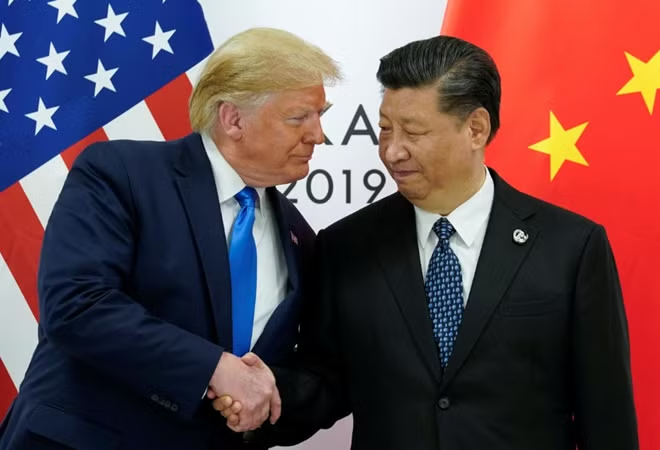
“We’re right back on track and we’ll see what happens,” Trump told reporters after an 80-minute meeting with Chinese President Xi Jinping on the sidelines of a summit of leaders of the Group of 20 (G20) major economies in Osaka, western Japan.
Trump said while he would not lift existing import tariffs, he would refrain from slapping new levies on an additional $300 billion worth of Chinese goods - which would have effectively extended tariffs to everything China exports to the America.
 |
“We’re holding back on tariffs and they’re going to buy farm products,” he said at a news conference, without giving any details of China’s future agricultural product purchases.
“If we make a deal, it will be a very historic event.”
He gave no timeline for what he called a complex deal but said he was not in a rush. “I want to get it right.”
HUAWEI HOPES
On Huawei, Trump said the U.S. commerce department would meet in the next few days on whether to take it off a list of firms banned from buying components and technology from U.S. companies without government approval.
China welcomed the step.
“If the U.S. does what it says, then of course, we welcome it,” said Wang Xiaolong, the Chinese foreign ministry’s envoy for G20 affairs.
U.S. microchip makers also applauded the move.
“We are encouraged the talks are restarting and additional tariffs are on hold and we look forward to getting more detail on the president’s remarks on Huawei,” John Neuffer, president of the U.S. Semiconductor Association, said in a statement.
Huawei has come under mounting scrutiny for over a year, led by U.S. allegations that “back doors” in its routers, switches and other gear could allow China to spy on U.S. communications.
While the company has denied its products pose a security threat, the United States has pressed its allies to shun Huawei in their fifth generation, or 5G, networks and has also suggested it could be a factor in a trade deal.
The problems at Huawei have filtered across to the broader chip industry, with Broadcom Inc warning of a broad slowdown in demand and cutting its revenue forecast.
RELIEF AND SCEPTICISM
In a lengthy statement on the two-way talks, China’s foreign ministry quoted Xi as telling Trump he hoped the United States could treat Chinese companies fairly.
On the issues of sovereignty and respect, China must safeguard its core interests, Xi was cited as saying.
“China is sincere about continuing negotiations with the United States ... but negotiations should be equal and show mutual respect,” the foreign ministry quoted Xi as saying.
Trump had threatened to extend existing tariffs to almost all Chinese imports into the United States if the meeting brought no progress on wide-ranging U.S. demands for reforms.
Financial markets are likely to breathe a sigh of relief on news of the resumption in U.S.-China trade talks.
“Returning to negotiations is good news for the business community and breathes some much needed certainty into a slowly deteriorating relationship,” said Jacob Parker, a vice-president of China operations at the U.S.-China Business Council.
“Now comes the hard work of finding consensus on the most difficult issues in the relationship, but with a commitment from the top we’re hopeful this will put the two sides on a sustained path to resolution,” he said.
Some, however, warned the pause might not last.
“Even if a truce happens this weekend, a subsequent breakdown of talks followed by further escalation still seems likely,” Capital Economics said in a commentary on Friday.
The United States says China has been stealing American intellectual property for years, forces U.S. firms to share trade secrets as a condition for doing business in China, and subsidizes state-owned firms to dominate industries.
China has said the United States is making unreasonable demands and must also make concessions.
Talks collapsed in May after Washington accused Beijing of reneging on reform pledges. Trump raised tariffs to 25% from 10% on $200 billion of Chinese goods, and China retaliated with levies on U.S. imports.
The U.S.-China feud had cast a pall over the two-day G20 gathering, with leaders pointing to the threat to global growth.
In their communique, the leaders warned of growing risks to the world economy but stopped short of denouncing protectionism, calling instead for a free, fair trade environment after talks some members described as difficult.