The new boat tour at the tourism hub of Trang An complex in the northern province of Ninh Binh is adding more prestige to the UNESCO-recognised World Heritage Site while at the same time strengthening the province’s tourism brand.
The new waterway tour, the third of its kind, offers tourists a scenic boat trip of three hours through the Trinh and Quy Minh temples and caves of May, Dia Linh, Van and Dai. During the tour, visitors also have chance to stop at the Vu Lam Palace and Kong film shooting site then return to the departure point.
With the new waterway route tour, which opened in February with a ticket price of VND200,000 (US$9) per person, Trang An now has three waterway tours and one road route to serve visitors.

A royal court music performance in the new boat tour in Trang An Complex. (Source: VNA)
The tours offer the chance to visit up to 11 caves, temples and pagodas including the Trinh Temple and picturesque mountainscapes. The river water is clear enough to view aquatic plants living on the river bed. The nature is pristine with forested mountains and green valleys of reeds and bushes.
The new route is not a difficult trek but includes walks to the Tran Temple, the Vu Lam worshipping palace of the Tran dynasty and to Kong Village, a recently built model aboriginal community with many simple bamboo huts and friendly local villagers – just like the village you see in the latest Kong film: Kong: Skull Island.
Nguyen Van Duong, a freelance tour guide specialising in Ninh Binh boat tours, told Vietnam News that like many other tours in the province, including those through Tam Coc and Bich Dong Complex, the new boat tour in Trang An was obviously attracting visitors to the area.
Duong said along with stops at spiritual and historical vestiges such as the Trinh and Quy Minh temples, the new stop at the Kong film studio on the tour was attracting foreign and international visitors seeking to satisfy their curiosity and admire the natural beauty of the complex.
The Trinh temple has a history of more than 1,000 years while the Quy Minh temple has been recently restored.
Those interested in history will be attracted to the Vu Lam military base, built by the first emperors of the Tran dynasty (1225-1400) after they defeated Mongol invaders.
Caves, especially May Cave with its different stalactites, and Dia Linh Cave, the longest in Trang An at 2km and featuring a pristine beauty, provide adventure trips for those interested in exploration.
Director of the provincial Tourism Department Bui Thanh Dong told Dan Tri online newspaper that this year the province expected to welcome 7.2 million tourists and gross a turnover of VND2,700 billion (US$117 million).
The new waterway tour is the first step in the province’s plan to increase the number of tourists, particularly those who wanted to follow adventurous tours, Dong said.
Nguyen Thanh Trang, a business representative from the agency C-Vietnam Travel, said positive signs had been recorded in tourism development since Ninh Bình has attracted more interest thanks to local historical and cultural vestiges as well as well preserved natural beauty and eco-systems.
Located about 90km south of Hanoi, Ninh Binh is known as “Ha Long Bay on Land”, given its limestone mountains rising out of paddy fields.
The most famous local attraction is the Tràng An Landscape Complex, which has been expanded over recent years and gained popularity for its green fields, mountains, caves and forests.
The province has been listed as one of the 50 best spots to visit in 2018 by US travel site Insider.
Together with other famous sites in the province such as Tam Coc Grottos and Van Long Lagoon, the Trang An Landscape Complex was also used as a location for the movie Kong: Skull Island, one of the biggest Hollywood blockbusters of 2017.
The locations opened to tourists last April.
Ninh Binh welcomed over 7 million visitors last year, up nearly 10 percent against 2016, of which international visitors were nearly 860,000.
The Trang An tourism complex has a total of 40 tourism spots of historical, cultural, art and natural vestiges including 20 recognised as national heritages.
In 2014, it was officially recognised as a mixed cultural and natural heritage by UNESCO thanks to its outstandingly natural & cultural values.
In UNESCO’s words, "Trang An is a resplendent complex of limestone karst peaks which are permeated with valleys, including submerged ones, and surrounded by steep, almost vertical cliffs", nestling on the southern shore of the Red River Delta.
Archaeological traces of human activity dating back thousands of years have been found within the complex.
The Trang An Complex boasts several nationally recognised sites like the Trang An ecotourism site and Hoa Lu, Vietnam's capital in the 10th and 11th centuries. The area also has many temples, pagodas, paddy fields, villages and other sacred sites. It is home to about 500 flora species, 73 species of birds and 41 species of other animals and has a diverse ecosystem.
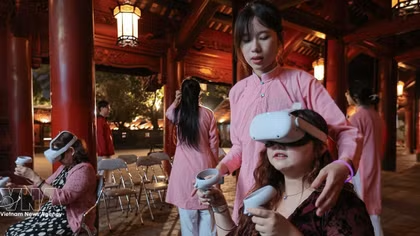
When innovation deepens understanding of traditional values rather than replacing them, heritage becomes not only something to preserve but also a resource for sustainable tourism, economic development and reinforcement of Hanoi’s position as a UNESCO Creative City.

Vietnamese swimmer Do Thanh Hai clinched gold with a time of 1 minute 33.91 seconds, ahead of compatriot Le Tien Dat, who secured silver in 1 minute 36.63 seconds. Iran’s Rashidabadi Ali rounded out the podium, taking bronze in 1 minute 47.78 seconds.
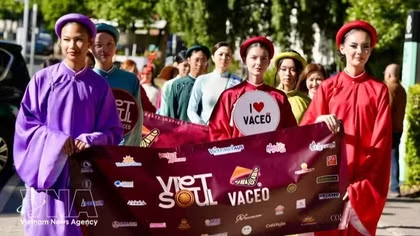
Colourful traditional Vietnamese Ao dai (traditional long dresses) brought a festive touch to the streets of Bankstown, Sydney, on October 17, as more than 20 Vietnamese people from different generations took part in an Ao dai street parade held as part of the Viet Soul 3 Festival.
Hanoi University of Pharmacy holds special significance in bilateral relations as it is closely associated with Alexandre Yersin, a French scientist of Swiss origin born in 1863 in the canton of Vaud, the homeland of President Parmelin. Yersin was the first principal of the Indochina Medical College, the predecessor of today’s Hanoi University of Pharmacy and Hanoi Medical University. He also made important contributions to the development of medicine in Vietnam.
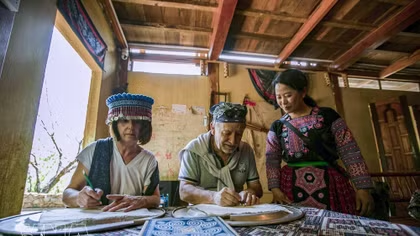
Brightly coloured brocade fabrics are no longer just daily attire, they have become a bridge between cultural preservation and economic empowerment, reaching beyond remote villages to international markets.
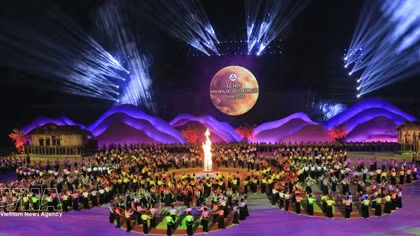
Chairman of the Lao Cai provincial People’s Committee Nguyen Tuan Anh said the province regards culture as the spiritual foundation, an endogenous resource and a driving force for sustainable development, with people at the centre of cultural creation, preservation and enjoyment.

Viet Nam Days in France 2026 aim to showcase Viet Nam's distinctive culture, country and people to French and international audiences as well as the Vietnamese community in France, promoting an image of an identity-rich, dynamic, creative and internationally integrated Viet Nam.
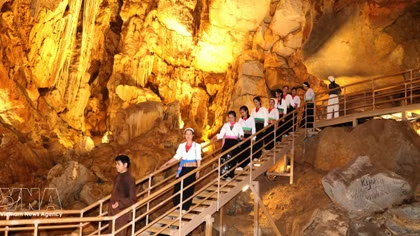
Visitors must walk about one kilometre from the Thung Ui forest entrance, climbing stone steps to an elevation of over 100 metres. The cave extends approximately 60–70 metres and features stalactites and stalagmites formed over millions of years.
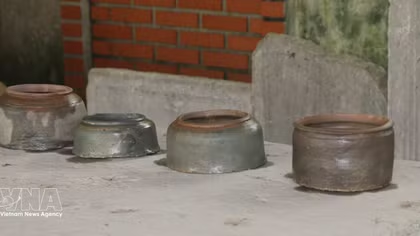
Preliminary findings showed that the jars had been deliberately arranged in two East–West rows, stacked in three staggered layers across an area measuring 2.2 metres long and 0.45–0.5 metres wide.
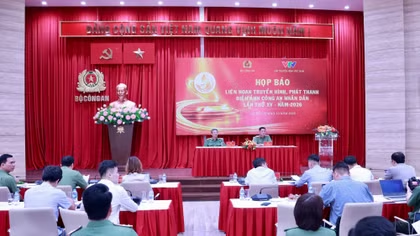
PSNews - “Professionalism, innovation, creativity, effectiveness, practicality and the promotion of digital transformation in line with modern media trends” will be the guiding principles of the 15th Public Security Television, Radio and Film Festival in 2026.
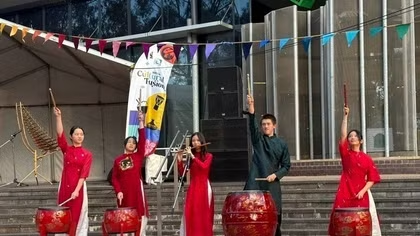
Vietnamese dance and traditional music classes organised by the Viet-Aus Culture Exchange Organisation (VACEO) have been held every Saturday afternoon in Bankstown, Sydney.
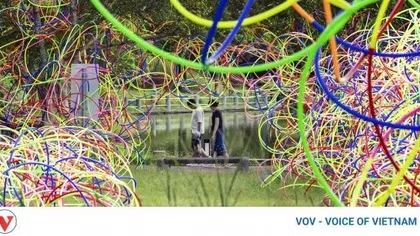
The Japan Foundation Center for Cultural Exchange in Vietnam is presenting the solo exhibition "Spinning Ghost Colors" by artist Kito Kengo from October 9 to December 6, at 27 Quang Trung Street in Hanoi's Cua Nam Ward.
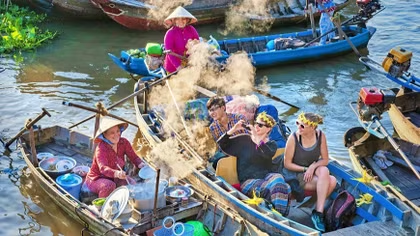
Vietnam has placed fourth on Lonely Planet’s list of the top 15 destinations shaping fall travel trends in 2026, recognized as an ideal choice for adventure travel amid favorable weather.
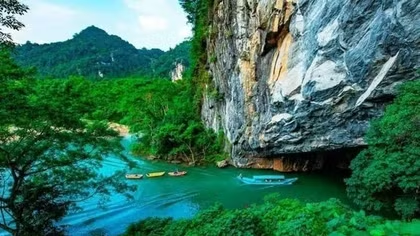
The opening ceremony and an art programme under the same theme will take place on November 24 at Phong Nha-Ke Bang National Park in Phong Nha commune, highlighting the UNESCO-listed natural heritage site and promoting cave exploration tours.
Under the 2026 cultural and tourism cooperation agenda, the two sides are sharing information on policies, markets and tourism products, as well as issues arising in cross-border activities.
Vietnam’s inclusion in the top 10 favourite countries in the 2026 Readers’ Choice Awards adds another important milestone to the country’s international tourism brand. The result not only underscores the destination’s appeal but also reflects growing international appreciation for Vietnam’s natural beauty, cultural heritage, cuisine and people.
The Hanoi Beverage Tourism Map will feature notable cafés, beverage and cocktail venues with QR codes providing destination information.
There are more than 30,000 women and children nationwide with serious illnesses, from poor or near-poor households, in need of care and support.

Vietnam’s gold medals came from karate and sepak takraw, reaffirming its strengths in sports with established traditions and focused investment. Meanwhile, bronze medals in canoeing and teqball showed potential in events where Vietnamese athletes are gaining international experience.

September alone saw 1.77 million foreign visitors arrive in Vietnam, up 16.1% from the same month last year.