Bowing to pressure, Hong Kong leader suspends extradition bill

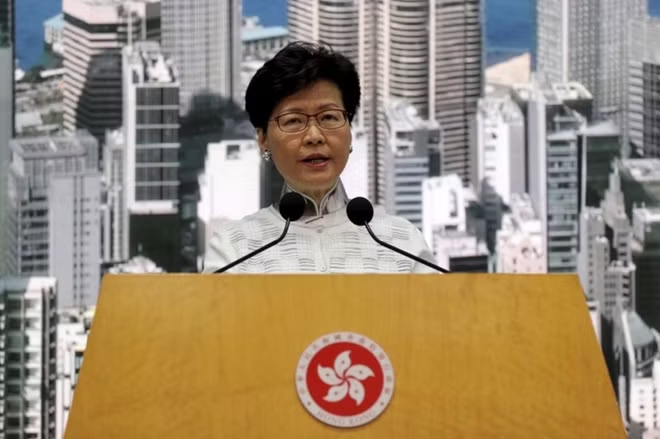
Hong Kong leader Carrie Lam on Saturday indefinitely delayed a proposed law that would have allowed extraditions to mainland China, in a dramatic retreat after anger over the bill triggered the city’s biggest and most violent street protests in decades.

The extradition bill, which would have covered Hong Kong’s seven million residents as well as foreign and Chinese nationals there, was seen by many as a threat to the rule of law in the former British colony.

Around a million people marched through Hong Kong last Sunday to oppose the bill, according to organizers of the protest, the largest in the city since crowds came out against the bloody suppression of pro-democracy demonstrations centered around Beijing’s Tiananmen Square on June 4, 1989.
Demonstrations continued through the week and were met with tear gas, bean bag rounds and rubber bullets from police, plunging the Asian finance hub into turmoil and piling heavy pressure on Lam.

“After repeated internal deliberations over the last two days, I now announce that the government has decided to suspend the legislative amendment exercise, restart our communication with all sectors of society, do more explanation work and listen to different views of society,” Lam told a news conference.

In her first public appearance or comments since Wednesday, she said there was no deadline, effectively suspending the process indefinitely.

Political opponents called for the bill to be scrapped completely. Protest organizers said they would go ahead with another rally on Sunday to demand Lam step down.

The about-face was one of the most significant political turnarounds under public pressure by the Hong Kong government since Britain returned the territory to China in 1997, and it threw into question Lam’s ability to continue to lead the city.

It also potentially alleviated an unwanted headache for the leadership in Beijing, which is grappling with a slowing economy and an all-consuming trade war with the United States.

Asked repeatedly if she would step down, Lam avoided directly answering and appealed to the public to “give us another chance”. She said she had been a civil servant for decades and still had work she wanted to do.

She added that she felt “deep sorrow and regret that the deficiencies in our work and various other factors have stirred up substantial controversies and disputes in society”.
Reuters

Other News

Vietnamese community in Venezuela backs rescue team on humanitarian mission

Vietnamese community in Venezuela backs rescue team on humanitarian mission

All members of the Vietnamese rescue team in Venezuela have maintained strict discipline, a strong sense of responsibility and unwavering focus when carrying out search, rescue and disaster recovery tasks, with the determination to successfully fulfil the international humanitarian mission entrusted by the Party, State and military.

Key issues ex high agenda at the ASEAN Future Forum 2026

Key issues ex high agenda at the ASEAN Future Forum 2026

PSNews - Nearly six decades after its founding, ASEAN is entering a new phase of transformation. Geopolitical turbulence, intensifying competition among major powers, non-traditional security challenges, and rapid technological change are raising fundamental questions about the region’s future trajectory. In this context, the ASEAN Future Forum (AFF) 2026 is more than a platform for regional countries to discuss current issues; it is designed to identify strategic pathways for ASEAN in the years ahead.

Malaysia bans social media accounts for children under 16

Malaysia bans social media accounts for children under 16

Under the new rules, social media platforms are required to implement age-verification systems and prevent users under 16 from creating accounts. The regulations apply to platforms with at least eight million users in Malaysia, including Facebook, Instagram, TikTok and YouTube.

Cambodia ranked world's top country for natural environment in 2026

Cambodia ranked world's top country for natural environment in 2026

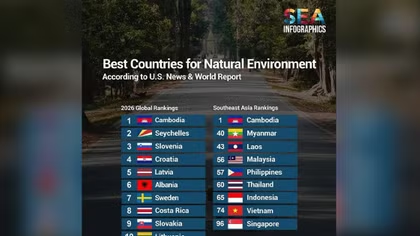
Cambodia currently manages 73 protected natural areas covering more than seven million hectares, equivalent to about 41% of the country’s total land area. These protected areas play a vital role in forest conservation, wildlife habitat protection and biodiversity preservation through stricter law enforcement and conservation measures.

ASEAN chief spotlights Vietnam’s role in shaping bloc’s future

ASEAN chief spotlights Vietnam’s role in shaping bloc’s future

Vietnam is expected to maintain active contributions across ASEAN’s three pillars - the political-security community, the economic community, and the socio-cultural community; while further enhancing regional connectivity through infrastructure projects and stronger economic linkages.

Vietnam supports UNESCO's people-centred approach, multilateral cooperation: official

Vietnam supports UNESCO's people-centred approach, multilateral cooperation: official

Van affirmed Vietnam’s support for the UNESCO80 reform roadmap, focusing on the organisation’s core mandate, priority areas, interdisciplinary approach, and the special status of the Vietnam National Commission for UNESCO, and UNESCO representative offices, alongside efforts to diversify resources and strengthen global partnerships to enhance the organisation’s effectiveness.

Regional media highlight significant step in Vietnam’s leadership structure

Regional media highlight significant step in Vietnam’s leadership structure

Under General Secretary and President Lam’s leadership, Vietnam is expected to maintain a balanced foreign policy, strengthen its regional standing and accelerate economic development, thereby improving living standards and creating new opportunities for international investors, according to the India-based platform Devdiscourse.

Laos identifies 10 key tasks to build independent, self-reliant economy

Laos identifies 10 key tasks to build independent, self-reliant economy

Laos will step up agricultural production to ensure food security, meet domestic demand and expand exports; encourage the development of agro-processing industries, including those related to rubber, aquatic products, cassava and sugarcane, as well as fertiliser and animal feed production, in order to increase added value and create jobs in rural areas.