- Spring festivals of ethnic minority groups
- Hoa Binh popularizes Traffic Rules to ethnic minorities
- Xe Dang ethnic group holds New rice festival
- Tet of the Hmong ethnic group in Dien Bien
Glar is a beautiful, clean and prosperous place. The commune People’s Committee Chairman proudly claimed that the land there was so fertile for farming that only the lazy can live in hunger and poverty there.
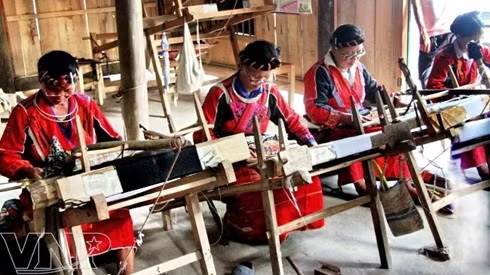
Dor 2 village in Glar commune is famous for the home of talented weavers who have taught the skills to their sisters in their village as well as neighbouring areas. People in Dor 2 have enjoyed a prosperous life for generations and the village’s cultural traditions have been well preserved, including gong performances, sculpture, folk singing, and brocade weaving.
Women in the village often gather at Mlonh’s private house, of which half of the total area is home to threads, weaving tools and displays of brocade products. This is a place where they can practice weaving while sharing their stories in personal life.
 |
Mlohn said that the participants often weave in their spare time, describing it as a meticulous and time-consuming job which requires practitioners to be industrious.
Their final products, including shirts, skirts, handbags, scarves, hats, wallets and bracelets, attract much interest from both Vietnamese and foreign visitors. Some visitors also have their names or phrases recalling their visit weaved into the products, such as ‘Memory of Gia Lai”, “What to Remember”, “Central Highlands in the Dry Season.”
As women have to do farming, gardening and housework in daytime, they can only gather by the looms at night fall or on the weekend. It takes at least three days to complete a brocade-weaved product, a 3m x 1.4m scarf can take a weaver up to one month to finish.
Beginners are often assigned to weave simple parts of the product such as the cuff, collar, and brims while the veterans are in charge of the more complicated parts, including patterns which run horizontally in skirts, loin cloths and shirts. Their products are sold to traders from Kon Tum, Dak Lak and Ninh Thuan provinces. They also receive orders from tourist groups and travel agents.
All women in Dor 2 know how to weave, even girls at second grade can weave decorative pieces for their sisters and mothers at home. Hlop, the 66-year-old mother of Mlonh, taught her daughters basic weaving techniques when they were little girls. Despite her age, Hlop is still the best in mixing colours of patterns.
The female group also learns how to apply industrial dyes to save time and work while enhancing the quality and durability of their products. They also update decorative patterns in order to meet the increasing demands of customers.
A weaving cooperative was set up few years ago by the Gia Lai provincial Department of Industry and Trade, providing adequate weaving equipment and ensuring product output for the villagers. However, it did not receive much interest from local women, who explained that they couldn’t take care of their housework and children if they went to the cooperative for work. Therefore, they brought their looms back to Mlonh’s house, weaving in their free-time.
Mlonh said that she could earn up to VND15 million (US$665) a month, which significantly helped her improve her living. She and other group members have positively participated in festivals and contests in the province and Central Highlands region in general, considering them as an opportunity to practice their skills while advertising traditional crafts and their products.
The events have also helped them learn how to create new deigns, weaving techniques, and decorative patterns of the Jrai, E De and Xe Dang ethnic groups.
Brocade weaving has been handed down from mothers to daughters and so on in the village. Brocade products of the Bahnar people have been sold everywhere in the Central Highlands region, receiving much interest from customers while significantly helping the ethnic women improve their lives.