China says business ties with Iran no harm to any other country

China’s business and energy ties with Iran do not harm the interests of any other country, the country’s Foreign Ministry said, after U.S. President Donald Trump said companies doing business with Iran would be barred from the United States.
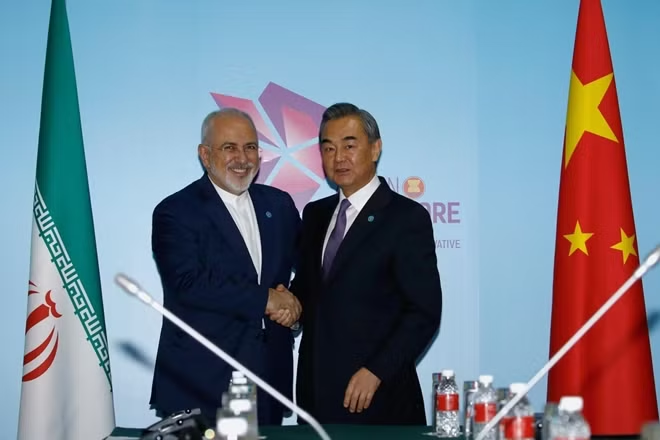
FILE PHOTO - Iran's Foreign Minister Mohammad Javad Zarif and China's Foreign Minister Wang Yi shake hands at a bilateral meeting on the sidelines of the ASEAN Foreign Ministers' Meeting in Singapore, August 3, 2018. REUTERS/Feline Lim

FILE PHOTO - Iran's Foreign Minister Mohammad Javad Zarif and China's Foreign Minister Wang Yi shake hands at a bilateral meeting on the sidelines of the ASEAN Foreign Ministers' Meeting in Singapore, August 3, 2018. REUTERS/Feline Lim

China has already defended its commercial relations with Iran as open and transparent as U.S. sanctions on Iran took effect despite pleas from Washington’s allies.

In a statement released late on Friday, China’s foreign ministry reiterated its opposition to unilateral sanctions and “long-armed jurisdiction”.

“For a long time, China and Iran have had open, transparent and normal commercial cooperation in the fields of business, trade and energy, which is reasonable, fair and lawful,” it said.

“This does not violate United Nations Security Council resolutions or China’s promised international obligations, nor does it harm the interests of any other country, and should be respected and protected,” the ministry added.

Using sanctions at the slightest pretext or to threaten anyone won’t resolve the problem, it said.

“Only dialogue and negotiations are the true path to resolving the issue,” the ministry added.

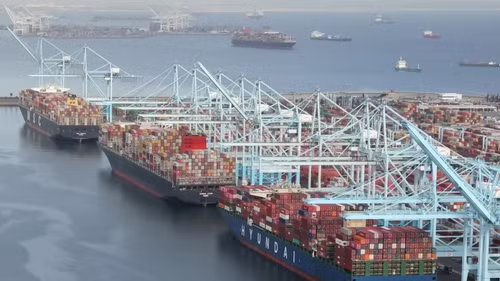
China, Iran’s top oil customer, buys roughly 650,000 barrels a day of crude oil from Tehran, or 7 percent of China’s total crude oil imports. At current market rates, the imports are worth some $15 billion a year.

State energy firms CNPC and Sinopec have invested billions of dollars in key Iranian oil fields such as Yadavaran and North Azadegan and have been sending oil to China.

European countries, hoping to persuade Tehran to continue to respect the nuclear deal, have promised to try to lessen the blow of sanctions and to urge their firms not to pull out.

But that has proven difficult, and European companies have quit Iran, arguing that they cannot risk their U.S. business.

Few American companies do much business in Iran so the impact of sanctions mainly stems from Washington’s ability to block European and Asian firms from trading there.
Reuters

Other News

Vietnam supports UNESCO's people-centred approach, multilateral cooperation: official

Vietnam supports UNESCO's people-centred approach, multilateral cooperation: official

Van affirmed Vietnam’s support for the UNESCO80 reform roadmap, focusing on the organisation’s core mandate, priority areas, interdisciplinary approach, and the special status of the Vietnam National Commission for UNESCO, and UNESCO representative offices, alongside efforts to diversify resources and strengthen global partnerships to enhance the organisation’s effectiveness.

Regional media highlight significant step in Vietnam’s leadership structure

Regional media highlight significant step in Vietnam’s leadership structure

Under General Secretary and President Lam’s leadership, Vietnam is expected to maintain a balanced foreign policy, strengthen its regional standing and accelerate economic development, thereby improving living standards and creating new opportunities for international investors, according to the India-based platform Devdiscourse.

Laos identifies 10 key tasks to build independent, self-reliant economy

Laos identifies 10 key tasks to build independent, self-reliant economy

Laos will step up agricultural production to ensure food security, meet domestic demand and expand exports; encourage the development of agro-processing industries, including those related to rubber, aquatic products, cassava and sugarcane, as well as fertiliser and animal feed production, in order to increase added value and create jobs in rural areas.

Malaysia steps up cyber security resilience

Malaysia steps up cyber security resilience

To ensure accountability, Malaysia plans to finalise the Cybercrime Bill this year which addresses both cyber-dependent and cyber-enabled offences, introducing stricter penalties and prison terms to enhance deterrence.

US public opinion positive about PM Pham Minh Chinh’s visit

US public opinion positive about PM Pham Minh Chinh’s visit

Public opinion in the US is generally positive about Vietnamese Prime Minister Pham Minh Chinh’s trip to the US from September 17-23 to attend the 78th session of the United Nations General Assembly, which took place immediately after the upgrading of the Vietnam - US relations to a comprehensive strategic partnership on the occasion of US President Joe Biden’s official visit to Vietnam.