Discovering one of oldest pottery villages in Southeast Asia

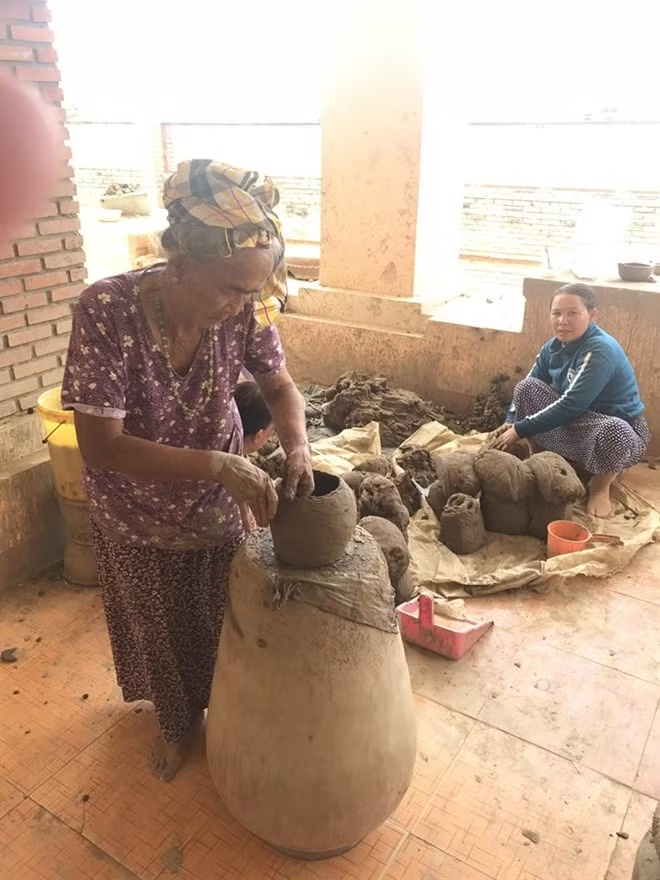
Truong Thi Gach, 82, of the Cham ethnic group, is from a very long line of ceramic artisans. Her great-great grandmother made pottery, and now, her own great-granddaughter works in one of the oldest pottery villages in Southeast Asia, located 10km from the central coastal city of Phan Rang in Ninh Thuan province.
Truong Thi Gach, 82, a Cham artisan, has been making pottery for 70 years in Bau Truc village in Ninh Thuan province (Photo: VNA)

Truong Thi Gach, 82, a Cham artisan, has been making pottery for 70 years in Bau Truc village in Ninh Thuan province (Photo: VNA)

“I learned how to make pottery from my mother and my grandmother when I was 10 years old,” Gach said. “I taught my daughters and granddaughters since our Cham culture only allows women to make pottery.”

Located on National Highway 1A, the Bau Truc Pottery Village in Ninh Phuoc district is famous for ceramics made from clay from the Quao River.

“Villagers take the soft clay and mix it with sand to create a base material,” Gach said. “These techniques have been passed down from generation to generation."

Cham pots are shaped by hand and are not made on a rotating electric wheel. The pots are dried under the sun for four to six hours before being fired outdoors over straw or wood.

The entire process, from beginning to end, is done by hand: from drying and soaking the materials in water to mixing sand and kneading the clay, to decorating the pots before firing.

“That’s what makes our products unique," Gach said. “We place the product on a chair or table and walk around it to shape it.”

Simple tools like anvils, moulds and wet cloths are also used. The patterns on the pots, which are freely decorated, often depict tree branches or shells, made with traditional techniques that colour the pottery in old, mysterious styles, according to Gach.

Images of snails or paintings featuring the daily life of Bau Truc Village’s people are often used for decoration as well.

Because the potters do not use kilns, their handmade jars are especially good for keeping water cool.

Pots from the village have natural colours: varying from reddish-brown, pink-red and dark gray with brown streaks, which are all characteristic of Chăm culture.

Upon entering the village gate, visitors can see pottery lining the streets and in front of houses, and can stop to learn techniques at workshops and take home their handmade items.

The village’s most popular items are reliefs featuring Cham women, kings or dancers, and products for spiritual worship or everyday household utensils.

Jars, decorative lamps, reliefs, and statuettes of Apsara (female dancers) and Shiva, one of the three main gods in Hinduism, are also sold at the village.

Future prospects

The village, which has existed since the reign of Cham King Po Klong Garai (1151-1205), holds a ceremony every year to honour Po Klong Chan, the founder of the village.  

Today, however, Bau Truc potters are trying desperately to survive.

Some 85 percent of the total 400 households in the village earn their living from making pottery.

However, the villagers fear they will have to stop working as potters because of the unstable output, low income, and lack of interest from traders.

Though the village has a variety of works in different sizes and colours, as well as fine art works and souvenirs, they have to compete with other craft villages with a long storied history, according to Phu Huu Minh Thuan, Director of the Bau Truc Pottery Village Cooperative.

Many products have simple designs that cannot match the variety and modern style of ceramics made by the famous Bat Trang Pottery and Binh Duong Pottery villages.

“Our monthly production is about 1,000 items, a small number compared with Bat Trang or Binh Duong,” Thuan said.

The artisans’ income is only around 2.5 million VND (110 USD) per month.

“That’s why many households no longer make pottery, even though they still love the traditional work. They have to look for other jobs with better earnings,” Thuan said.

To save the village’s craft, Thuan has recommended several solutions to provincial authorities, including financial support to register an official village trademark, and more trade promotions at seminars and conferences.

Ninh Thuan authorities are also planning to compile a dossier on Cham pottery in a bid to earn UNESCO cultural heritage recognition.

However, the provincial authorities urgently need support from government agencies, especially the Ministry of Culture, Sports and Tourism and the Vietnam National Institute of Culture and Arts Studies in HCM City, according to Thuan.

In 2017, the pottery made in Bau Truc Village in Ninh Thuan was recognised as a national intangible cultural heritage by the Ministry of Culture, Sports and Tourism.


VNS/VNA

Other News

Vietnam secure berth at FIFA U17 World Cup 2026 for first time

Vietnam secure berth at FIFA U17 World Cup 2026 for first time

Vietnam national U17 football team secured a place at the FIFA U17 World Cup 2026 for the first time after defeating United Arab Emirates national U17 football team 3-2 on in the final Group C match of the AFC U17 Asian Cup 2026 in Saudi Arabia on early May 14 (Vietnam time).

Vietnam’s most beautiful railway station twins with French counterpart

Vietnam’s most beautiful railway station twins with French counterpart

A twinning agreement between Da Lat Railway Station in Vietnam and Trouville-Deauville Railway Station in France was signed at the French Embassy in Vietnam on May 7, creating new opportunities for cooperation in station management and operations, as well as cultural and tourism promotion between the two sides.

Hanoi gains two more craft villages in World Crafts Cities network

Hanoi gains two more craft villages in World Crafts Cities network

The recognition of Chuyen My and Son Dong craft villages as members of the World Crafts Cities network represents international acknowledgement of the cultural value, artisanal techniques, creativity and sustainable vitality of Vietnam’s traditional craft villages, he said.

Thang Long - Hanoi Festival 2026 to return in September

Thang Long - Hanoi Festival 2026 to return in September

Co-hosted by the municipal People’s Committee, the Department of Culture and Sports, and domestic and foreign agencies, the whole spectacle is meant to honour the city’s millennia-old heritage while reafffirming its strategy of establishing culture as a development engine.

Spreading Vietnamese cultural identity in digital space

Spreading Vietnamese cultural identity in digital space

In the context of deep international integration, cultural identity serves as both a “shield” against assimilation and a defining marker of a nation’s image. Protecting and promoting uniquely Vietnamese cultural values has therefore become a pressing task, particularly in an increasingly complex digital environment.

ITE HCMC 2026 to promote Vietnam’s tourism on global map

ITE HCMC 2026 to promote Vietnam’s tourism on global map

With its large scale, the ITE HCMC 2026 aims to promote tourism cooperation between Vietnam and priority markets such as Northeast Asia, Western Europe, North America, Southeast Asia, and Oceania while also boosting visitor arrivals from the Indian market

Vietnamese puppetry seeks renewal amid preservation challenges

Vietnamese puppetry seeks renewal amid preservation challenges

Although widely regarded as a cultural “speciality” attracting tourists, Vietnamese puppetry is facing multiple challenges in preservation and development, requiring renewed efforts to both safeguard its identity and adapt to contemporary cultural currents.

Project on digital transformation in cultural sector approved

Project on digital transformation in cultural sector approved

By 2030, the project targets the establishment of shared digital platforms across 100% of cultural sectors. All digitised cultural heritage will be standardised under the national data framework and shared in accordance with regulations, while 80% of public digital heritage assets are expected to receive digital identifiers to clarify ownership and management, encouraging organisations and individuals to do the same and support market development.

Vietnam eyes becoming region’s leading tourism destination

Vietnam eyes becoming region’s leading tourism destination

Vietnam has in recent years undergone a notable transformation in its tourism development strategy, placing a strong emphasis on nature-based and eco-tourism. This shift is not merely aligned with global trends, but represents a necessary step towards safeguarding valuable natural resources, while appealing to a growing segment of environmentally conscious travellers.