Easing visa policy key to boosting international tourist numbers

Vietnam is expected to welcome a high influx of foreign visitors from September to April of the following year, a period representing the peak season for foreign tourist attraction, providing that it moves to ease its visa policies.

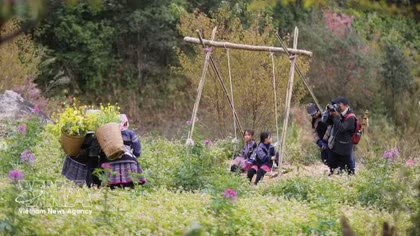
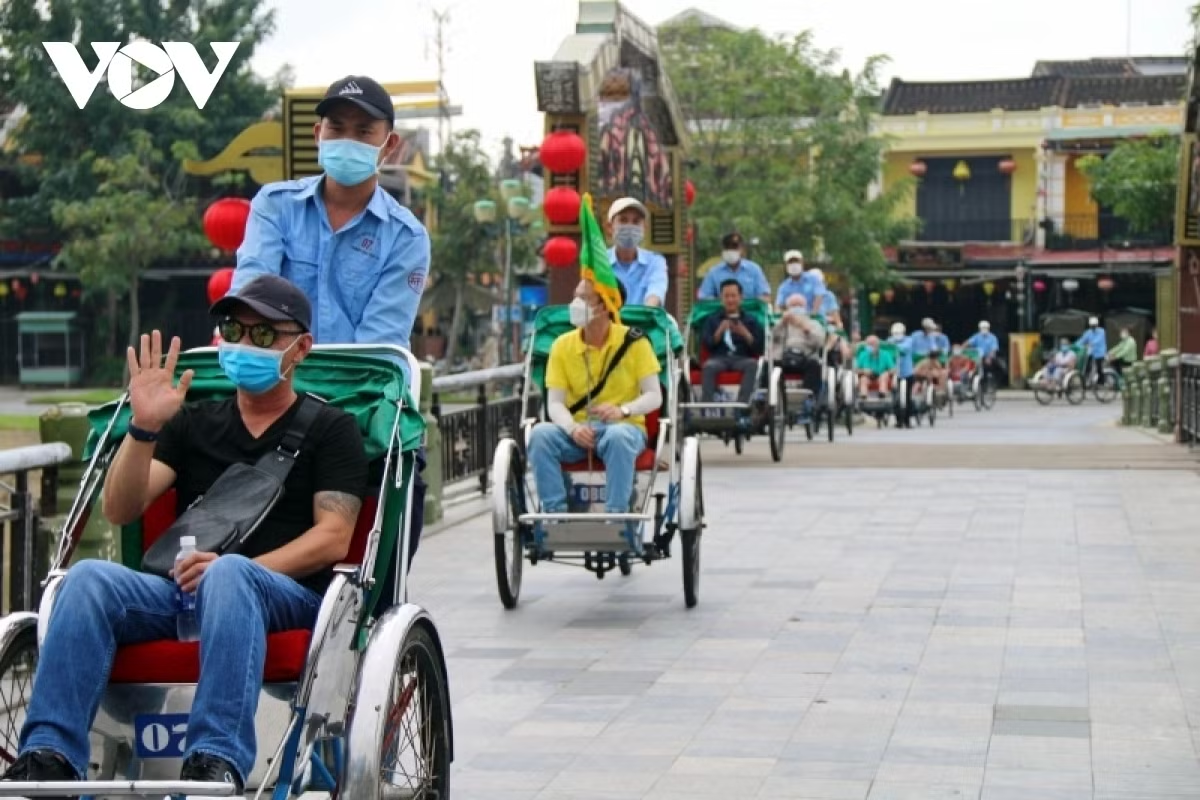
easing visa policy key to boosting international tourist numbers picture 1

Vietnam has set a target of welcoming 5 million foreign visitors this year, but statistics show it had only attracted 1.44 million as of August 31. It hopes to meet the yarly target as the September - April period is considered the peak season for foreign visitors in Vietnam. 

The Vietnam National Administration of Tourism believes that the domestic tourism market has already recovered from the COVID-19 pandemic thanks to tourism stimulus programmes launched by localities nationwide.

Localities welcomed roughly 80 million domestic holidaymakers during the initial eight months of the year, marking an increase of 33.6% compared to the same period from 2019, the pre-pandemic period in which the tourism sector was in its heyday.

However, the number of foreign arrivals has so far yet to meet expectations, though the country reopened its borders in the middle of March. Statistics show 1.44 million foreign arrivals have been reported over the past eight months, representing a decline of 87.3% compared to the same period from 2019 and meeting less than one third of this year’s plan. 

According to the calculations made by local travel companies, Vietnam attracted 18 million international tourists in 2019, and its revenue was large compared to the revenue generated by 85 million domestic tourists in the same year. Therefore, tour operators fear that they will continue to encounter difficulties over the coming months unless the international tourism market has yet to fully recover.

As part of efforts to attract international visitors, easing visa policies is considered an important tool. While Vietnam is considering expanding visa exemption as a solution to boosting international tourism, neighbouring countries have already taken action.

The Thailand Centre for COVID-19 Situation Administration recently approved the Tourism Authority of Thailand’s proposal which will extend the visa exemption stay to 45 days for visitors from more than 50 countries and territories, as opposed to the previous maximum stay of 30 days. This new policy is set to start from October 1, 2022 and run to March 31, 2023. In addition, visitors with visas issued upon arrival in Thailand will also be able to double their stay to 30 days.

As soon as this new policy takes effect, Thailand hopes to receive approximately 10 million visitors this year, or 3.9 million visitors more than the target set in April.

Elsewhere, the Republic of Korea (RoK) first opened its doors to foreign tourism in June and quickly implemented a visa-waiver programme for some markets, including for Vietnamese nationals visiting to Gangwon province and Jeju island. Immediately after the implementation of this policy, many charter flights brought Vietnamese tourists to Jeju and YangYang airport in Gangwon.

In contrast, Vietnam only exempts visas for citizens of 25 countries and territories, with the duration of stay mainly ranging from 15 to 30 days. This visa policy is causing difficulties for travel firms, with many describing the visa procedure as a game of chance.

According Dang Minh Truong, chairman of multi-sectoral Sun Group, Vietnam has yet to take advantage of the visa policy which the World Tourism Organization has previously identified as key to attracting foreign visitors.

The facts clearly show that neighbouring countries with more open visa policies enjoy an outstanding advantage in the race to welcome international visitors compared to Vietnam. Typically, 2019 saw Vietnam welcome a record high of 18 million international visitors, while Thailand celebrated achieving the milestone of receiving 40 million international visitors. The policy of extending the stay of tourists also helps Thailand to attract more international travelers who wish to stay longer and spend more.

Tourism expert Nguyen Duc Chi frankly points out the competitive race of luring tourists has begun. Japan has officially opened its doors to tourists, while the RoK and Thailand are also willing to ease visas to quickly increase arrivals. Due to this, Vietnam will ultimately lose out to its rivals unless it takes action, he concludes.


VOV

Other News

Vietnam secure berth at FIFA U17 World Cup 2026 for first time

Vietnam secure berth at FIFA U17 World Cup 2026 for first time

Vietnam national U17 football team secured a place at the FIFA U17 World Cup 2026 for the first time after defeating United Arab Emirates national U17 football team 3-2 on in the final Group C match of the AFC U17 Asian Cup 2026 in Saudi Arabia on early May 14 (Vietnam time).

Vietnam’s most beautiful railway station twins with French counterpart

Vietnam’s most beautiful railway station twins with French counterpart

A twinning agreement between Da Lat Railway Station in Vietnam and Trouville-Deauville Railway Station in France was signed at the French Embassy in Vietnam on May 7, creating new opportunities for cooperation in station management and operations, as well as cultural and tourism promotion between the two sides.

Hanoi gains two more craft villages in World Crafts Cities network

Hanoi gains two more craft villages in World Crafts Cities network

The recognition of Chuyen My and Son Dong craft villages as members of the World Crafts Cities network represents international acknowledgement of the cultural value, artisanal techniques, creativity and sustainable vitality of Vietnam’s traditional craft villages, he said.

Thang Long - Hanoi Festival 2026 to return in September

Thang Long - Hanoi Festival 2026 to return in September

Co-hosted by the municipal People’s Committee, the Department of Culture and Sports, and domestic and foreign agencies, the whole spectacle is meant to honour the city’s millennia-old heritage while reafffirming its strategy of establishing culture as a development engine.

Spreading Vietnamese cultural identity in digital space

Spreading Vietnamese cultural identity in digital space

In the context of deep international integration, cultural identity serves as both a “shield” against assimilation and a defining marker of a nation’s image. Protecting and promoting uniquely Vietnamese cultural values has therefore become a pressing task, particularly in an increasingly complex digital environment.

ITE HCMC 2026 to promote Vietnam’s tourism on global map

ITE HCMC 2026 to promote Vietnam’s tourism on global map

With its large scale, the ITE HCMC 2026 aims to promote tourism cooperation between Vietnam and priority markets such as Northeast Asia, Western Europe, North America, Southeast Asia, and Oceania while also boosting visitor arrivals from the Indian market

Vietnamese puppetry seeks renewal amid preservation challenges

Vietnamese puppetry seeks renewal amid preservation challenges

Although widely regarded as a cultural “speciality” attracting tourists, Vietnamese puppetry is facing multiple challenges in preservation and development, requiring renewed efforts to both safeguard its identity and adapt to contemporary cultural currents.

Project on digital transformation in cultural sector approved

Project on digital transformation in cultural sector approved

By 2030, the project targets the establishment of shared digital platforms across 100% of cultural sectors. All digitised cultural heritage will be standardised under the national data framework and shared in accordance with regulations, while 80% of public digital heritage assets are expected to receive digital identifiers to clarify ownership and management, encouraging organisations and individuals to do the same and support market development.

Vietnam eyes becoming region’s leading tourism destination

Vietnam eyes becoming region’s leading tourism destination

Vietnam has in recent years undergone a notable transformation in its tourism development strategy, placing a strong emphasis on nature-based and eco-tourism. This shift is not merely aligned with global trends, but represents a necessary step towards safeguarding valuable natural resources, while appealing to a growing segment of environmentally conscious travellers.