Education Minister confirms teacher shortages

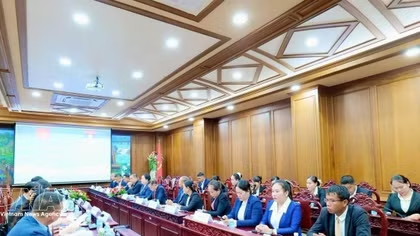
Minister of Education and Training Phung Xuan Nha on September 24 stood before a committee hearing at the National Assembly to explain a shortage of thousands of teachers nationwide.

The hearing was chaired by the Committee for Culture, Education, Youth, Adolescents and Children to look into the responsibility of the Ministry of Education and Training in the recruitment process.

A severe lack of teachers in recent years has forced a number of localities to illegally hire more teachers to meet the demand.

In a report by the education minister Nha, the number of teachers at kindergartens and schools was more than 1.16 million as of August 15, 2018, of which nearly 859,000 teachers work in public institutions while more than 23,600 teach in non-public sector.

Vietnam was currently short of just under 76,000 teachers to meet the ever increasing demand, Nha said. Shortage of kindergarten teachers was the most severe as more than 43,000 were still needed across the country. It was estimated that primary, secondary and high schools lacked some 19,000, 10,000 and 3,100 teachers respectively.
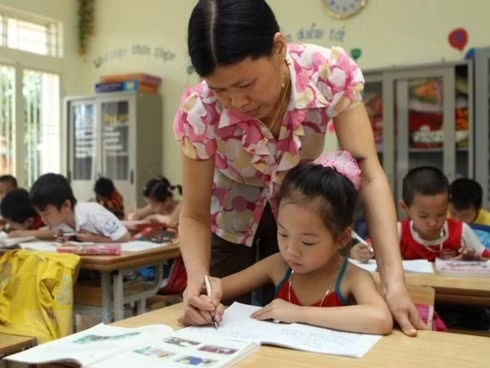
Minister of Education and Training Phung Xuan Nha on September 24 stood before a committee hearing at the National Assembly to explain a shortage of thousands of teachers nationwide
 Minister of Education and Training Phung Xuan Nha on September 24 stood before a committee hearing at the National Assembly to explain a shortage of thousands of teachers nationwide 

Secondary schools, however, suffered from teacher shortage and unbalance at the same time, the minister said.

The teacher unbalance occurred between subjects traditionally deemed more important like Maths or Literature and those deemed less important like Art or Music, or between educational institutions or cities and provinces that the authorities failed to manage and adjust.

Secondary schools in Vietnam were reported to need more than 10,000 teachers but also had some 12,100 surplus.

The nationwide teacher shortage came from various reasons, the minister told the committee hearing.

“It could be due to changes in school/class size after a school restructuring or a population increase in central areas, big cities or industrial zones,” he said.

“At kindergarten level, a programme to make education for five-year-old children universal also strained the teacher supply while a big jump in the number of children born in 2012 (11 localities reported ‘abnormal’ increase of student size) put pressure on primary schools this year.”

2012 was the Year of Dragon, which was believed by Vietnamese people to be one of the best years to have children as they will be destined to have a prosper life in the future.

Another reason for the severe teacher shortage resulted from the Government’s rigid policy to downsize public employees since 2015, which only allowed localities to recruit half of the number of teachers they lost – mostly from retirement.

That left many localities, for example Phu Yen, Quang Ngai, Dak Lak and Hanoi, with no choice but to "break the law" and sign illegal contracts with kindergarten and primary teachers for the sake of the students.

Nha said the education ministry was collaborating with the Ministry of Home Affairs – which oversees the recruitment of public employees – to help localities collect data on their teachers, population and students from 2015 to 2018.

The education ministry will work out solutions based on such reports to resolve the teacher shortage situation and submit them to Prime Minister Nguyen Xuan Phuc for approval as soon as possible, he added.


VNA

Other News

Hanoi ready to implement Capital Law 2026, unlocking new development momentum

Hanoi ready to implement Capital Law 2026, unlocking new development momentum

The effectiveness of the Capital Law 2026 will be measured not by the number of legal documents issued but by tangible improvements in governance and public administration, better services for people and businesses, faster administrative procedures, stronger investment attraction and higher economic growth.

Vietnamese students earn honours at ROBOG Asia Cup 2026

Vietnamese students earn honours at ROBOG Asia Cup 2026

Three teams from Chu Van An Secondary School in Vietnam’s Thai Nguyen province have earned First Prize honours and advanced to the quarterfinals at the ROBOG Asia Cup 2026, a regional robotics and artificial intelligence (AI) competition for students held in Hong Kong, China.

Hanoi sets out new investment blueprint with century-long development vision

Hanoi sets out new investment blueprint with century-long development vision

As of early June, Hanoi had attracted 74.6 billion USD in foreign direct investment (FDI) through more than 9,250 valid projects. FDI inflows in the first six months were projected at 3.2 billion USD, surpassing the annual target by 116%, while nearly 16,000 new businesses were established in the first five months, up 34.4% year-on-year.

Vietnam promotes legal cooperation and rule of law at global forum

Vietnam promotes legal cooperation and rule of law at global forum

Vietnam’s development and international integration have gone hand in hand with the improvement of its legal system, the incorporation of international commitments into domestic legislation, and legal reforms aimed at fostering development, openness and global integration. The country regards international law as an essential instrument for building fair, mutually beneficial relations among nations.

Hanoi to hold investment promotion event on June 29

Hanoi to hold investment promotion event on June 29

At the event, Hanoi authorities plan to grant investment policy decisions and investment registration certificates to 20 exemplary projects in the fields of transportation infrastructure, industrial parks, urban development, social housing, environment, science and technology, and foreign investment attraction.

Hanoi's Red River urban area development draws widespread attention

Hanoi's Red River urban area development draws widespread attention

Located south of the Red River and extending from the historic inner city to newly developing areas in the south and the west, the central urban area along Red River’s right bank covers approximately 45,317 hectares and is projected to accommodate around 6.365 million residents by 2045 and 6.455 million by 2065.

Hanoi's Red River urban area development draws widespread attention

Hanoi's Red River urban area development draws widespread attention

Located south of the Red River and extending from the historic inner city to newly developing areas in the south and the west, the central urban area along Red River’s right bank covers approximately 45,317 hectares and is projected to accommodate around 6.365 million residents by 2045 and 6.455 million by 2065.

Regional cooperation strengthened to combat cross-border drug crime

Regional cooperation strengthened to combat cross-border drug crime

Vietnam, China, Laos and Myanmar face common challenges as drug syndicates increasingly exploit the Mekong River, cross-border transport networks, e-commerce platforms, international logistics services, cyberspace and cryptocurrencies to organise drug transactions and smuggling operations.