Empowering women and girls through Vietnamese martial arts and sports

PSNews - Recently, the United Nations Population Fund (UNFPA), the Embassy of Japan in Viet Nam, Guardian Girls International (GGI), and the World Vovinam Federation (WVVF) launched the global project Guardian Girls Vovinam (GGV) to empower women and girls through Vietnamese martial arts and sports.

Empowering women and girls through Vietnamese martial arts and sports -0
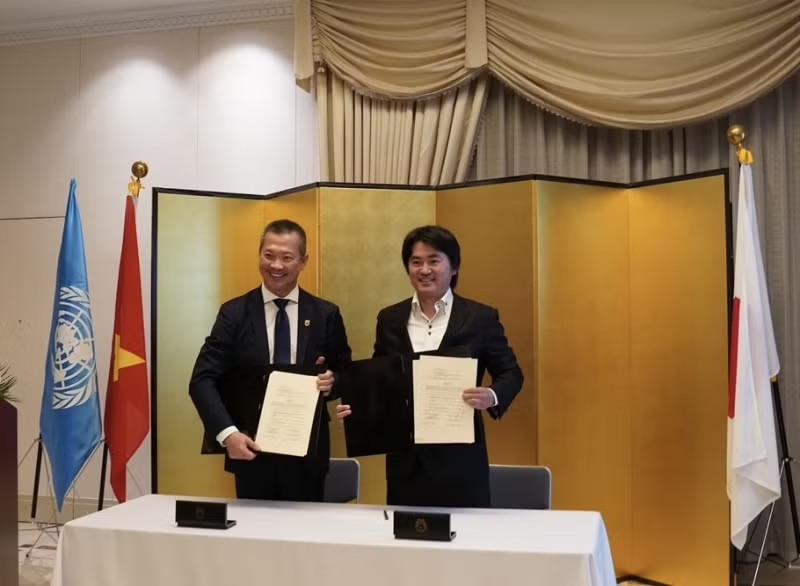
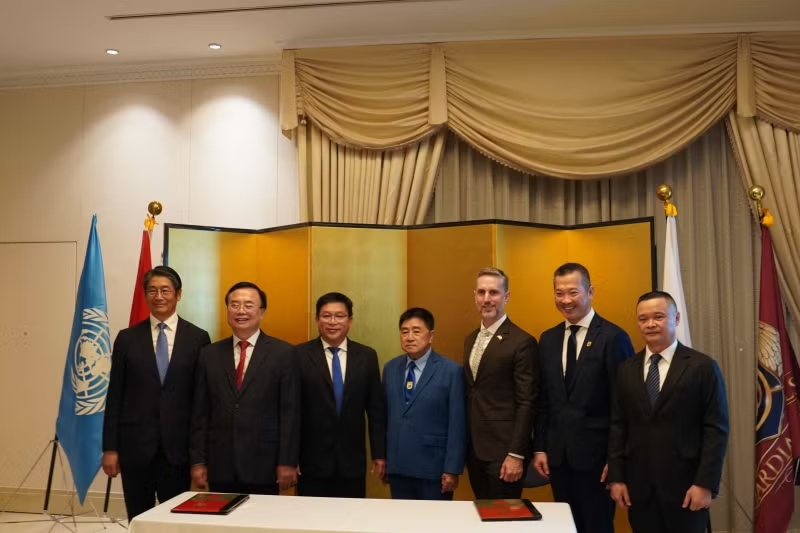
The signing of the MOU between Shin Koyamada, Co-Founder and Board Chairman of GGI, and Dr. Mai Huu Tin, Board President of WVVF, officially launched the global rollout of the GGV project in Vietnam.

The initiative of empowering women and girls through martial arts, specifically Vovinam, marks a significant milestone in connecting traditional Vietnamese martial arts with efforts to empower women and girls. The event also positions Vietnam as the first ASEAN country, and the first with an international sports federation headquartered in Southeast Asia, to formally join the GGI movement. 

Earlier, on the evening of September 16, at the residence of the Japanese Ambassador to Viet Nam, Mr. Shin Koyamada, co-founder and Chairman of the Board of GGI, and Dr. Mai Huu Tin, President of the World Vovinam Federation (WVVF), signed a Memorandum of Understanding (MOU), officially initiating the rollout of the GGV project in Viet Nam and globally.
Empowering women and girls through Vietnamese martial arts and sports -1
Ambassador Ito, Dau Mot University President Doan Ngoc Xuan, Vovinam Grandmasters, UNFPA Rep Jackson, WVVF President Tin, WVVF VP Chien

Vietnam joins 22 other countries across five continents where GGI has initiated projects to promote gender equality and prevent violence against women and girls (VAWG).

The GGV is the flagship project of GGI, an international NGO under the Koyamada International Foundation (KIF). The project is implemented exclusively in partnership with WVVF and its network of more than 60 national Vovinam federations worldwide. It harnesses the power of Vovinam, Viet Nam’s traditional martial art—not only a combat discipline combining strikes and holds, but also a symbol of physical strength rooted in philosophy and Vietnamese cultural identity.
Empowering women and girls through Vietnamese martial arts and sports -2
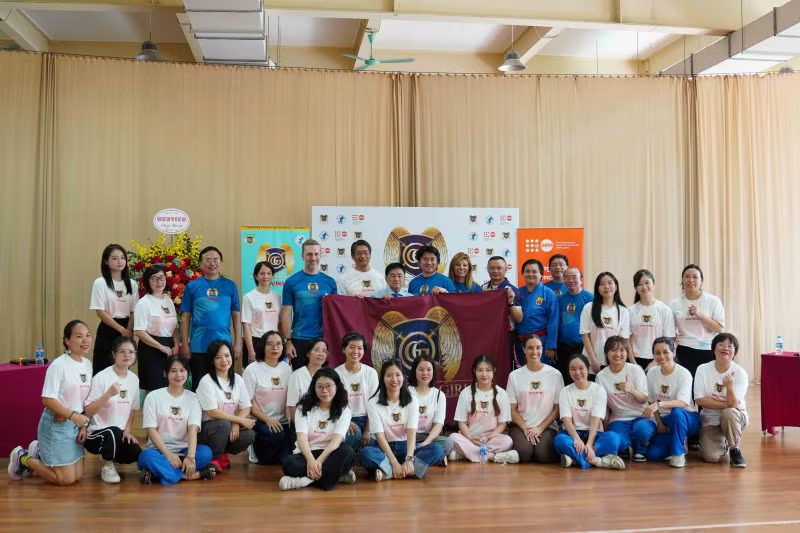
Representative of UNFPA in Viet Nam Matt Jackson, Japanese Ambassador to Viet Nam Naoki Ito and delegates at the launch ceremony of the GGV project on the morning of September 17.

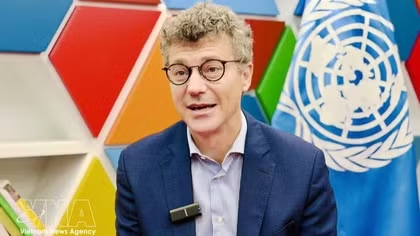
Speaking at the event, UNFPA Representative in Viet Nam Matt Jackson emphasized that sustainable solutions to end gender-based violence must be built on local culture, community-led initiatives, and multi-sectoral cooperation. Guardian Girls Vovinam, he said, is a clear example of this vision, as Vietnamese traditional martial arts are applied to equip women and girls with confidence, practical skills, and self-agency.

Japanese Ambassador to Viet Nam Naoki Ito affirmed Japan’s strong commitment to promoting gender equality and preventing violence against women and girls. In 2021, through cooperation with UNFPA, Japan also supported the establishment and operation of three One-Stop Service Centers, known as Sunshine Homes, in Thanh Hoa, Da Nang, and Ho Chi Minh City to assist women and girls affected by gender-based violence.
Empowering women and girls through Vietnamese martial arts and sports -3
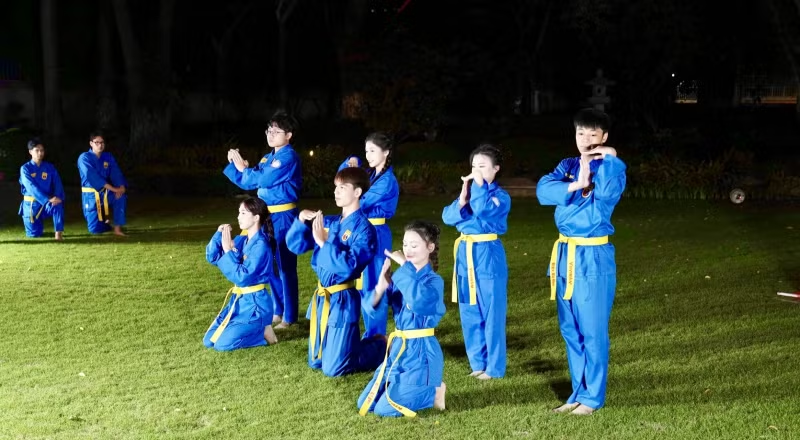
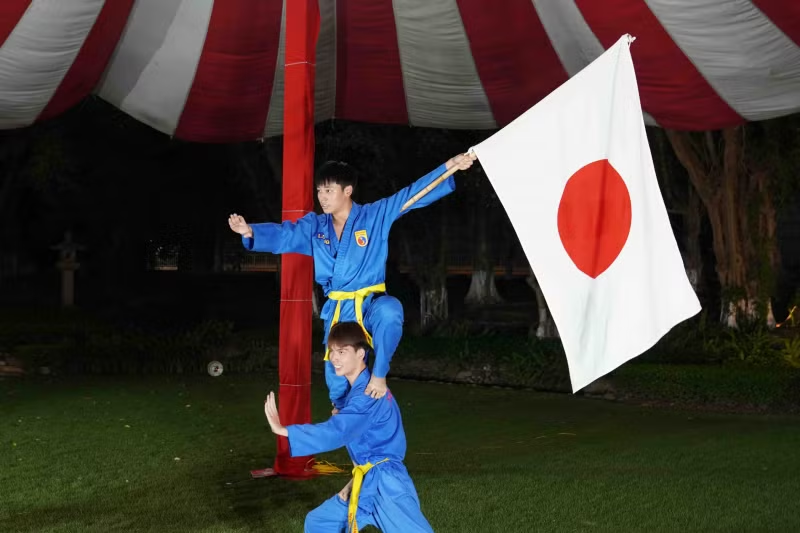
GGV leverages Vovinam, a traditional Vietnamese martial art that integrates striking and grappling techniques, symbolizing both physical strength and philosophical depth. 
Empowering women and girls through Vietnamese martial arts and sports -4
Vovinam Demonstration

“Today, by joining the Guardian Girls Viet Nam project, we reaffirm this commitment while also honoring both innovation and tradition. Through Vovinam, a traditional martial art of Viet Nam, this initiative reflects the shared values of Japan and Viet Nam in promoting the rights, safety, and holistic development of women and girls”, Ambassador Ito stressed.

Therefore, the GGV project has introduced a new approach to bringing Viet Nam’s traditional martial arts to serve the community in a profound and humanitarian way. As Mr. Shin Koyamada shared: “This journey is especially meaningful as it begins in Viet Nam, the birthplace of Vovinam, where culture, tradition, and resilience are deeply woven into national identity. The GGV project is not only about martial arts or sports, but also about creating change, affirming self-worth, and ensuring the right to live free from fear.

By Kim Khanh

Other News

Vietnam secure berth at FIFA U17 World Cup 2026 for first time

Vietnam secure berth at FIFA U17 World Cup 2026 for first time

Vietnam national U17 football team secured a place at the FIFA U17 World Cup 2026 for the first time after defeating United Arab Emirates national U17 football team 3-2 on in the final Group C match of the AFC U17 Asian Cup 2026 in Saudi Arabia on early May 14 (Vietnam time).

Vietnam’s most beautiful railway station twins with French counterpart

Vietnam’s most beautiful railway station twins with French counterpart

A twinning agreement between Da Lat Railway Station in Vietnam and Trouville-Deauville Railway Station in France was signed at the French Embassy in Vietnam on May 7, creating new opportunities for cooperation in station management and operations, as well as cultural and tourism promotion between the two sides.

Hanoi gains two more craft villages in World Crafts Cities network

Hanoi gains two more craft villages in World Crafts Cities network

The recognition of Chuyen My and Son Dong craft villages as members of the World Crafts Cities network represents international acknowledgement of the cultural value, artisanal techniques, creativity and sustainable vitality of Vietnam’s traditional craft villages, he said.

Thang Long - Hanoi Festival 2026 to return in September

Thang Long - Hanoi Festival 2026 to return in September

Co-hosted by the municipal People’s Committee, the Department of Culture and Sports, and domestic and foreign agencies, the whole spectacle is meant to honour the city’s millennia-old heritage while reafffirming its strategy of establishing culture as a development engine.

Spreading Vietnamese cultural identity in digital space

Spreading Vietnamese cultural identity in digital space

In the context of deep international integration, cultural identity serves as both a “shield” against assimilation and a defining marker of a nation’s image. Protecting and promoting uniquely Vietnamese cultural values has therefore become a pressing task, particularly in an increasingly complex digital environment.

ITE HCMC 2026 to promote Vietnam’s tourism on global map

ITE HCMC 2026 to promote Vietnam’s tourism on global map

With its large scale, the ITE HCMC 2026 aims to promote tourism cooperation between Vietnam and priority markets such as Northeast Asia, Western Europe, North America, Southeast Asia, and Oceania while also boosting visitor arrivals from the Indian market

Vietnamese puppetry seeks renewal amid preservation challenges

Vietnamese puppetry seeks renewal amid preservation challenges

Although widely regarded as a cultural “speciality” attracting tourists, Vietnamese puppetry is facing multiple challenges in preservation and development, requiring renewed efforts to both safeguard its identity and adapt to contemporary cultural currents.

Project on digital transformation in cultural sector approved

Project on digital transformation in cultural sector approved

By 2030, the project targets the establishment of shared digital platforms across 100% of cultural sectors. All digitised cultural heritage will be standardised under the national data framework and shared in accordance with regulations, while 80% of public digital heritage assets are expected to receive digital identifiers to clarify ownership and management, encouraging organisations and individuals to do the same and support market development.

Vietnam eyes becoming region’s leading tourism destination

Vietnam eyes becoming region’s leading tourism destination

Vietnam has in recent years undergone a notable transformation in its tourism development strategy, placing a strong emphasis on nature-based and eco-tourism. This shift is not merely aligned with global trends, but represents a necessary step towards safeguarding valuable natural resources, while appealing to a growing segment of environmentally conscious travellers.