- Ethnic people builds new life in resettlement village Muong Chien I, Son La
- Dao Thuc village water puppetry lures visitors
- Visitors cheer up at wrestling festival of Sinh village
Triem Tay Village, located in Dien Ban Town, approximately two kilometers from the UNESCO-recognized Hoi An Ancient Town in Quang Nam Province, has begun to earn a reputation in recent years among foreign and local ecotourists as the epitome of pastoral life in Vietnam.
Both visitors and locals have been amazed by the village’s breathtaking transformation from an erosion-plagued hamlet into a bustling tourist destination.
Just a stone’s throw from Hoi An Ancient Town, Triem Tay Village, an ‘oasis’ nestled along the iconic Thu Bon River, boasts pristine charm adorned with meandering paths lined with lush areca palm trees and neatly pruned tea hedges.
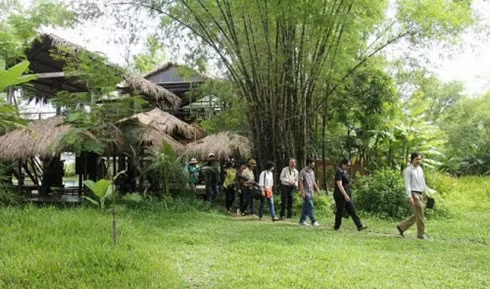 |
This village is perhaps one of the few places left in Vietnam where teeny alleys bear names.
The area has turned into a countryside retreat for holidaymakers wishing to take advantage of the idyllic landscape by unwinding in refreshing breezes and allowing themselves to become just a little closer to nature.
Other pastoral delights include a first-hand peek into daily life in rural Vietnam with visitors having the opportunity to partake in daily routines such as weaving sedge mattresses, cooking mi Quang (the central region’s signature noodle soup), and tending to ornamental plants and organic vegetables.
Tourists can also visit 300-year-old buildings owned by descendants of the Vo Thi and Vo Dai lineages.
In an effort to transform the village, the United Nations Educational, Scientific and Cultural Organization (UNESCO) and the International Labor Organization jointly offered English classes to villagers in 2014.
Their ongoing efforts to improve the area have also included training local residents in skills instrumental to community tourism development and waste management over the past two years.
Other factors contributing to Triem Tay Village’s success are the opening of the Cam Kim Bridge a few months ago, which brought about a complete overhaul of the hamlet’s image.
The changes made by UNESCO intervention and improved infrastructure have left few aware that villagers from Triem Tay were once victimized by relentless soil erosion and infertile land.
Nguyen Hien, director of Triem Tay Community Tourism Cooperative, said many have left the area in search of a better life elsewhere.
“Never in our wildest dreams did we imagine such dramatic changes,” he added.
The locals have already begun to benefit from each of these initiatives. Pham Thi Khanh, 58, a mattress weaver, said thanks to the English courses, she and other seasoned craftspeople in the village are now armed with an acceptable command of the English language to aid them in the effort to bring more tourists to the community.
Her husband used to cross the Thu Bon River in his sampan in the early morning hours to peddle wares in Hoi An.
“Now we receive many Westerners who snap photos around our house and buy my mattresses. My husband now works for the tourism cooperative,” Khanh added.
Duong Phu Thu, another resident, shared that his family had planned to move to another village after the plot next to his home gave way in 2009.
He was filled with doubts as rumors began circulating that someone had rented the area and planned to turn it into a tourism attraction.
Thu’s and others’ disbelief evaporated as soon as the tourism project came into shape.
He attributed the project’s success to the hard work of Bui Kien Quoc, a 72-year-old overseas Vietnamese architect now living in Hoi An City.
Struck by the village’s pastoral, untouched landscape during his first visit, Quoc made up his mind to initiate the project, he said.
“The greatest headache is how to anchor soil without harming the landscape and ambiance. I especially try to stay away from concrete dykes, as leaving plots unequally eroded and bunkered may impact areas in the vicinity,” he added.
His project was met with disbelief by locals as even bamboo, known for its sturdiness, has previously succumbed to the sheer power of coastal erosion.
Locals then recommended reed and co rui (a type of grass), which can survive flooding and soil erosion.
The architect then came up with an eco-friendly three-layer dyke.
The first layer is made up of reed, capable of rooting in water at a depth of around one meter.
The second layer is comprised of co rui with sturdy roots which can withhold soil effectively and minimize impact on the dykes.
The third layer, at a depth of approximately three meters, is vetiver grass, best known for its ability to persist in deep water and protect soil against erosion with its finely structured root system.
Quoc’s dykes have survived four seasons and remain intact, unlike the dyke system along Cua Dai Beach, a gem of Hoi An City, part of which has been relentlessly engulfed by encroaching seawater in recent years.
“The sturdy dykes have saved money for the local government’s budget, anchored residents’ homes, and allowed them to earn stable incomes,” Quoc noted.
“Triem Tay, which has grown into the district’s most promising tourism site, no longer sees its residents leaving home to work elsewhere. Instead, it draws workers from other localities,” Duong Van Ca, a local official, said.