Experiencing local life in Lang Son

When visiting the northern province of Lang Son, Bac Son district’s Quynh Son commune is often the first stop for tourists who wish to experience local life through homestays.
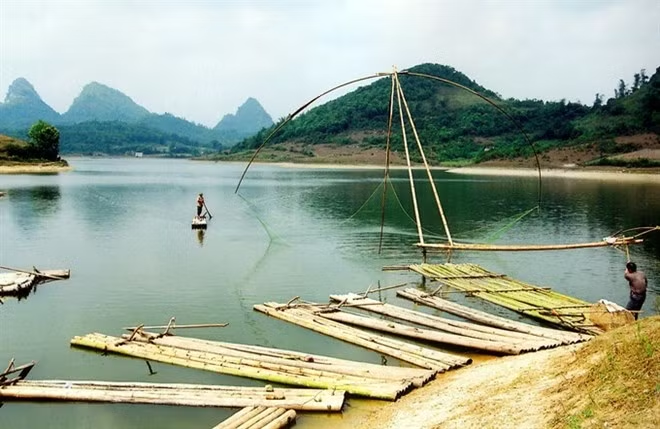
A river in Bac Son district, Lang Son province (Photo: VNA)

A river in Bac Son district, Lang Son province (Photo: VNA)

Located some 170km northeast of Hanoi, Lang Son played a role in the historic Bac Son Uprising against the French in 1940. The area has not only beautiful natural landscapes but also traditional cultural values highlighted by tours to the village.

Chu Thi Thu Phuong, Director of Quynh Son commune’s Homestay Management Board, said the commune has 460 families with 1,800 people residing in six villages, 90 percent of whom are part of the Tay ethnic group.

After a 2010 survey, concerned agencies decided to set up the first five homestay services in five family homes.

There are now eight families offering the service and 20 other households are preparing to register.

Duong Cong Chai, who was among the first five families hosting guests, said he now has eight rooms for guests to stay overnight.

“Each year, I receive nearly 800 guests, 15-20 per cent of whom are foreigners,” he said.

In the first eight months of this year, Chai received 60 groups of visitors with 500 people staying overnight.

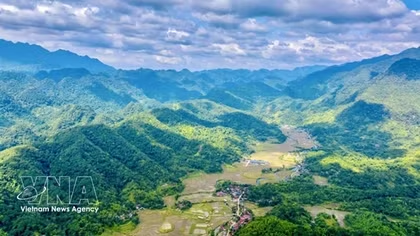
From a nearby mountain peak, one can see the whole Bac Son valley with its colourful rice fields – green at the beginning of rice planting season and yellow in harvest season.

Bac Son town appears in the skyline with various modern buildings, which are in stark contrast with the houses on stilts in Tay villages.

Tay people in the northern mountainous region, especially the ones in Quynh Son commune, have long lived in houses on stilts. On the first floor, they store agricultural products and raise cattle and poultry. The living room, bedroom and kitchen are on the upper floor. Some of them build houses to keep animals separate from the main living area.

In wealthy families, walls of the main house are made of lim (iron wood), while families with less income may use cheaper wood or bamboo.

Most of the houses on stilts in the area are roofed with yin-yang tiles, a kind of construction material produced by the Tay group in the commune.

“Yin-yang tile lasts for long time,” said Duong Cong Chich, a local. 

“Some houses have been there for 60 years but the roof is still in good condition.”

Houses roofed with yin-yang tiles are cool in the summer and warm in the winter, he said.

The tile is made by a careful process from clay from the rice fields, which is sliced into small pieces. The clay pieces are then sprayed with water for 20 days to make them more soft and elastic. Workers put the clay into moulds to make curved tiles, which are left to dry in the sun for one to two months before being put in oven to bake for ten days. The completed tile is extremely hard but is not easily broken.

There are 30 families in Quynh Son commune producing the material for customers in the province and other neigbouring areas.

Tourists coming to the commune can taste local delicacies like fish steamed with lemongrass, boiled chicken and black sticky rice cake.

The black glutinous cake is made of sticky rice planted on the mountain, beans and ash.

After washing and soaking rice and beans in water, fire ash is added along with salt and pork, then the whole package is wrapped in dong leaves. The cake is boiled, and then sliced into small pieces containing various colours: the white of fatty pork, the yellow of the beans and the dark brown of rice mixed with ash.

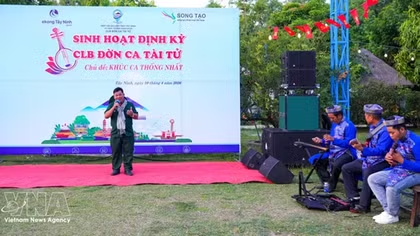
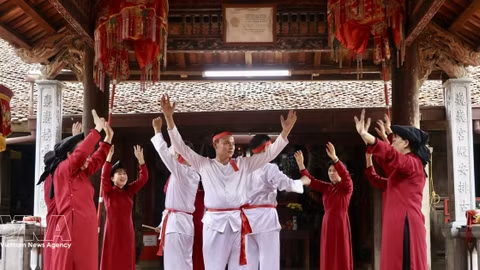
At night, tourists are entertained with folk music performances by locals.

Phuong said around 40 locals are divided into two teams to serve guests. Interested visitors can join the performance as well.

In day time, tourists can join locals to fish, farm and make traditional food, or can visit historical sites like Nong Luc Communal House built under the Nguyen Dynasty (1802-1945), Bac Son Guerilla Museum, Mo Nhai French Military Station and Vu Lang Shooting Site.

VNS/VNA

Other News

Vietnam secure berth at FIFA U17 World Cup 2026 for first time

Vietnam secure berth at FIFA U17 World Cup 2026 for first time

Vietnam national U17 football team secured a place at the FIFA U17 World Cup 2026 for the first time after defeating United Arab Emirates national U17 football team 3-2 on in the final Group C match of the AFC U17 Asian Cup 2026 in Saudi Arabia on early May 14 (Vietnam time).

Vietnam’s most beautiful railway station twins with French counterpart

Vietnam’s most beautiful railway station twins with French counterpart

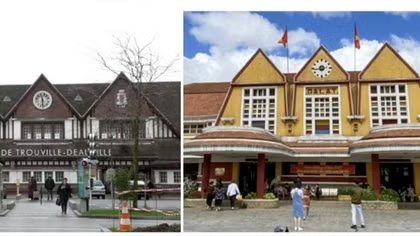
A twinning agreement between Da Lat Railway Station in Vietnam and Trouville-Deauville Railway Station in France was signed at the French Embassy in Vietnam on May 7, creating new opportunities for cooperation in station management and operations, as well as cultural and tourism promotion between the two sides.

Hanoi gains two more craft villages in World Crafts Cities network

Hanoi gains two more craft villages in World Crafts Cities network

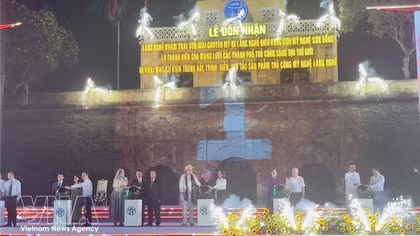
The recognition of Chuyen My and Son Dong craft villages as members of the World Crafts Cities network represents international acknowledgement of the cultural value, artisanal techniques, creativity and sustainable vitality of Vietnam’s traditional craft villages, he said.

Thang Long - Hanoi Festival 2026 to return in September

Thang Long - Hanoi Festival 2026 to return in September

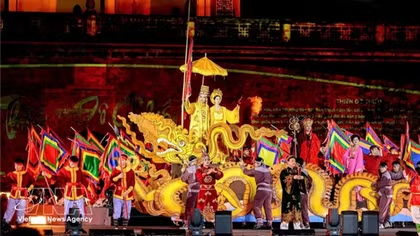
Co-hosted by the municipal People’s Committee, the Department of Culture and Sports, and domestic and foreign agencies, the whole spectacle is meant to honour the city’s millennia-old heritage while reafffirming its strategy of establishing culture as a development engine.

Spreading Vietnamese cultural identity in digital space

Spreading Vietnamese cultural identity in digital space

In the context of deep international integration, cultural identity serves as both a “shield” against assimilation and a defining marker of a nation’s image. Protecting and promoting uniquely Vietnamese cultural values has therefore become a pressing task, particularly in an increasingly complex digital environment.

ITE HCMC 2026 to promote Vietnam’s tourism on global map

ITE HCMC 2026 to promote Vietnam’s tourism on global map

With its large scale, the ITE HCMC 2026 aims to promote tourism cooperation between Vietnam and priority markets such as Northeast Asia, Western Europe, North America, Southeast Asia, and Oceania while also boosting visitor arrivals from the Indian market

Vietnamese puppetry seeks renewal amid preservation challenges

Vietnamese puppetry seeks renewal amid preservation challenges

Although widely regarded as a cultural “speciality” attracting tourists, Vietnamese puppetry is facing multiple challenges in preservation and development, requiring renewed efforts to both safeguard its identity and adapt to contemporary cultural currents.

Project on digital transformation in cultural sector approved

Project on digital transformation in cultural sector approved

By 2030, the project targets the establishment of shared digital platforms across 100% of cultural sectors. All digitised cultural heritage will be standardised under the national data framework and shared in accordance with regulations, while 80% of public digital heritage assets are expected to receive digital identifiers to clarify ownership and management, encouraging organisations and individuals to do the same and support market development.

Vietnam eyes becoming region’s leading tourism destination

Vietnam eyes becoming region’s leading tourism destination

Vietnam has in recent years undergone a notable transformation in its tourism development strategy, placing a strong emphasis on nature-based and eco-tourism. This shift is not merely aligned with global trends, but represents a necessary step towards safeguarding valuable natural resources, while appealing to a growing segment of environmentally conscious travellers.