People’s Artist and movie star Tra Giang’s impressions of nature will be shown at a solo exhibition to celebrate Lunar New Year at the HCM City Fine Arts Museum next week.
Giang, one of the country’s first and leading movie actresses, has found recognition for her painting. Her exhibition Qua Mien Tay Bac (Travelling to Northwest) contains 30 paintings featuring the beauty of the Vietnamese people, colourful flowers, fruits and landscapes.
Featured works include Hai Hau — Nam Dinh (Hau River in Nam Dinh province), Deo Pha Din (Pha Din Mountain Pass), Ban Xin Chai – Sapa (Xin Chai Village in Sapa) and Thung Lung Do (Red Valley), which portray moutainous areas and local people.
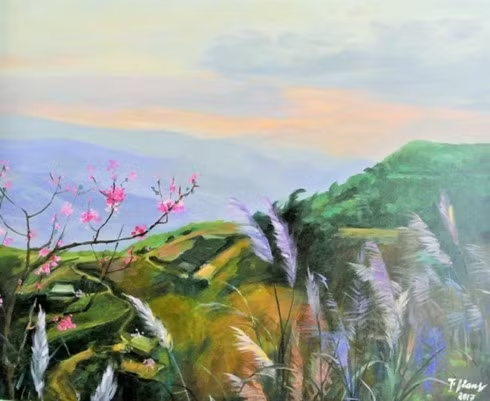 |
Her still life paintings of flowers show movement and are rendered in vivid colours, forms and textures.
"I decided to spend my remaining time on painting because I found in art an unlimited love for life and people," said the 76-year-old Giang, in an interview with Sai Gon Giai Phong (Liberated Saigon) newspaper.
Born in Quang Ngai province, Giang studied at the Vietnam Cinematography School in 1959. She began her career when she was at school.
Her first film was Mot Ngay Mua Thu (The First Day of Fall), a production by Huy Van, one of the country’s most talented movie directors.
Known as a movie star in the 1970s, Giang played leading roles in quality movies such as Vi Tuyen 17 Ngay va Dem (Parallel 17 Days and Nights), Chi Tu Hau (Mrs Tu Hau) and Ngay Le Thanh (The Holy Day), which are recognised as canons of the Vietnam revolutionary movie.
Playing a southern woman during the American War in both Vi Tuyen 17 Ngay va Dem by People’s Artist Hai Ninh and Chi Tu Hau by People’s Artist Pham Ky Nam, she won the best actress prize at the Moscow International Film Festival in 1963 and 1973.
She performed in dozens of films directed by gurus such as Bach Diep and Tran Phuong.
Giang began her love for painting in 1999 when her close friends, female artist Le Thi Thoa, former deputy director of the Pasteur Institute, and renowned artists Mai Truc and Quang Luan, influenced her.
The desire to paint led Giang to study at classes at the Ho Chi Minh City University of Fine Arts.
"I work like a kid with fresh love and enthusiasm for art,” said Giang, adding that through painting she can fly and dance as free as a bird.
Her first solo exhibition, He Ve (Summer Comes Back), opened at Lotus Gallery in 2006, and since then, she has organised dozens of solo and group exhibitions.
Her last solo showcase was Mua Xuan (Spring) at the HCM City Fine Arts Museum. The 10-day exhibition Qua Mien Tay Bac will open on January 18.
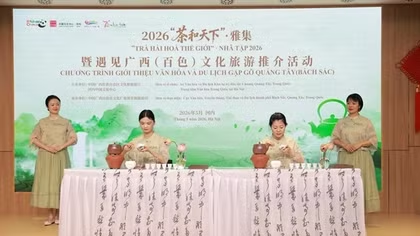
The Tea for Harmony: Yaji Cultural Salon and tourism promotion event themed Meet Guangxi (Baise) brought distinctive Chinese cultural features to the capital through activities organised by the Department of Culture and Tourism of Guangxi Zhuang Autonomous Region.
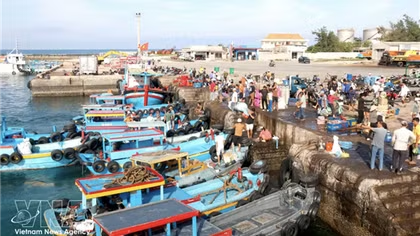
The Phu Quy special zone, an island district off the south-central coast of Vietnam, is capitalising on its strong marine economy potential, particularly in tourism and fisheries, to transform the island’s economy, improve local livelihoods and position itself as a key sea-based economic hub.
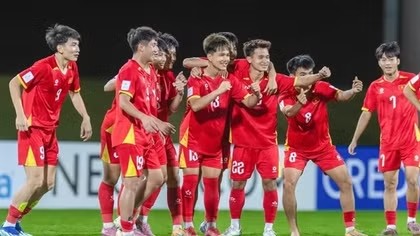
Vietnam national U17 football team secured a place at the FIFA U17 World Cup 2026 for the first time after defeating United Arab Emirates national U17 football team 3-2 on in the final Group C match of the AFC U17 Asian Cup 2026 in Saudi Arabia on early May 14 (Vietnam time).
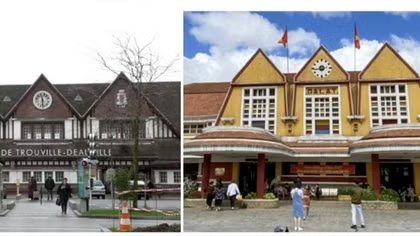
A twinning agreement between Da Lat Railway Station in Vietnam and Trouville-Deauville Railway Station in France was signed at the French Embassy in Vietnam on May 7, creating new opportunities for cooperation in station management and operations, as well as cultural and tourism promotion between the two sides.
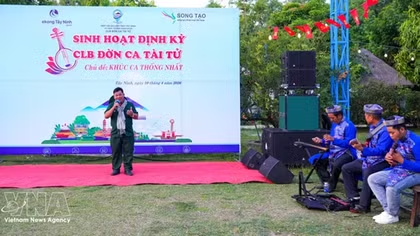
As Tay Ninh identifies tourism as a crucial economic pillar, integrating Don ca tai tu into tourism offerings is seen as a strategic move.
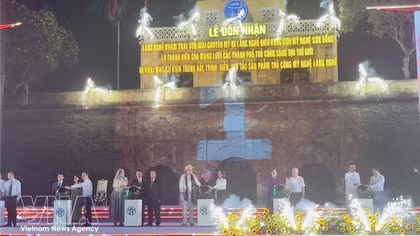
The recognition of Chuyen My and Son Dong craft villages as members of the World Crafts Cities network represents international acknowledgement of the cultural value, artisanal techniques, creativity and sustainable vitality of Vietnam’s traditional craft villages, he said.
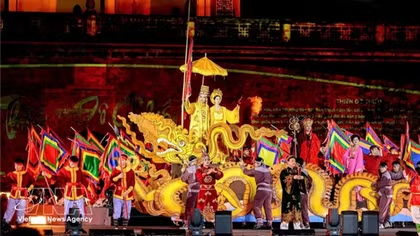
Co-hosted by the municipal People’s Committee, the Department of Culture and Sports, and domestic and foreign agencies, the whole spectacle is meant to honour the city’s millennia-old heritage while reafffirming its strategy of establishing culture as a development engine.
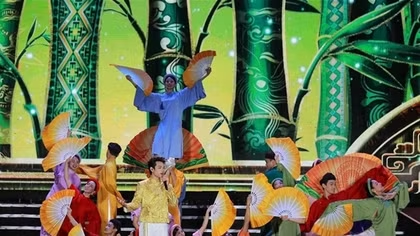
In the context of deep international integration, cultural identity serves as both a “shield” against assimilation and a defining marker of a nation’s image. Protecting and promoting uniquely Vietnamese cultural values has therefore become a pressing task, particularly in an increasingly complex digital environment.
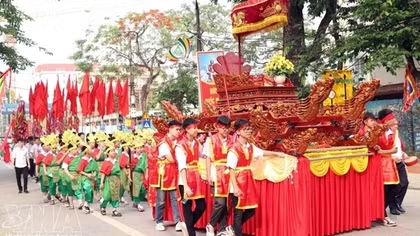
In Ho Chi Minh City, leaders, residents, overseas Vietnamese, students and pupils offered incense and flowers in tribute to the Hung Kings and Nguyen Huu Canh, credited with opening up the Sai Gon – Gia Dinh area.
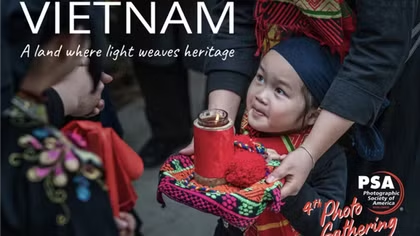
The gathering offers a platform for photographers worldwide to exchange ideas and share experiences, marking the fourth edition of the event.
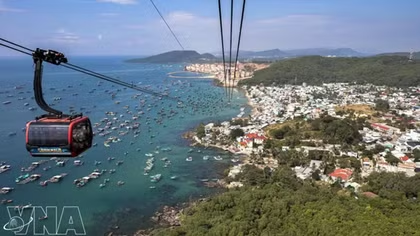
A survey by booking.com shows that around 33% of Vietnamese respondents are planning short domestic trips for the upcoming Hung Kings Commemoration Day and Reunification Day (April 30)–May Day (May 1) holidays, while 22% are opting for longer international journeys compared to last year.
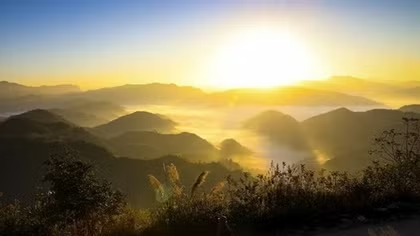
In the first quarter of 2026, Vietnam posted the fastest tourism growth in the region, welcoming 6.76 million international arrivals, up 12.4% year-on-year. Key markets such as China, the Republic of Korea and Taiwan continued to underpin demand.
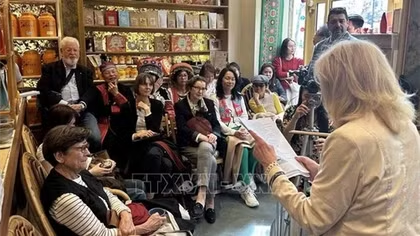
From the moment attendees entered the exhibition space in Paris, visitors were enveloped in a harmonious blend of sensory experiences, with the delicate aroma of tea, the robust notes of coffee, and the vivid colours of Vietnamese handicrafts.
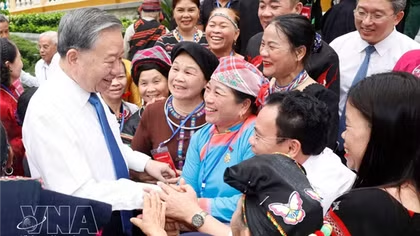
Only when culture is nurtured basing on the self-awareness and pride of each individual can it exist and develop sustainably, remarked Party General Secretary and State President To Lam.
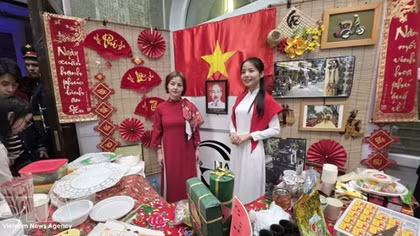
This year’s festival drew the participation of 15 representatives from embassies in Russia, along with a large number of students from countries, including Vietnam, Kazakhstan, Uzbekistan, Tajikistan, Kyrgyzstan and Haiti.
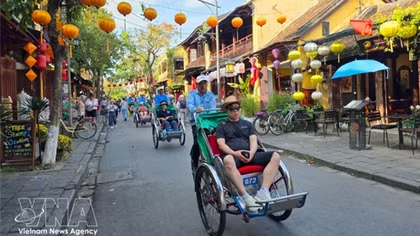
With its large scale, the ITE HCMC 2026 aims to promote tourism cooperation between Vietnam and priority markets such as Northeast Asia, Western Europe, North America, Southeast Asia, and Oceania while also boosting visitor arrivals from the Indian market
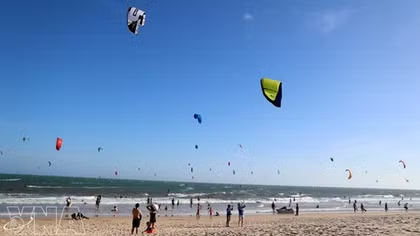
Mui Ne’s appearance in global trend reports signals a new movement, where destinations can no longer rely solely on scenery but must tell their own stories and craft distinctive and personalised experiences.
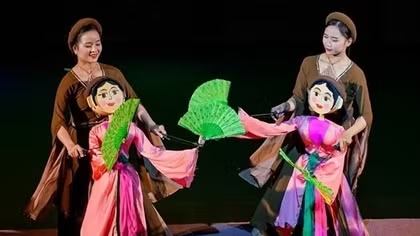
Although widely regarded as a cultural “speciality” attracting tourists, Vietnamese puppetry is facing multiple challenges in preservation and development, requiring renewed efforts to both safeguard its identity and adapt to contemporary cultural currents.
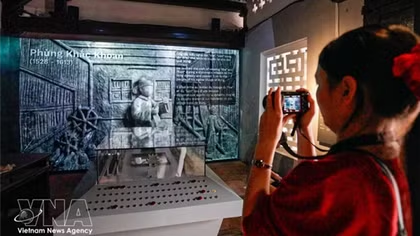
By 2030, the project targets the establishment of shared digital platforms across 100% of cultural sectors. All digitised cultural heritage will be standardised under the national data framework and shared in accordance with regulations, while 80% of public digital heritage assets are expected to receive digital identifiers to clarify ownership and management, encouraging organisations and individuals to do the same and support market development.
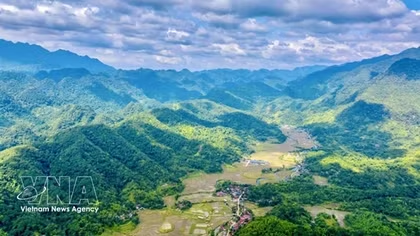
Vietnam has in recent years undergone a notable transformation in its tourism development strategy, placing a strong emphasis on nature-based and eco-tourism. This shift is not merely aligned with global trends, but represents a necessary step towards safeguarding valuable natural resources, while appealing to a growing segment of environmentally conscious travellers.