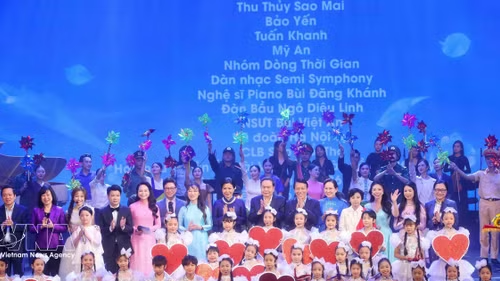
A music video dedicated to 10 young female volunteers who sacrificed their lives for the Dong Loc Victory touched the audience’s hearts during its debut on July 25 in Hanoi.

The video, entitled Cuc Oi, is based on a song of the same name composed by Hang Ry, adopted from the poem written by Yen Thanh.
Excellent Artist To Nga has had the idea to make the video for 12 years, but for a number of reasons was unable to release it until now.
Nga said it’s the biggest project in her 25-year-long career.
She invested a lot of time and effort to make the music video like a short movie, with professional audio, beautiful scenes and impressive special effects. Two hundred actors and actresses were involved in filming.
In the video, Nga performs the song Cuc Oi and narrates the story of Ho Thi Cuc, one of ten female volunteers at the Dong Loc T-junction.
Located in Dong Loc commune, Can Loc district in the central province of Ha Tinh, Dong Loc T-junction is a part of the Ho Chi Minh Trail.
From 1965 to 1968, the US army dropped nearly 50,000 bombs and fired tens of thousands of missiles on the Dong Loc T-junction to cut off the transport route to the southern front.
At that time, in order to keep traffic flowing, all human resources were mobilised to clear the road.
Ten girls volunteered to work at the Dong Loc T-junction to ensure the safe operation of the transport route sending supplies to the southern front.
At noon on the 15th day of bombing, a bomb fell very close to the mouth of the cave where the 10 volunteers, aged from 17 to 24, were sheltering while they worked to fill in bomb craters to reopen the intersection. The bomb killed them all on July 24, 1968.
The bodies of most of the young girls were soon found. However, Cuc was found many days later. It was said that Cuc was an innocent, kind-hearted and energetic girl. She and other girls at the Dong Loc T-junction become an inspiration for many works of art.
There are many songs and poems about them but Nga chose the one composed by poet Yen Thanh and musician Hang Ry because she felt a connection with it. Thanh was also a comrade of her father during the war.
“My team felt emotional during their time making the music video in Ha Tinh province,” said Nga.
“We want to dedicate this work to the brave girls at Dong Loc T-junction.”
For director Lam Ha, making this video was a big challenge because war is a difficult subject for any director.
“I tried to make something different from other films of this genre. The fierce scenes of the war just highlight the beauty of the people’s souls.”
“Though the story is about war, it’s a music video, not a historical film, so it’s still made in a very artistic way.”
The debut is one among many activities to commemorate the 50th anniversary of the death of 10 girls at Dong Loc T-junction.


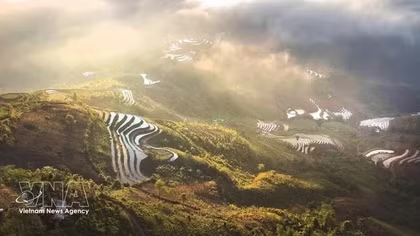
In recent years, Ta Xua, dubbed "the paradise of clouds", has emerged as one of the mountainous destinations attracting strong interest from young travellers, particularly for its spectacular sea of clouds stretching across the mountains in the northwestern region.
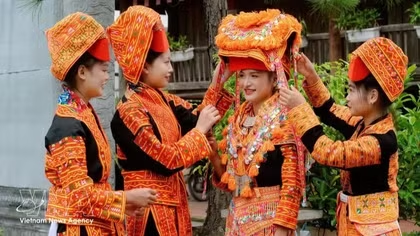
Training local young people in filming, audio recording, digital storytelling, data preservation and responsible use of AI can help build a new generation of cultural custodians. This, in turn, can help transform cultural heritage into a resource for economic development while contributing to the country’s broader development.
The exhibits are presented as historical and legal materials proving Vietnam’s sovereignty over Hoang Sa and Truong Sa in the East Sea.
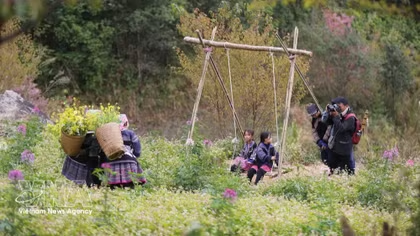
With growing recognition of indigenous knowledge, customs and cultural values as unique assets, ethnic communities in the northern mountainous region are shifting from simply providing tourism services to becoming creators and owners of tourism products, confidently telling their own cultural stories
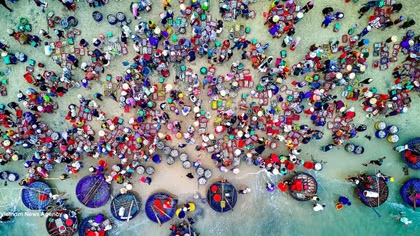
When local people remain the custodians of their resources, tourism can become a reason for them to stay, maintain their livelihoods, and renew community value rather than replacing it.

Alongside the RoK, Da Nang has stepped up tourism promotion in India, Japan, China, Russia and CIS countries, Australia, Europe, the Middle East and Southeast Asia.

Jonathan Wallace Baker, UNESCO Representative to Vietnam, noted that the official proclamation of the 2027–2036 period as the "International Decade of Culture for Sustainable Development" comes at a particularly important moment. As the international community works to accelerate progress towards the 2030 Agenda while beginning to consider what comes after 2030, the Decade provides a ten-year framework to strengthen the place of culture in development.
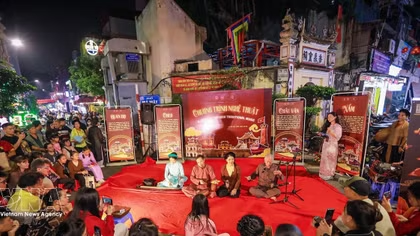
Under Resolution 80-NQ/TW, dated January 7, 2026, November 24 was designated Vietnam Culture Day, to be observed annually. The occasion aims to give the public opportunities to participate in, create and enjoy cultural activities, helping spread positive values and foster pride in Vietnamese culture.
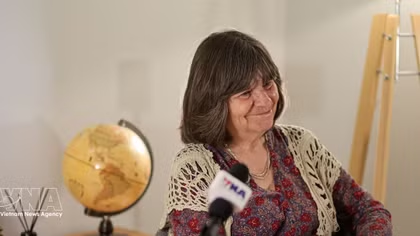
"Vietnam is part of my life," affirmed Patricia Abarzua Munoz, emphasising that the friendship between the Chilean and Vietnamese peoples is built on shared values and mutual respect.

For the MICE tourism sector in both Ho Chi Minh City and Vietnam, growth can no longer be driven merely by increasing the number of events; instead, the focus must shift to enhancing the value of each event and the competitiveness of each destination.
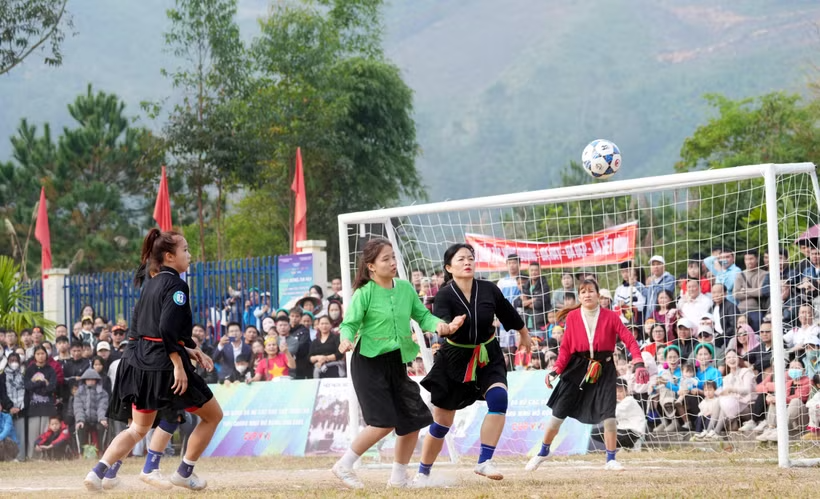
Women’s football movements in local communities have been quietly growing, but they’ve now built up enough momentum to inspire organisers to launch the first Vietnam Ethnic Minority Women’s Football – VTV Cup in 2026.
For 2026, Vietnam's tourism sector is targeting 25 million foreign arrivals, 150 million domestic trips and total revenue of 1.125 quadrillion VND (43 billion USD).

Vietnamese film Quan Ky Nam (Ky Nam Inn) has won several awards at the 25th Imagine India International Film Festival (IIIFF) in Madrid, including Best Director.

According to the magazine, boat trips into Phong Nha Cave and strolls through Paradise Cave (both family-friendly) offer a tantalising glimpse of their astonishing scale, but the real adventure lies deeper within the park, where cavers wade through underground rivers and weave among stalagmites.

Tourism effectiveness should be measured not only by visitor numbers and revenue, but also by spending, length of stay, repeat visits, job quality, visitor satisfaction and environmental carrying capacity, said experts.

The National Statistics Office under the Ministry of Finance reported that Vietnam welcomed nearly 2 million international visitors in August, up 19.7% from July and 18.4% year-on-year. The figure represented 63.6% of the tourism sector’s full-year target of 25 million arrivals.

For the Mong people in Ta Dung, Dak R’mang is not merely a weekly rendezvous, but a space preserving memories of their northwestern hometowns and cultural identity in their new land.

Ngo Phuong Ly, the spouse of General Secretary of the Communist Party of Vietnam Central Committee and President To Lam, said the two countries share similarities in silk weaving and can enrich their cultural heritage through exchanges and experience sharing.

The Ho Chi Minh City Department of Tourism said on late September 2 that the southern metropolis welcomed an estimated 1.65 million domestic visitors and 62,000 foreign tourists over the break.