Forum discusses internationalisation in higher education

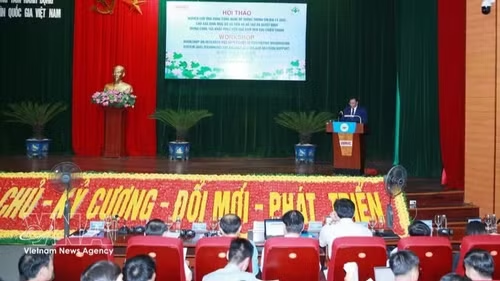
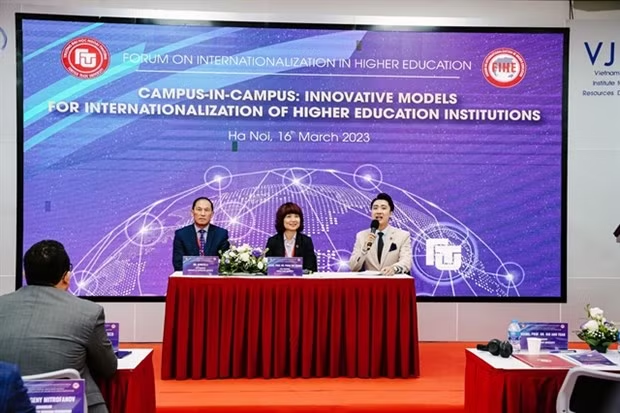
"Campus-in-Campus: Innovative Models for Internationalisation of Higher Education Institutions" was the main theme of the sixth international forum on internationalisation in higher education (FIHE 6) taking place in Hanoi on March 16.

The FIHE 6 attracted more than 200 representatives from over 80 educational institutions, organisations and businesses domestically and internationally as well as 25 embassies in Vietnam.

The annual event, which has been an initiative of the Foreign Trade University (FTU) since 2017, is a forum for higher education institutions to exchange ideas, explore collaboration opportunities and pursue their internationalisation goals.
Forum discusses internationalisation in higher education -0
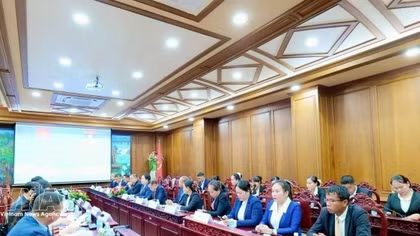
A panel discussion at the sixth international forum on internationalisation in higher education (FIHE 6) in Hanoi on March 16. (Photo courtesy of FTU)

Speaking at the event, FTU President Bui Anh Tuan said that internationalisation activities at universities have become one of the most important and urgent tasks to improve the quality of education and provide global learning experiences for Vietnamese students as well as international students in Vietnam.

“Higher education institutions need to realise the importance of replacing traditional approaches and build new partnering models to optimise borderless resources for training programmes, documents, and facilities and ultimately achieve sustainable development for higher education,” said Tuan.

“With the aim towards a win-win partnership, reduction of competition and optimisation of education, research and other resources without any national or international barriers, the Campus-in-Campus (CiC) model can be considered a breakthrough initiative in the internationalisation of higher education by sharing resources of campuses among partner institutions. This will facilitate and enhance borderless mobility including but not limited to programmes, curricula, students, and faculty among higher education institutions across regions and by that, making full use of available resources. Education for all in this case can be done through Sustainable Development Goals,” said Tuan.

At the event, speakers said that the internationalisation of education was no longer a new topic. However, unequal resource allocation and economic gaps have created significant differences among countries. This is a time when higher education institutions need a strategic vision and effective resource utilisation. In this context, cross-border cooperation in higher education plays an important role in the development of higher education institutions, and the CiC model can help these institutions maximise resources for the benefit of stakeholders.

A highlight of the FIHE 6 was an open fair on internationalisation in higher education. The fair showcases the internationalisation activities of FTU’s partner universities and organisations. It also provided a platform for stakeholders in the higher education ecosystem to share experiences, lessons learned, and critical points to consider when implementing internationalisation in higher education.
VNA

Other News

Hanoi ready to implement Capital Law 2026, unlocking new development momentum

Hanoi ready to implement Capital Law 2026, unlocking new development momentum

The effectiveness of the Capital Law 2026 will be measured not by the number of legal documents issued but by tangible improvements in governance and public administration, better services for people and businesses, faster administrative procedures, stronger investment attraction and higher economic growth.

Vietnamese students earn honours at ROBOG Asia Cup 2026

Vietnamese students earn honours at ROBOG Asia Cup 2026

Three teams from Chu Van An Secondary School in Vietnam’s Thai Nguyen province have earned First Prize honours and advanced to the quarterfinals at the ROBOG Asia Cup 2026, a regional robotics and artificial intelligence (AI) competition for students held in Hong Kong, China.

Hanoi sets out new investment blueprint with century-long development vision

Hanoi sets out new investment blueprint with century-long development vision

As of early June, Hanoi had attracted 74.6 billion USD in foreign direct investment (FDI) through more than 9,250 valid projects. FDI inflows in the first six months were projected at 3.2 billion USD, surpassing the annual target by 116%, while nearly 16,000 new businesses were established in the first five months, up 34.4% year-on-year.

Vietnam promotes legal cooperation and rule of law at global forum

Vietnam promotes legal cooperation and rule of law at global forum

Vietnam’s development and international integration have gone hand in hand with the improvement of its legal system, the incorporation of international commitments into domestic legislation, and legal reforms aimed at fostering development, openness and global integration. The country regards international law as an essential instrument for building fair, mutually beneficial relations among nations.

Hanoi to hold investment promotion event on June 29

Hanoi to hold investment promotion event on June 29

At the event, Hanoi authorities plan to grant investment policy decisions and investment registration certificates to 20 exemplary projects in the fields of transportation infrastructure, industrial parks, urban development, social housing, environment, science and technology, and foreign investment attraction.

Hanoi's Red River urban area development draws widespread attention

Hanoi's Red River urban area development draws widespread attention

Located south of the Red River and extending from the historic inner city to newly developing areas in the south and the west, the central urban area along Red River’s right bank covers approximately 45,317 hectares and is projected to accommodate around 6.365 million residents by 2045 and 6.455 million by 2065.

Hanoi's Red River urban area development draws widespread attention

Hanoi's Red River urban area development draws widespread attention

Located south of the Red River and extending from the historic inner city to newly developing areas in the south and the west, the central urban area along Red River’s right bank covers approximately 45,317 hectares and is projected to accommodate around 6.365 million residents by 2045 and 6.455 million by 2065.

Regional cooperation strengthened to combat cross-border drug crime

Regional cooperation strengthened to combat cross-border drug crime

Vietnam, China, Laos and Myanmar face common challenges as drug syndicates increasingly exploit the Mekong River, cross-border transport networks, e-commerce platforms, international logistics services, cyberspace and cryptocurrencies to organise drug transactions and smuggling operations.