 |
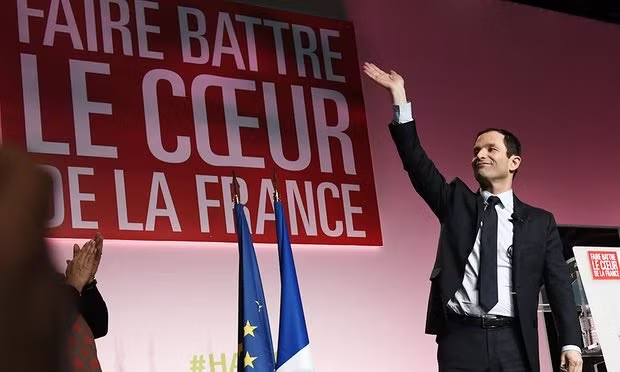
| Benoît Hamon at a public meeting in Marseille, southern France, on Tuesday. Photograph: Anne-Christine Poujoulat/AFP/Getty |
In recent weeks, Benoît Hamon and Jean-Luc Mélenchon have been ploughing their political furrows, criss-crossing France, addressing meetings and outlining their programmes for the presidency.
French Socialists choose leftwing rebel Benoît Hamon for Élysée fight
But for the candidates of the Socialist party (PS) and hard-left movement La France insoumise (Unsubmissive France), the results have been distinctly underwhelming.
Amid the travails of France’s mainstream right, whose candidate’s ever-deepening woes have been dominating media coverage, there has been little space left for the left. Both Mélenchon, a hard-left firebrand, and Hamon, a staunchly leftwing rebel outsider, are struggling to make their voices heard.
Mélenchon, who took 11.1% of the vote in the first round of the last presidential election in 2012 with the backing of the Communist party, has frequently lamented the 2017 campaign is being “hijacked and held hostage” by Les Républicains (LR) and the far-right Front National (FN). But the uproar from the “fake jobs” scandal surrounding François Fillon has drowned out his lament.
“All we’re talking about is this, it’s the decadence of the French Fifth Republic … the system is rotten from within because of money,” Mélenchon told French TV. “We need an electoral campaign. We need to discuss the issues and all we are talking about is an affair that has nothing to do with me. How can we have a democratic debate in these conditions?”
Ali Rabeh, Hamon’s campaign chief of staff, said: “In the meetings people are talking about the real issues. In the media it’s ‘Fillon affair, Fillon affair, Fillon affair’. The debate really has been taken hostage by the right and the far right and that’s complicated for us, because we’re not getting our programme through the media wall.”
Hamon himself, whose platform includes the introduction of a universal basic income, the legalisation of cannabis and a tax on robots, has said the Fillon saga is “saturating the democratic debate”, complaining: “Whenever I’m asked about public services, I’m asked about Fillon. When I want to talk about business, I’m asked about Fillon.”
Fillon and Marine Le Pen are each at the centre of separate “fake jobs” scandals: Fillon is struggling with plummeting popularity but Le Pen is relatively stable and still favourite to win the first round of the election at the end of April.
The left’s problem is that it has not one but four candidates in the first round vote; four and a half if the former Socialist minister Emmanuel Macron, who is standing on a “not right, not left, third way” platform, is counted.
When the French president, François Hollande, announced his decision not to seek a second term in office, he explained that he wanted to avoid the “dispersion and explosion of the left in France”.
The French left, however, has once again dispersed and failed to unite behind a single candidate. If Hamon and Mélenchon were able to pool their voters behind one or the other, polls suggest the single candidate would stand a good chance of being in the second round of the election.
The two men had a brief attempt at talks last month, but neither would give way. Mélenchon cited his superior age and experience; Hamon his greater popularity.
Since then, Hamon, 49, has been boosted by Yannick Jadot, the Ecology party (EELV) candidate who has withdrawn his own candidacy; Mélenchon, 65, is supported, once again, by the Communist party (PCF).
“If we fail to band together, this will be a collective failure,” said Cécile Duflot, from the Ecology party and a former minister in the Socialist government. The mayor of Paris, Anne Hidalgo, has urged leftwing voters to “assemble around Benoît”.