Global Policy Journal: Vietnam may become model of anti-IUU fishing

The US’s Global Policy Journal website has said Vietnam may become a model for ASEAN countries in fighting illegal, unreported and unregulated (IUU) fishing.
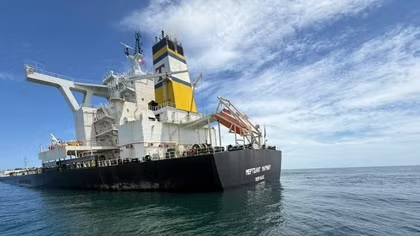
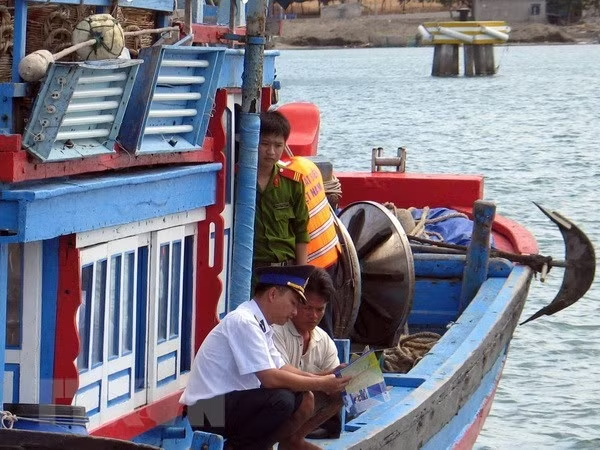
Illustrative image (Source: VNA)

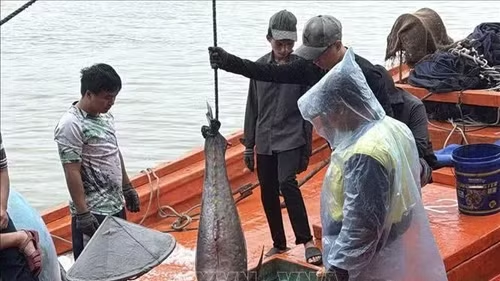
Illustrative image (Source: VNA)

An article published by the website on May 9 said the threat of a bad report card from the European Union (EU) has alarmed more than 30,000 Vietnamese commercial trawlers.

It quoted Tony Long, former Director of the World Wildlife Fund’s European Policy Office and senior fellow of the Global Government Institute, as saying that the EU carding system to drive out illegal fishing is showing it has teeth, adding that countries are terrified that the ultimate sanction, the red card, imposes potentially enormous financial sanctions and significant risks.

The article said, citing source as the Vietnam Association of Seafood Exporters and Processors (VASEP), that fishing is a cornerstone of Vietnam’s economy and since 2006, the nation has been globally ranked among the top 10 exporting countries in fisheries. 
Vietnam’s export of fishery products to the EU and the US range between 1.9 and 2.2 billion USD, and 350 – 400 million USD, respectively.

The article said Vietnam’s Ministry of Agriculture and Rural Development (MARD), the Directorate of Fisheries and VASEP have mandated that all of them take actions to balance fishing capacity and fishing fleet policy. The new Fisheries Law has been approved by the National Assembly, including regulations to fight IUU.

Prime Minister Nguyen Xuan Phuc issued a national action plan to crack down on IUU fishing.  As part of this drive, 62 seafood companies have joined to ensure sustainable practices.

The government has issued several decrees and directives, supplemented IUU fishing regulations to legal documents, enforced regulations, held educational workshops for fishermen, enhanced cooperation with coastal and island countries to prevent IUU fishing and organized regular dialogues with the EU on efforts to improve fisheries management.

Vietnam’s responses also include placing observers, many of whom are former fishing captains, aboard commercial trawlers to monitor catches.

Additionally, fishing captains have been encouraged to keep an accurate logbook or registry of catches for inspection or become subject to fines up to 2,000 USD and revocation of commercial fishing licenses.

The article said Hanoi simply does not want to repeat Thailand’s mistakes, where a high percentage of the fishing fleet is unregistered and outside government control. Neither does it want to follow its neighbour, Cambodia, and be at the end of the line with a red card from the EU and unable to export fish.

The article said the Vietnamese Directorate of Fisheries has developed a national fishery database that integrates data related to fishing vessels including registration, licensing, logbook entries and now uniformly-accepted software (VNFISHBASE) utilised in eight coastal provinces.

It added that there is a need for more vocational centres to educate fishermen about fishing regulations.

According to the Food and Agriculture Organization of the United Nations (FAO), between 11 and 26 million tonnes of fish, or 15 percent of the world catch, are caught illegally every year. As the world’s biggest fish importer, the EU does not wish to be complicit in these unsustainable fishing practices. 

Since 2012, the EU Commission has initiated formal dialogues with several countries, thus the “yellow card” status warning. When significant progress is observed, the commission can end the dialogue or raise the status to a “green card”. When there is no or little compliance, it results in a failing grade - a “red card”, which translates into no exports.

VNA

Other News

Hanoi ready to implement Capital Law 2026, unlocking new development momentum

Hanoi ready to implement Capital Law 2026, unlocking new development momentum

The effectiveness of the Capital Law 2026 will be measured not by the number of legal documents issued but by tangible improvements in governance and public administration, better services for people and businesses, faster administrative procedures, stronger investment attraction and higher economic growth.

Vietnamese students earn honours at ROBOG Asia Cup 2026

Vietnamese students earn honours at ROBOG Asia Cup 2026

Three teams from Chu Van An Secondary School in Vietnam’s Thai Nguyen province have earned First Prize honours and advanced to the quarterfinals at the ROBOG Asia Cup 2026, a regional robotics and artificial intelligence (AI) competition for students held in Hong Kong, China.

Hanoi sets out new investment blueprint with century-long development vision

Hanoi sets out new investment blueprint with century-long development vision

As of early June, Hanoi had attracted 74.6 billion USD in foreign direct investment (FDI) through more than 9,250 valid projects. FDI inflows in the first six months were projected at 3.2 billion USD, surpassing the annual target by 116%, while nearly 16,000 new businesses were established in the first five months, up 34.4% year-on-year.

Vietnam promotes legal cooperation and rule of law at global forum

Vietnam promotes legal cooperation and rule of law at global forum

Vietnam’s development and international integration have gone hand in hand with the improvement of its legal system, the incorporation of international commitments into domestic legislation, and legal reforms aimed at fostering development, openness and global integration. The country regards international law as an essential instrument for building fair, mutually beneficial relations among nations.

Hanoi to hold investment promotion event on June 29

Hanoi to hold investment promotion event on June 29

At the event, Hanoi authorities plan to grant investment policy decisions and investment registration certificates to 20 exemplary projects in the fields of transportation infrastructure, industrial parks, urban development, social housing, environment, science and technology, and foreign investment attraction.

Hanoi's Red River urban area development draws widespread attention

Hanoi's Red River urban area development draws widespread attention

Located south of the Red River and extending from the historic inner city to newly developing areas in the south and the west, the central urban area along Red River’s right bank covers approximately 45,317 hectares and is projected to accommodate around 6.365 million residents by 2045 and 6.455 million by 2065.

Hanoi's Red River urban area development draws widespread attention

Hanoi's Red River urban area development draws widespread attention

Located south of the Red River and extending from the historic inner city to newly developing areas in the south and the west, the central urban area along Red River’s right bank covers approximately 45,317 hectares and is projected to accommodate around 6.365 million residents by 2045 and 6.455 million by 2065.

Regional cooperation strengthened to combat cross-border drug crime

Regional cooperation strengthened to combat cross-border drug crime

Vietnam, China, Laos and Myanmar face common challenges as drug syndicates increasingly exploit the Mekong River, cross-border transport networks, e-commerce platforms, international logistics services, cyberspace and cryptocurrencies to organise drug transactions and smuggling operations.