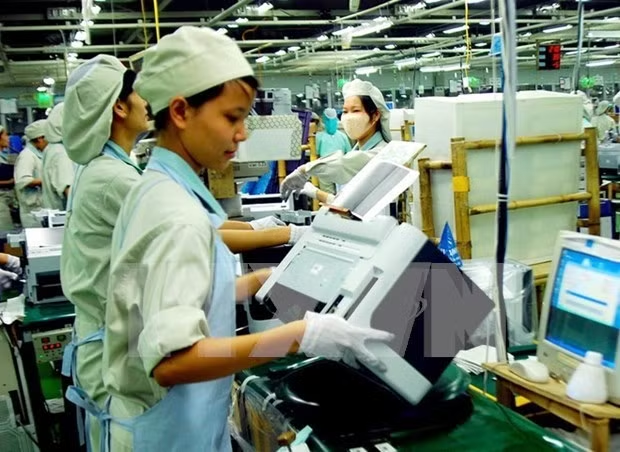
Gov’t issues new rules on foreign workers in Vietnam

The Government recently issued Decree No 152/2020/ND-CP featuring regulations on foreigners working in Vietnam and the recruitment and management of Vietnamese working for foreign organisations and individuals in the country.

The Government recently issued Decree No 152/2020/ND-CP featuring regulations on foreigners working in Vietnam and the recruitment and management of Vietnamese working for foreign organisations and individuals in the country.

This degree stipulates that foreigners working in Vietnam are those under labour contracts; moving within a business; carrying out contracts or agreements on economy, trade, finance, banking, insurance, science - technique, culture, sports, education, vocational training, or health care; providing services under contract; offering services; working for foreign non-governmental organisations or international organisations permitted to operate under Vietnam’s law; working as volunteers; being in charge of setting up trade representative offices; being managers, managing directors, experts, or technical personnel; taking part in the implementation of bidding packages or projects in Vietnam; or being relatives of members of foreign representative agencies in Vietnam who are allowed to work in the country under regulations in the international treaties to which Vietnam is a party.

At least 30 days prior to the day planned to start using foreign labourers, employers, except for contractors, are responsible for identifying the demand for foreign employees for each position that Vietnamese workers have yet to satisfy and explaining the issue to the Ministry of Labour, Invalids and Social Affairs (MoLISA) or the provincial-level People’s Committees in the localities where foreigners are set to work in.

If they want to change the demand for foreign labourers, employers have to report to the MoLISA or provincial-level People’s Committees at least 30 days prior to the day planned to start using foreign labourers, according to the decree.

The decree also stated that in case foreigners are subject to Clauses 3, 4, and 5 of Article 154 in the Labour Code and Clauses 1, 2, 8, 9, 10, 11, 12, and 13 of Article 7 in this decree, employers do not have to identify the foreign labourer demand.

Meanwhile, the MoLISA or the provincial-level People’s Committees have to issue documents accepting or rejecting the use of foreign workers for each job position within 10 working days since the reception of explanation about or report on the change in foreign labourer demand.
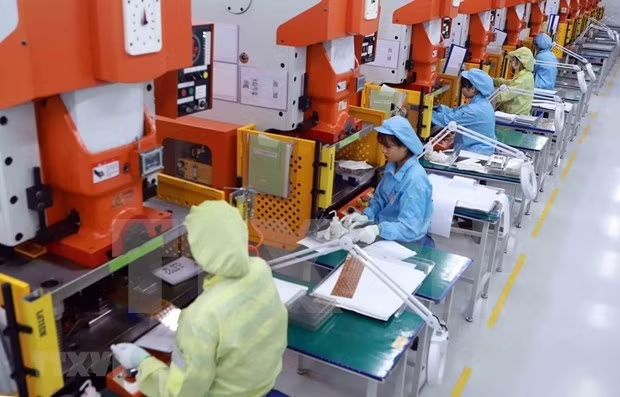
In addition, before recruiting foreigners, contractors has responsibility for detailing the number, professional capacity, and experience of foreign workers they want to employ to implement bidding packages in Vietnam, while proposing the recruitment of Vietnamese workers for the positions for which they plan to employ foreigners to the chairpersons of provincial-level People’s Committees in the localities where bidding packages are carried out.

The chairpersons of provincial-level People’s Committees will order local agencies and organisations to introduce and supply Vietnamese workers for the contractors or coordinate with agencies and organisations in other localities to introduce and supply Vietnamese workers.

If local parties are unable to provide Vietnamese workers for contractors within two months since they receive the request for at least 500 Vietnamese labourers, one month in terms of the request for 100 to less than 500 Vietnamese labourers, or 15 days in terms of the request for under 100 Vietnamese labourers, the chairpersons of provincial-level People’s Committees have to make decisions on contractors’ recruitment of foreigners for the jobs for which no qualified Vietnamese workers are found.

Contractors have to report on the use of foreign employees during the first half of a year and the whole year before July 5 and January 5 of the following year, respectively, the decree said.


VNA

Other News

Vietnam steps up implementation of ethnic affairs strategy through 2030

Vietnam steps up implementation of ethnic affairs strategy through 2030

To accelerate the implementation of the the Ethnic Affairs Strategy by 2030, with a vision toward 2045, the Prime Minister requested ministries, agencies and local authorities to continue thoroughly carrying out the Party and State’s policies on ethnic affairs, enhancing the effectiveness of State management and strengthening oversight of policy implementation.

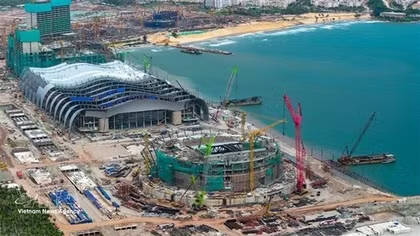
Security preparations reviewed for APEC 2027 in Phu Quoc

Security preparations reviewed for APEC 2027 in Phu Quoc

The team examined the APEC 2027 Convention Centre, where main conference activities are scheduled; Sun Serenia Hospital, designated to provide healthcare and emergency medical services for delegates; provincial road DT.975, which connects Phu Quoc International Airport to the convention centre; and the area surrounding Phu Quoc International Airport.

Hanoi accelerates seven Red River bridge projects, many exceed 70% completion

Hanoi accelerates seven Red River bridge projects, many exceed 70% completion

According to the municipal Transport Construction Investment Project Management Board, the city is simultaneously implementing seven projects, namely Tu Lien, Ngoc Hoi, Tran Hung Dao, Thuong Cat, Van Phuc, Hong Ha and Me So bridges. Construction is being carried out on multiple fronts, focusing on bored piles, pile caps, piers and superstructure works.

Dien Bien battlefield legacy powers tourism revival

Dien Bien battlefield legacy powers tourism revival

Seventy-two years after the Dien Bien Phu Victory, its legacy still reverberates. The unity, self-reliance, and resilience forged in that historic triumph remain a powerful internal engine, now propelling Dien Bien toward fast and sustainable development.

Hanoi accelerates shift to green buses, targets 100% by 2030

Hanoi accelerates shift to green buses, targets 100% by 2030

In the 2027–2030 period, the city will accelerate the transition towards the complete phase-out of fossil fuel-powered buses. The share of electric and green energy-fueled buses is projected to reach 79–89% by 2029 and 100% by 2030.

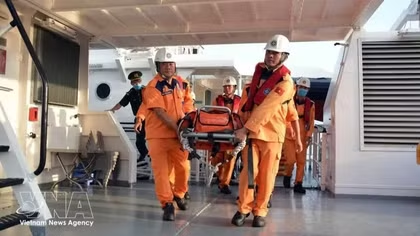
36 fishermen safely rescued after boat breaks down near Truong Sa

36 fishermen safely rescued after boat breaks down near Truong Sa

At 8:00 the same day, KN475 began towing the disabled fishing boat toward Da Tay A island. The towing operation was carried out safely, and by 18:30 both the vessel and its crew had arrived at the island without incident, where repairs and additional support procedures were arranged.

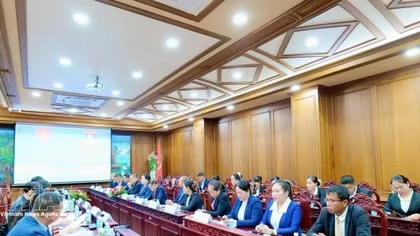
Vietnamese language contest in Laos strengthens youth ties, bilateral friendship

Vietnamese language contest in Laos strengthens youth ties, bilateral friendship

Held in response to the launch of the Vietnamese Language Day among overseas Vietnamese communities, the event aimed to enhance the quality of Vietnamese language teaching and learning in Laos while contributing to the great friendship, special solidarity, comprehensive cooperation and strategic cohesion between the two countries.

Vietnamese language contest in Laos strengthens youth ties, bilateral friendship

Vietnamese language contest in Laos strengthens youth ties, bilateral friendship

Held in response to the launch of the Vietnamese Language Day among overseas Vietnamese communities, the event aimed to enhance the quality of Vietnamese language teaching and learning in Laos while contributing to the great friendship, special solidarity, comprehensive cooperation and strategic cohesion between the two countries.

Hanoi launches 10 electric bus routes from April 1

Hanoi launches 10 electric bus routes from April 1

By the end of April, the number of buses using electricity and other green energy sources in the city is expected to reach 822, including 683 electric buses and 139 compressed natural gas (CNG) buses, representing 42.1% of the total number of vehicles.