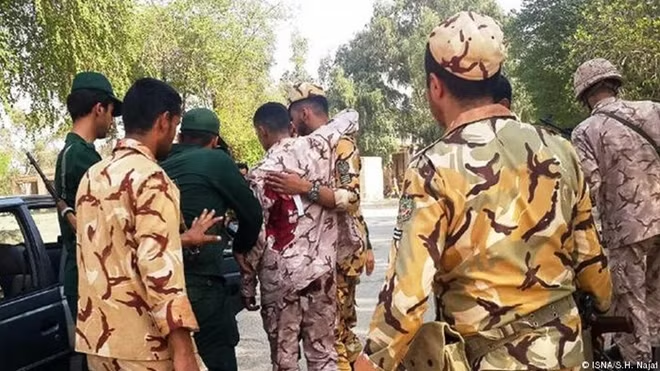
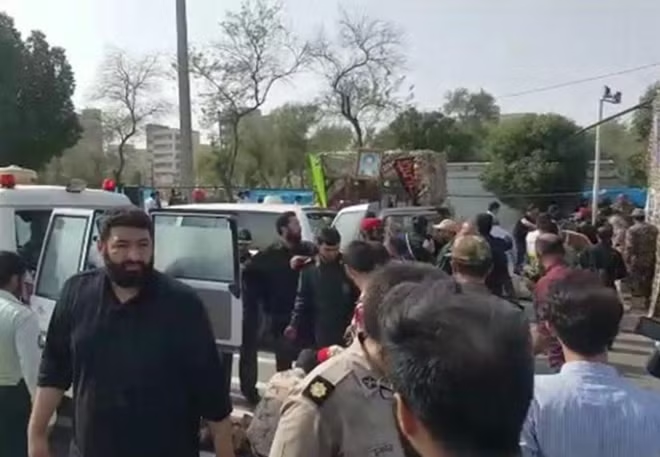
State television said the assault, which wounded more than 60 people, targeted a stand where Iranian officials had gathered in the city of Ahvaz to watch an annual event marking the start of the Islamic Republic’s 1980-88 war with Iraq.
An Iranian ethnic Arab opposition movement called the Ahvaz National Resistance, which seeks a separate state in oil-rich Khuzestan province, claimed responsibility for the attack.
Islamic State militants also claimed responsibility. Neither claim provided evidence. All four attackers were killed.
Women and children also died in the assault, state news IRNA agency reported.
 |
Brigadier General Abolfazl Shekarchi, a senior spokesman for Iran’s armed forces, said the attackers had hidden weapons in an area near the parade route several days in advance.
“All four terrorists were quickly neutralized by security forces,” Shekarchi told state television. “A four-year-old girl and a wheelchair-bound war veteran were among the dead.”
Attacks on the military are rare in Iran.
The bloodshed struck a blow to security in OPEC oil producer Iran, which has been relatively stable compared with neighboring Arab countries that have grappled with upheaval since the 2011 uprisings across the Middle East.
The Islamic Revolutionary Guards Corp (IRGC),the most powerful and heavily armed military force in the country, have been the sword and shield of Shi’ite clerical rule in Iran since its 1979 Islamic Revolution.
The Guards play a big role in Iran’s regional interests and have a vast stake worth billions of dollars in Iran’s economy.
A video distributed to Iranian media showed soldiers crawling to escape gunfire. One picked up a gun and scrambled to his feet as women and children fled for their lives.
 |
WHERE DID THEY COME FROM?
A video on state television’s website showed confused soldiers. Standing in front of the stand, one asked: “Where did they come from?” Another responded: “From behind us.”
State television blamed “takfiri elements”, a reference to Sunni Muslim militants, for the attack. Ahvaz is in the center of Khuzestan province, where there have been sporadic protests by minority Arabs in predominantly Shi’ite Iran.
The gunmen were trained by two Gulf Arab states and had ties to the United States and Israel, according to Shekarchi.
“They are not from Daesh (Islamic State) or other groups fighting (Iran’s) Islamic system ... but they are linked to America and (Israel’s intelligence agency) Mossad,” he told state news agency IRNA.
There was no immediate Gulf Arab comment on his remarks.
Tensions between mainly Shi’ite Iran and mostly Sunni Saudi Arabia have risen in recent years, with the two countries supporting opposite sides in wars in Syria and Yemen and rival political parties in Iraq and Lebanon.
Iranian President Hassan Rouhani ordered security forces to identify those responsible for the violence, the semi-official ISNA news agency said.
The attack occurred a day before Rouhani heads to New York to address the annual U.N. General Assembly next week.
“Rouhani will use the terrorist attack to justify Iran’s presence in the Middle East...The attack will strengthen the IRGC’s position inside Iran and in the region,” Tehran-based political analyst Hamid Farahvashian said.