- Take a look at the future of Ha Long Bay's cruise ships
- Director of “Kong: Skull Island” revisits Ha Long Bay
- Kayak services on Ha Long Bay resume

Recognised twice by the UNESCO as a global heritage, Ha Long Bay remains one of the country’s top attractions – drawing in 9.87 million tourists last year, of which, 4.28 million are foreign tourists, bringing in US$797 million in revenues, up 30% against 2016.
Everyone it seems wants a slice of the pie with a boom in accommodation – 12,000 rooms, 80 hotels, and 512 cruises (including overnight ones).
Pham Dinh Huynh, deputy head of the bay’s management board, said the international recognition of the Bay has been a boom to the province’s development but also causes a lot of troubles for the authorities.
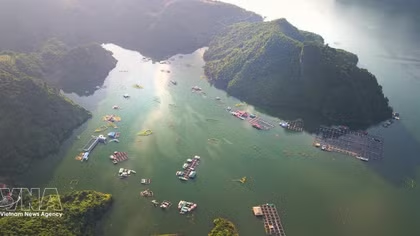
Ha Long Bay is not just a purely tourist site. Several vital socio-economic activities make use of the bay – marine transport route cuts through the bay to move goods from Cai Lan Port to Hai Phong Port and others, aquaculture activities on the water surface, in addition to the rapid expansion of coastal urban areas including the planned development of the special economic zone Van Don.
Dang Van Bai, vice chairman of the Vietnam Heritage Association, shared his concerns over whether the understaffed management board could be capable of overseeing the 438sq.km heritage area with 788 islands of various sizes.
The issue of wastewater involves many stakeholders, coming from different places, discharging different types of wastewater – coal mining, operations of fishing vessels, operations of hotels or restaurants – therefore, any unilateral action plan would not be effective, stressed Jake Brunner, programme coordinator of International Union for Conservation of Nature (IUCN) in Vietnam.
Ho Quang Huy, vice chairman of the provincial People’s Committee, acknowledged that the future of the bay depends on commitments to particular measures to safeguard its environment. Huy said that the province is hastening the building of legal frameworks to make sure a rigorous implementation of the environment master plan envisioned for the bay, as well as mechanisms for cooperation between competent bodies.
The role of community-based campaigns conducted by both the State organisations like youth’s union, women’s association, as well as civil societies are also underlined, with specific activities such as awareness raising campaigns held across schools in the area, or clean-up operations on the beach and over the waters.
Huy also said that in the future, the authorities will need to hold comprehensive water quality monitoring more frequently, at least once every three months, as well as more unannounced inspections to timely prevent violations.
The operations of the hundreds of cruise ships in the Ha Long Bay area inevitably results in bilge water, and the pollution threats from this oily mixture poses are so dangerous that three years ago, the province has ordered a halt on building any more tourist cruise, otherwise the number would not just be kept at the current 500-600 but might swell to thousands, Huynh said.
“Previously, with lax regulations, most cruises operated without supervision, only recently the province has started to enforce stricter rules, but at the moment, only 10% of the cruises are outfitted with bilge water treatment system, while the remaining 90% are old-schooled sailboats and could not be added such a system,” he said.
However, even so, according to IUCN, with experts’ estimating the daily wastewater discharge from cruises reaching some 502cu.m, a treatment system that is capable of handling the total amount of wastewater could cost around US$3.1 million – 1.2 million for 12 boats for collecting bilge water, US$800,000 for port-based treatment plants, and US$500,000 for necessary on-board equipment for cruises. The daily operational cost for the entire system would come to US$251 a day, which would require cruise operator to pay up to US$5 per cu.m of wastewater handled.
Nguyen Duy Phu, Chairman of the Pelican luxury cruise company, said they have studied IUCN’s figures and concluded that the actual number of ships needed to collect bilge water from all cruises operational in the bay would be at least five times higher than the suggested figure, which would mean the total investment needed for the wastewater treatment would rocket to a dozen million dollars.
Phu also shared the bay management board’s position that despite various efforts and programmes by the province, “it’s not enough, and would never be enough if we only rely on State resources.”
Do Van Ha, Director of the Ha Long JSC, said the tourist companies are willing to co-operate with authorities to design the wastewater treatment system in the bay. Ha also suggested that the tourist companies could ‘start with small things’ right now, for example, switching to the use of biopolymer packaging as well as cooperation with local people to collect and recycle plastic waste.
Recently, Quảng Ninh Province has implemented a US$29.6 million programme (sourced from Japan’s ODA) to collect waste on land, but a water protection programme in similar veins is still lying in waiting.
When Vietnam is preparing documents to seek the third recognition of Ha Long Bay as the world heritage site from UNESCO, it’s highly important that the water resources in the area are put under tighter control.