Hanoi to pilot new grassroots governance model in two communes

The pilot aims to translate the goals and characteristics of socialism into practical governance at the grassroots level while developing a modern, transparent, efficient and service-oriented local administration.

Hanoi will pilot a new "socialist commune/ward" model in Phuc Thinh and Thu Lam communes as part of efforts to modernise grassroots governance and improve the quality of life and well-being of residents.

The initiative is outlined in Resolution No. 16-NQ/TU, issued on July 8 by the municipal Party Committee. The pilot aims to translate the goals and characteristics of socialism into practical governance at the grassroots level while developing a modern, transparent, efficient and service-oriented local administration that promotes people's right to mastery and serves as a basis for refining policies before wider implementation across the capital.

hanoi.jpg
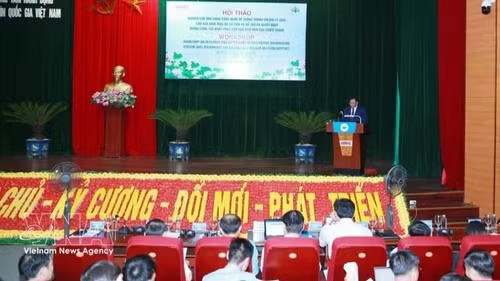
Hanoi will pilot a new "socialist commune/ward" model in Phuc Thinh and Thu Lam communes. Illustrative photo: VNA

According to the resolution, people will be placed at the centre of the model, serving as both the driving force and ultimate beneficiaries of development. Policies and solutions will focus on improving living standards, ensuring social equity and progress, leaving no one behind, and promoting balanced development across the economy, culture, society and the environment.

Phuc Thinh and Thu Lam were selected for the pilot based on their development potential, infrastructure conditions, governance capacity and readiness for innovation. Hanoi will conduct comprehensive assessments of the pilot implementation, including its impact on resources, infrastructure, human capital, data management and governance capacity, while also examining regional connectivity issues such as transport, public services, environmental protection and public security.

To ensure effective implementation, the city will establish a controlled pilot mechanism covering new approaches to spatial planning, service-oriented local governance, citizen participation, and systems for measuring quality of life and happiness. A unified set of measurable evaluation criteria will also be developed.

The city will prioritise investment in the pilot areas, improve the capacity of grassroots officials, accelerate digital transformation, build shared data platforms and expand commune-level digital administration services, including fully online public services and digital systems for receiving and monitoring public feedback.

Under the roadmap, Hanoi will finalise the project and implementation plan in 2026. The model will be rolled out in the two pilot communes during 2027–2030, followed by a review in 2030 to refine policies and consider broader expansion. If successful, the model will be gradually extended to other eligible localities during 2031–2035 before a comprehensive evaluation in 2035.


en.vietnamplus.vn

Other News

Hanoi ready to implement Capital Law 2026, unlocking new development momentum

Hanoi ready to implement Capital Law 2026, unlocking new development momentum

The effectiveness of the Capital Law 2026 will be measured not by the number of legal documents issued but by tangible improvements in governance and public administration, better services for people and businesses, faster administrative procedures, stronger investment attraction and higher economic growth.

Vietnamese students earn honours at ROBOG Asia Cup 2026

Vietnamese students earn honours at ROBOG Asia Cup 2026

Three teams from Chu Van An Secondary School in Vietnam’s Thai Nguyen province have earned First Prize honours and advanced to the quarterfinals at the ROBOG Asia Cup 2026, a regional robotics and artificial intelligence (AI) competition for students held in Hong Kong, China.

Hanoi sets out new investment blueprint with century-long development vision

Hanoi sets out new investment blueprint with century-long development vision

As of early June, Hanoi had attracted 74.6 billion USD in foreign direct investment (FDI) through more than 9,250 valid projects. FDI inflows in the first six months were projected at 3.2 billion USD, surpassing the annual target by 116%, while nearly 16,000 new businesses were established in the first five months, up 34.4% year-on-year.

Vietnam promotes legal cooperation and rule of law at global forum

Vietnam promotes legal cooperation and rule of law at global forum

Vietnam’s development and international integration have gone hand in hand with the improvement of its legal system, the incorporation of international commitments into domestic legislation, and legal reforms aimed at fostering development, openness and global integration. The country regards international law as an essential instrument for building fair, mutually beneficial relations among nations.

Hanoi to hold investment promotion event on June 29

Hanoi to hold investment promotion event on June 29

At the event, Hanoi authorities plan to grant investment policy decisions and investment registration certificates to 20 exemplary projects in the fields of transportation infrastructure, industrial parks, urban development, social housing, environment, science and technology, and foreign investment attraction.

Hanoi's Red River urban area development draws widespread attention

Hanoi's Red River urban area development draws widespread attention

Located south of the Red River and extending from the historic inner city to newly developing areas in the south and the west, the central urban area along Red River’s right bank covers approximately 45,317 hectares and is projected to accommodate around 6.365 million residents by 2045 and 6.455 million by 2065.

Hanoi's Red River urban area development draws widespread attention

Hanoi's Red River urban area development draws widespread attention

Located south of the Red River and extending from the historic inner city to newly developing areas in the south and the west, the central urban area along Red River’s right bank covers approximately 45,317 hectares and is projected to accommodate around 6.365 million residents by 2045 and 6.455 million by 2065.