Hanoi rolls out inner-city traffic plan to support low-emission zone pilot

The municipal Department of Construction said the plan includes traffic restrictions, designated parking areas, public bus services and public bicycle stations to help residents adjust their travel routes and access alternative transport options.

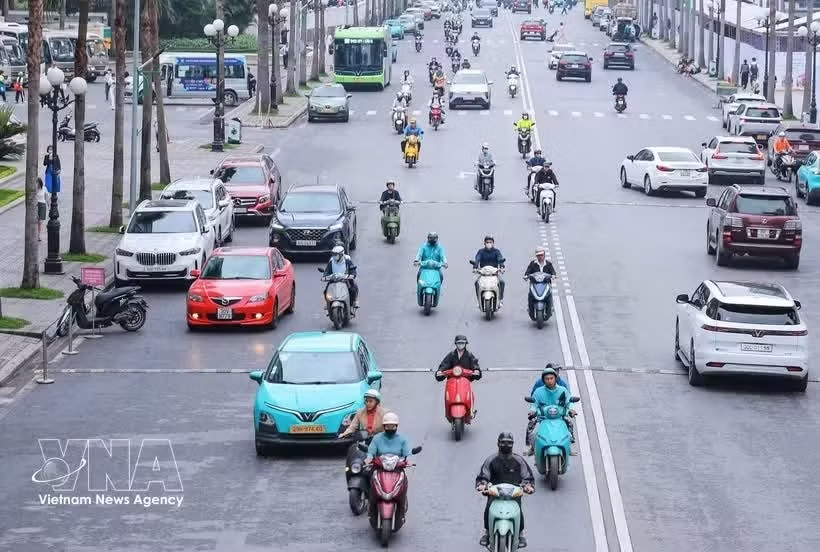
Hanoi (VNA) – Hanoi began implementing a traffic management plan from July 1 to support the first-phase pilot of a low-emission zone (LEZ) within Ring Road 1, aiming to reduce vehicle emissions while promoting public transport and green mobility.
hanoi.jpg
Hanoi begins implementing a traffic management plan from July 1 to support the first-phase trial of a low-emission zone (LEZ) within Ring Road 1. (Photo: VNA)

The municipal Department of Construction said the plan includes traffic restrictions, designated parking areas, public bus services and public bicycle stations to help residents adjust their travel routes and access alternative transport options.

The first phase, running from July 1 to December 31, will be piloted in zones 1 and 2 of Hoan Kiem ward.

Zone 1, encompassing the Hoan Kiem Lake pedestrian area, Hanoi Old Quarter and weekend night market, will continue operating as a pedestrian zone. Motorcycles, motorbikes and all cars, except those operated by the Ministries of National Defence and Public Security, will be prohibited from entering between 7 pm and midnight every Friday, Saturday and Sunday.

Zone 2, covering the Old Quarter and surrounding Hoan Kiem Lake area within the Ring Road 1 boundary, will impose restrictions on fossil fuel-powered passenger vehicles with more than 16 seats, excluding buses and school buses. These vehicles will be banned during morning and evening peak hours from 6 am to 9 am and from 4 pm to 7:30 pm daily, while stopping and parking along surrounding roads will also be prohibited during the same periods.

To facilitate passenger transfers, the city will establish four designated pick-up and drop-off points for large passenger vehicles during restricted hours, Ba Trieu, Tran Nhat Duat, Tran Quang Khai and Tran Khanh Du streets.

Fossil fuel-powered trucks will continue to operate under existing regulations issued by the Hanoi People's Committee.

To support the pilot, the municipal Department of Construction has coordinated with local authorities to review and arrange 220 parking facilities. It has also worked with the city police and relevant wards to install 44 public bicycle stations with 456 bicycles in Hoan Kiem and Cua Nam wards.

In addition, the department plans to develop several park-and-ride sites connected to public transport, enabling commuters to leave private vehicles outside the restricted area and continue their journeys by bus or urban rail.

The city will also offer free travel on subsidised public bus services within Ring Road 1 from July 1, 2026 to June 30, 2027, under a resolution adopted by the municipal People's Council. Commercial and tourist buses are not covered by the policy. As of July 1, 45 bus routes operate within the Ring Road 1 area, including 29 with terminals located inside the zone and 16 passing through it.

The municipal Department of Construction has requested the Hanoi Police to coordinate with local authorities in directing traffic, strengthening enforcement against traffic and parking violations, and expanding surveillance camera coverage at key intersections and transfer points.

Ward-level authorities have also been asked to ensure security at parking facilities and identify additional locations suitable for parking and transfer hubs linked to public transport, helping residents travel conveniently into the low-emission zone./.

en.vietnamplus.vn

Other News

Hanoi ready to implement Capital Law 2026, unlocking new development momentum

Hanoi ready to implement Capital Law 2026, unlocking new development momentum

The effectiveness of the Capital Law 2026 will be measured not by the number of legal documents issued but by tangible improvements in governance and public administration, better services for people and businesses, faster administrative procedures, stronger investment attraction and higher economic growth.

Vietnamese students earn honours at ROBOG Asia Cup 2026

Vietnamese students earn honours at ROBOG Asia Cup 2026

Three teams from Chu Van An Secondary School in Vietnam’s Thai Nguyen province have earned First Prize honours and advanced to the quarterfinals at the ROBOG Asia Cup 2026, a regional robotics and artificial intelligence (AI) competition for students held in Hong Kong, China.

Vietnam promotes legal cooperation and rule of law at global forum

Vietnam promotes legal cooperation and rule of law at global forum

Vietnam’s development and international integration have gone hand in hand with the improvement of its legal system, the incorporation of international commitments into domestic legislation, and legal reforms aimed at fostering development, openness and global integration. The country regards international law as an essential instrument for building fair, mutually beneficial relations among nations.

Hanoi's Red River urban area development draws widespread attention

Hanoi's Red River urban area development draws widespread attention

Located south of the Red River and extending from the historic inner city to newly developing areas in the south and the west, the central urban area along Red River’s right bank covers approximately 45,317 hectares and is projected to accommodate around 6.365 million residents by 2045 and 6.455 million by 2065.

Hanoi's Red River urban area development draws widespread attention

Hanoi's Red River urban area development draws widespread attention

Located south of the Red River and extending from the historic inner city to newly developing areas in the south and the west, the central urban area along Red River’s right bank covers approximately 45,317 hectares and is projected to accommodate around 6.365 million residents by 2045 and 6.455 million by 2065.

Regional cooperation strengthened to combat cross-border drug crime

Regional cooperation strengthened to combat cross-border drug crime

Vietnam, China, Laos and Myanmar face common challenges as drug syndicates increasingly exploit the Mekong River, cross-border transport networks, e-commerce platforms, international logistics services, cyberspace and cryptocurrencies to organise drug transactions and smuggling operations.