Young lecturer brings AI, robotics into vocational education

For years, the 39-year-old teacher has worked to bring advanced technologies once found only in modern factories into vocational classrooms, helping bridge the gap between education and industry.

An Giang (VNA) – Amid the hum of machinery and the rhythmic movements of robotic arms in the training workshop of An Giang Vocational College in An Giang province, lecturer Nguyen Duc Tai patiently guides students through programming commands on computer screens.
download-15.png
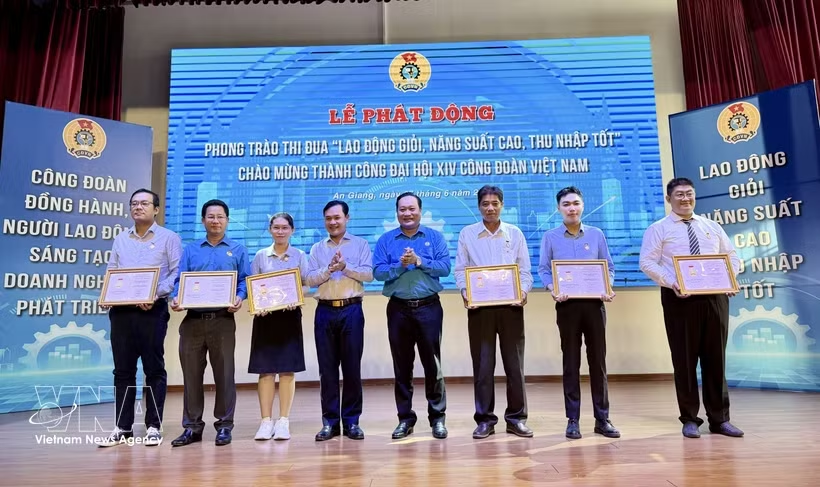
Master's degree holder Nguyen Duc Tai (far left) receives the Vietnam General Confederation of Labour's Creative Labour Certificate in 2025 for his three-axis camera robot. (Photo: VNA)

For years, the 39-year-old has worked to bring advanced technologies once found only in modern factories into vocational classrooms, helping bridge the gap between education and industry.

Turning ideas into practical training tools

Tai developed a passion for scientific research and technological innovation while at university, believing science should be applied to solve real-world problems.

After joining An Giang Vocational College, he realised the school's training equipment lagged behind technologies used by businesses, while purchasing modern machinery required significant funding. Instead of waiting for new equipment, he designed and built training models himself.

One of his most notable innovations is a three-axis camera robot integrating precision mechanics, control programming and AI-based image processing. Built using Jetson Nano, Arduino, Python, OpenCV and YOLO, the model enables students to practise computer vision and industrial automation in the classroom.

Rather than relying solely on textbooks, students programme robots, train AI image-recognition models and develop complete automation systems during practical sessions. Tai said this hands-on approach helps them master new technologies while meeting industry demands.

His work has earned widespread recognition. He has led numerous research projects and won prizes at national competitions for self-made teaching equipment. His three-axis camera robot received the Vietnam General Confederation of Labour's Creative Labour Certificate in 2025, following the same honour for his autonomous robot project in 2022. In 2023, he was honoured as one of Vietnam's outstanding young teachers.
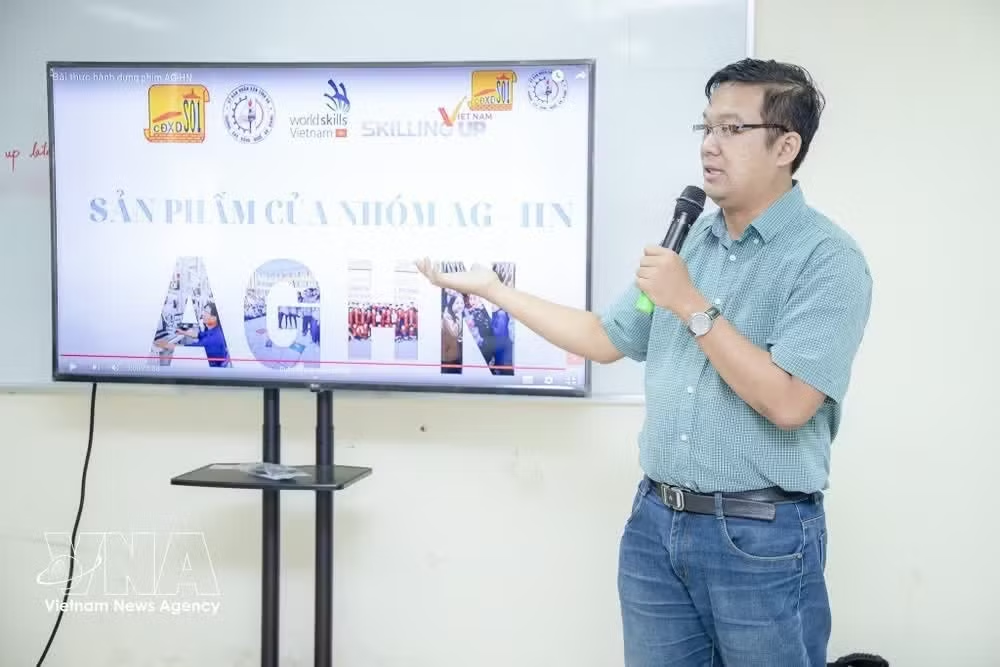
Lecturer Nguyen Duc Tai during a teaching session at An Giang Vocational College (Photo:VNA)

Helping vocational students master AI

After more than a decade in vocational education, Tai has built a learning environment where students gain early exposure to AI, robotics and automation.

He said his greatest reward is seeing students confidently enter the labour market with the skills to master new technologies.

One example is Nguyen Quoc Thang, a final-year mechatronics student who, under Tai's guidance, learned robot programming, automation system design and scientific research. In 2025, Thang won second prize at the Mekong Delta Intermediate and College Startup Competition with a project applying the Internet of Things (IoT) to agriculture.

Many of Tai's students have also earned prizes at the national Euréka Student Scientific Research Awards and provincial innovation competitions, highlighting the effectiveness of combining research with practical training.

To nurture creativity, Tai founded the Mechatronics Innovation Club, where students transform ideas into products serving the community. The club has developed automatic hand-sanitiser dispensers during the COVID-19 pandemic and organised free electrical repair programmes for poor households and farmers.

Among Tai's former students, many now work as engineers and technicians at major companies, while others continue developing AI and automation solutions in their workplaces.

Nguyen Thanh Hai, Secretary of the Party Committee and Rector of An Giang Vocational College, described Tai as one of the school's outstanding young lecturers in scientific research, innovation and digital technology application. By turning complex technologies such as AI, robotics and machine vision into accessible lessons, he has inspired students to pursue research and innovation.

Through his practical teaching methods and technological innovations, Tai is helping modernise vocational education, improve training quality and support the development of a highly skilled workforce for An Giang and the Mekong Delta./.

VNA
en.vietnamplus.vn

Other News

Hanoi ready to implement Capital Law 2026, unlocking new development momentum

Hanoi ready to implement Capital Law 2026, unlocking new development momentum

The effectiveness of the Capital Law 2026 will be measured not by the number of legal documents issued but by tangible improvements in governance and public administration, better services for people and businesses, faster administrative procedures, stronger investment attraction and higher economic growth.

Hanoi sets out new investment blueprint with century-long development vision

Hanoi sets out new investment blueprint with century-long development vision

As of early June, Hanoi had attracted 74.6 billion USD in foreign direct investment (FDI) through more than 9,250 valid projects. FDI inflows in the first six months were projected at 3.2 billion USD, surpassing the annual target by 116%, while nearly 16,000 new businesses were established in the first five months, up 34.4% year-on-year.

Vietnam promotes legal cooperation and rule of law at global forum

Vietnam promotes legal cooperation and rule of law at global forum

Vietnam’s development and international integration have gone hand in hand with the improvement of its legal system, the incorporation of international commitments into domestic legislation, and legal reforms aimed at fostering development, openness and global integration. The country regards international law as an essential instrument for building fair, mutually beneficial relations among nations.

Hanoi to hold investment promotion event on June 29

Hanoi to hold investment promotion event on June 29

At the event, Hanoi authorities plan to grant investment policy decisions and investment registration certificates to 20 exemplary projects in the fields of transportation infrastructure, industrial parks, urban development, social housing, environment, science and technology, and foreign investment attraction.

Hanoi's Red River urban area development draws widespread attention

Hanoi's Red River urban area development draws widespread attention

Located south of the Red River and extending from the historic inner city to newly developing areas in the south and the west, the central urban area along Red River’s right bank covers approximately 45,317 hectares and is projected to accommodate around 6.365 million residents by 2045 and 6.455 million by 2065.

Hanoi's Red River urban area development draws widespread attention

Hanoi's Red River urban area development draws widespread attention

Located south of the Red River and extending from the historic inner city to newly developing areas in the south and the west, the central urban area along Red River’s right bank covers approximately 45,317 hectares and is projected to accommodate around 6.365 million residents by 2045 and 6.455 million by 2065.

Regional cooperation strengthened to combat cross-border drug crime

Regional cooperation strengthened to combat cross-border drug crime

Vietnam, China, Laos and Myanmar face common challenges as drug syndicates increasingly exploit the Mekong River, cross-border transport networks, e-commerce platforms, international logistics services, cyberspace and cryptocurrencies to organise drug transactions and smuggling operations.

Month for listening to people to be held nationwide

Month for listening to people to be held nationwide

Under the plan, activities will be carried out nationwide at all administrative levels, from provinces and centrally run cities to communes, wards and special zones. VFF committees and socio-political organisations are required to engage directly with local communities through dialogues and meetings, with special attention given to vulnerable groups and those outside mass organisations.