Cao Bang accelerates DNA sampling of unidentified war martyrs

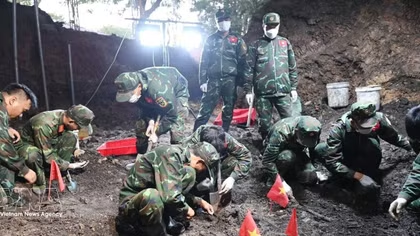
The work, which began on July 9, is being carried out by military and medical personnel following strict technical procedures. The process includes exhumation, biological sample collection, sealing and preservation of samples, documentation, and digitalisation of all relevant information. Each sample is carefully verified and catalogued, while excavation sites are accurately marked.

Cao Bang (VNA) – Authorities in the northern province of Cao Bang have begun collecting DNA samples and digitising records from 135 unidentified war martyrs' graves at Quang Uyen Martyrs' Cemetery as part of efforts to identify fallen soldiers.
3.jpg
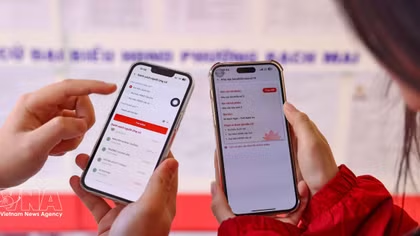
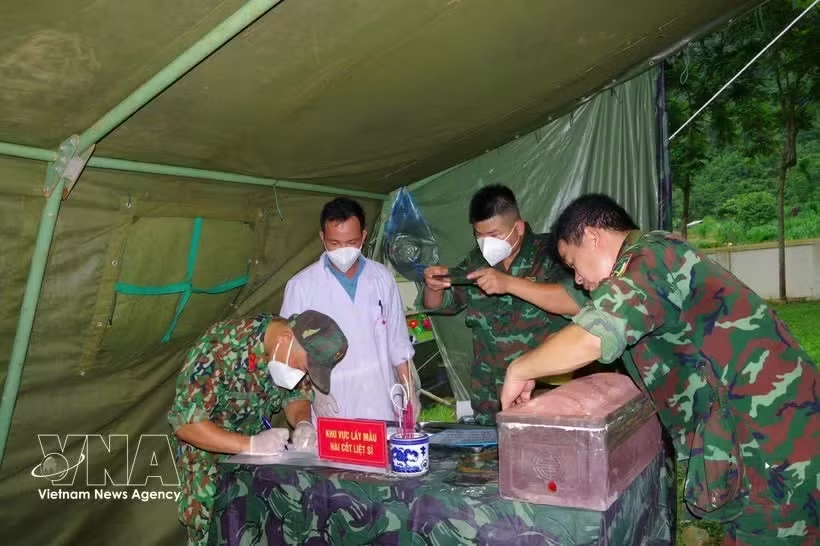
Authorities digitise data collected during the sampling and forensic identification process for fallen soldiers' remains. (Photo: VNA)

The work, which began on July 9, is being carried out by military and medical personnel following strict technical procedures. The process includes exhumation, biological sample collection, sealing and preservation of samples, documentation, and digitalisation of all relevant information. Each sample is carefully verified and catalogued, while excavation sites are accurately marked.

Once sampling is completed, the martyrs' remains are reinterred in new ceramic ossuaries, with graves and the cemetery restored to their original condition. All related data will be digitised and uploaded to the national management system to support future DNA matching and identity verification.

Major Nguyen Van Thin, an information technology officer at the Cao Bang provincial Military Command, said the on-site digitalisation process requires absolute accuracy. Despite challenging weather conditions, teams are working against the clock to record every detail, including grave layouts, soil layers, artefacts and GPS coordinates, to maximise the chances of identifying the martyrs and reconnecting them with their families.

According to Colonel Ma Cong Hoc, Political Commissar of the Military Command, the province has 15 martyrs' cemeteries, 14 of which contain unidentified graves. The search, recovery and identification programme will be implemented in two phases, from April 2026 to July 2027.

The programme aims to complete DNA analysis of 670 samples, recover about 40 additional sets of martyrs' remains, and establish a genetic database of relatives of unidentified martyrs to facilitate DNA matching and identification.

DNA sampling, sample handover and the digitisation of records at Quang Uyen Martyrs' Cemetery are expected to be completed before August 9, 2026./.
en.vietnamplus.vn

Other News

Hanoi ready to implement Capital Law 2026, unlocking new development momentum

Hanoi ready to implement Capital Law 2026, unlocking new development momentum

The effectiveness of the Capital Law 2026 will be measured not by the number of legal documents issued but by tangible improvements in governance and public administration, better services for people and businesses, faster administrative procedures, stronger investment attraction and higher economic growth.

Vietnamese students earn honours at ROBOG Asia Cup 2026

Vietnamese students earn honours at ROBOG Asia Cup 2026

Three teams from Chu Van An Secondary School in Vietnam’s Thai Nguyen province have earned First Prize honours and advanced to the quarterfinals at the ROBOG Asia Cup 2026, a regional robotics and artificial intelligence (AI) competition for students held in Hong Kong, China.

Hanoi sets out new investment blueprint with century-long development vision

Hanoi sets out new investment blueprint with century-long development vision

As of early June, Hanoi had attracted 74.6 billion USD in foreign direct investment (FDI) through more than 9,250 valid projects. FDI inflows in the first six months were projected at 3.2 billion USD, surpassing the annual target by 116%, while nearly 16,000 new businesses were established in the first five months, up 34.4% year-on-year.

Vietnam promotes legal cooperation and rule of law at global forum

Vietnam promotes legal cooperation and rule of law at global forum

Vietnam’s development and international integration have gone hand in hand with the improvement of its legal system, the incorporation of international commitments into domestic legislation, and legal reforms aimed at fostering development, openness and global integration. The country regards international law as an essential instrument for building fair, mutually beneficial relations among nations.

Hanoi to hold investment promotion event on June 29

Hanoi to hold investment promotion event on June 29

At the event, Hanoi authorities plan to grant investment policy decisions and investment registration certificates to 20 exemplary projects in the fields of transportation infrastructure, industrial parks, urban development, social housing, environment, science and technology, and foreign investment attraction.

Hanoi's Red River urban area development draws widespread attention

Hanoi's Red River urban area development draws widespread attention

Located south of the Red River and extending from the historic inner city to newly developing areas in the south and the west, the central urban area along Red River’s right bank covers approximately 45,317 hectares and is projected to accommodate around 6.365 million residents by 2045 and 6.455 million by 2065.

Hanoi's Red River urban area development draws widespread attention

Hanoi's Red River urban area development draws widespread attention

Located south of the Red River and extending from the historic inner city to newly developing areas in the south and the west, the central urban area along Red River’s right bank covers approximately 45,317 hectares and is projected to accommodate around 6.365 million residents by 2045 and 6.455 million by 2065.

Regional cooperation strengthened to combat cross-border drug crime

Regional cooperation strengthened to combat cross-border drug crime

Vietnam, China, Laos and Myanmar face common challenges as drug syndicates increasingly exploit the Mekong River, cross-border transport networks, e-commerce platforms, international logistics services, cyberspace and cryptocurrencies to organise drug transactions and smuggling operations.