Hanoi traffic jam solution competition winner announced

Authorities in Hanoi have awarded $100,000 to the winner of the contest to seek solutions for the city’s traffic problems.

According to Ngo Manh Tuan, deputy director of the city’s Department of Transport, none of the entries warranted first prize, so the organisers decided to grant the second prize worth USD100,000 for a Japan-Vietnam partnership which consisted of the Nikken Sekkei Civil Engineering Ltd. and Nikken Sekkei Research Institute and Vietnam Institute for Urban and Rural Planning.

Meanwhile, the five remaining finalists received USD25,000 each, Tuan added. 

A representative of the Department of Transport said the winner offered seven solutions to deal with congestion.

Firstly, traffic network must be developed along with urban expansion. Secondly, the traffic network should also be renovated and adjusted to east congestion spots.

Thirdly, public transportation development is a must, especially rapid bus transit and urban railway systems. Simultaneously, there should be solution to encourage citizens to use more public transport.

The proposed fifth solution is to have strict management and regulations to deal with violators and to prevent congestion.

Next, Hanoi should follow a transit-oriented development model, a type of urban development that maximises the amount of residential, business and entertainment locations within walking distance of public transport.

Finally, the authorities must have short-term and long-term plans to link and effectively implement the proposed solutions.

Earlier, the city launched the contest to seek solutions from the public to deal with its traffic congestion by 2025 with a vision to 2030. The first prize will be USD200,000 and the second prize will be USD100,000.

Chairman of the municipal People’s Committee Nguyen Duc Chung led the board of examiners for the contest which also includes 13 other city leaders.

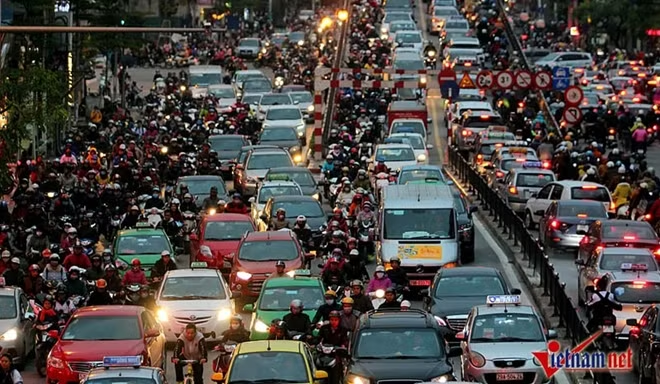
Traffic jams are estimated to cause average annual loss of around VND12.8 trillion (USD600 million) for Hanoi, said Nguyen Phi Thuong, Chairman of Transport Corporation Hanoi. He added that private vehicles were among the main reasons leading to the city’s more serious air pollution and congestion.

Statistics showed that up to 16,000 new motorbikes and 500 new cars are registered in the city every month. By late January this year, Hanoi had more than 5.5 million personal vehicles, including early 500,000 cars and more than five million motorcycles. The numbers are expected to increase to more than 7.3 million motorbikes and 1.3 million cars by 2025.

DTiNews

Other News

Hanoi ready to implement Capital Law 2026, unlocking new development momentum

Hanoi ready to implement Capital Law 2026, unlocking new development momentum

The effectiveness of the Capital Law 2026 will be measured not by the number of legal documents issued but by tangible improvements in governance and public administration, better services for people and businesses, faster administrative procedures, stronger investment attraction and higher economic growth.

Vietnamese students earn honours at ROBOG Asia Cup 2026

Vietnamese students earn honours at ROBOG Asia Cup 2026

Three teams from Chu Van An Secondary School in Vietnam’s Thai Nguyen province have earned First Prize honours and advanced to the quarterfinals at the ROBOG Asia Cup 2026, a regional robotics and artificial intelligence (AI) competition for students held in Hong Kong, China.

Hanoi sets out new investment blueprint with century-long development vision

Hanoi sets out new investment blueprint with century-long development vision

As of early June, Hanoi had attracted 74.6 billion USD in foreign direct investment (FDI) through more than 9,250 valid projects. FDI inflows in the first six months were projected at 3.2 billion USD, surpassing the annual target by 116%, while nearly 16,000 new businesses were established in the first five months, up 34.4% year-on-year.

Vietnam promotes legal cooperation and rule of law at global forum

Vietnam promotes legal cooperation and rule of law at global forum

Vietnam’s development and international integration have gone hand in hand with the improvement of its legal system, the incorporation of international commitments into domestic legislation, and legal reforms aimed at fostering development, openness and global integration. The country regards international law as an essential instrument for building fair, mutually beneficial relations among nations.

Hanoi to hold investment promotion event on June 29

Hanoi to hold investment promotion event on June 29

At the event, Hanoi authorities plan to grant investment policy decisions and investment registration certificates to 20 exemplary projects in the fields of transportation infrastructure, industrial parks, urban development, social housing, environment, science and technology, and foreign investment attraction.

Hanoi's Red River urban area development draws widespread attention

Hanoi's Red River urban area development draws widespread attention

Located south of the Red River and extending from the historic inner city to newly developing areas in the south and the west, the central urban area along Red River’s right bank covers approximately 45,317 hectares and is projected to accommodate around 6.365 million residents by 2045 and 6.455 million by 2065.

Hanoi's Red River urban area development draws widespread attention

Hanoi's Red River urban area development draws widespread attention

Located south of the Red River and extending from the historic inner city to newly developing areas in the south and the west, the central urban area along Red River’s right bank covers approximately 45,317 hectares and is projected to accommodate around 6.365 million residents by 2045 and 6.455 million by 2065.

Regional cooperation strengthened to combat cross-border drug crime

Regional cooperation strengthened to combat cross-border drug crime

Vietnam, China, Laos and Myanmar face common challenges as drug syndicates increasingly exploit the Mekong River, cross-border transport networks, e-commerce platforms, international logistics services, cyberspace and cryptocurrencies to organise drug transactions and smuggling operations.